115682169450


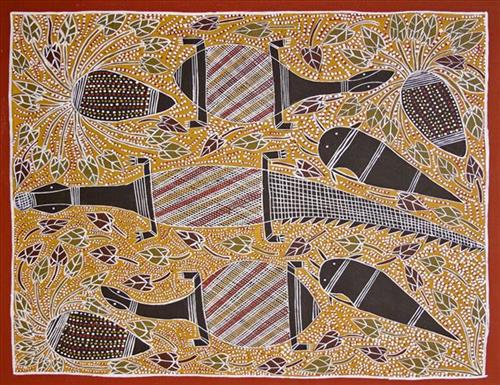
Evonne’s Dhulumburrk (Waterlily)

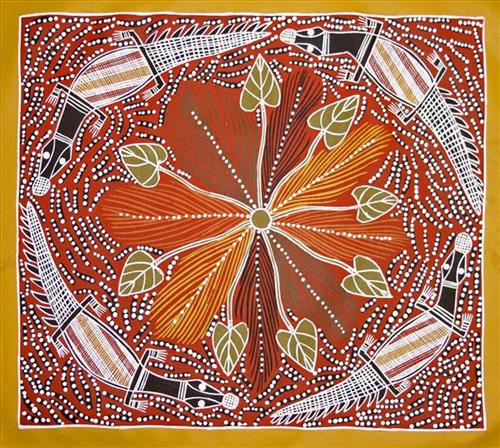
This painting depicts Dhulumburrk (Nymphaea violacea), a fresh waterlily. The flowers and lily pads of fresh waterlilies can be seen far and wide across the Arafura wetlands, providing coverage for many animal species including Banda (long-necked turtle) and Baru (crocodile). The flowers come in many beautiful colours, in particular a vibrant purple. Evonne depicted her own way of interpreting waterlily roots and lotus roots.


115682169560


Raypiny Dhawu (Fresh Water Story)

All Aboriginal people originate from a spiritual source, fixed in a particular place in their land or the sea. These ‘spiritual reservoirs’ are often in the form of special waterholes made by Wangarr (creative spirits) that were created long ago close to the beginning of time. These creator beings moved across the countryside, shaping the land and implanting in each tract of country, the spiritual life force for the people who were to own it. These creative spirits took many forms and when they gave the land to each group, they also gave songs, dances, ceremony, the associated laws and language.


The creation story for Ganalbingu people took place near the middle section of the Glyde River where it becomes the Goyder River. Their land, Ngaliyindi, sits astride the Arafura Swamp in Central Arnhem Land. Many Ganalbingu artists paint totemic species significant to their clan. These can include baru (crocodile), banda (long necked turtle), buliya (catfish), yalman (waterlilies), gumang (magpie geese), dakawa (fresh water yabby), ratjuk (barramundi), warrnyu (flying fox) and more.
 

115682169537


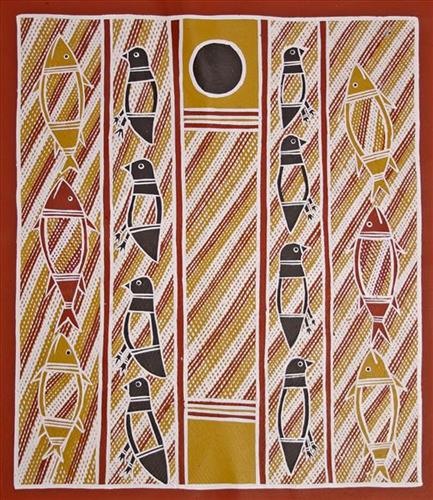
Badurru (Milky Way)

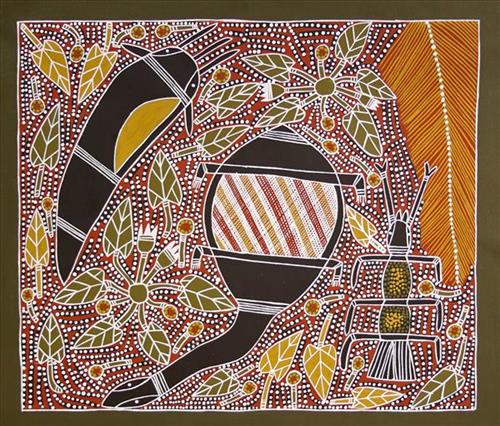
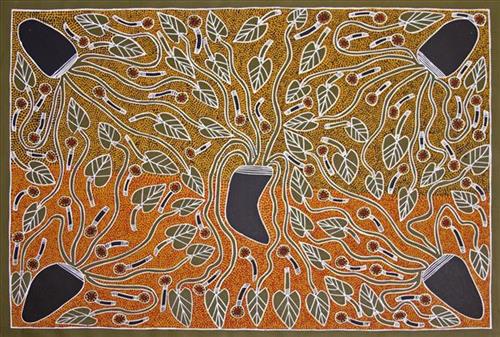
This painting depicts Badurru (Milky Way), a significant storyline and songline for the Durrurrnga people. The dupun (hollow log) represents the Badurru bunggul (dance) performed during ceremony. The Badurru dhawu (story) is of a Waak Waak (crow) and cat travelling through the Milky Way and how all the different clans traded with each other.

115682170381


Raypiny Dhawu (Fresh Water Story)

All Aboriginal people originate from a spiritual source, fixed in a particular place in their land or the sea. These ‘spiritual reservoirs’ are often in the form of special waterholes made by Wangarr (creative spirits) that were created long ago close to the beginning of time. These creator beings moved across the countryside, shaping the land and implanting in each tract of country, the spiritual life force for the people who were to own it. These creative spirits took many forms and when they gave the land to each group, they also gave songs, dances, ceremony, the associated laws and language.


The creation story for Ganalbingu people took place near the middle section of the Glyde River where it becomes the Goyder River. Their land, Ngaliyindi, sits astride the Arafura Swamp in Central Arnhem Land. Many Ganalbingu artists paint totemic species significant to their clan. These can include baru (crocodile), banda (long necked turtle), buliya (catfish), yalman (waterlilies), gumang (magpie geese), dakawa (fresh water yabby), ratjuk (barramundi), warrnyu (flying fox) and more.
 

115682170120


Baru Dhawu (Crocodile Story)

Baru (the crocodile man), was from the Gumatj clan. People usually call him Gurdu Gurdu or Baru which means crocodile. He lived his life at a place called Yirrkala. Living near him were other people, and when Baru didn’t have enough to eat he began to kill and eat these other people. After a while others noticed that some people were missing. When Baru went to the toilet, the people could smell this strong smell, so they knew that he ate the other people. Some men went to get help and they took message sticks to the other tribes. Some were sending smoke signals. When they came to Baru’s camp they started to spear him in the left side of his ribs. He dropped into the fire and burnt his left hand and maybe his right hand. He then ran into the bush and yelled to his countrymen – the animals, birds and fish that live on the land and in the sea. He stopped and he named the tribes and clans and also the places until he came to a place called Gamarru/Guyurru. There he took a rest and said to himself “This is where I stop and call this place Gamarru/Guyurru”. Baru, still in pain from the fire, then jumped into the water and turned himself into a crocodile. The fire left scars on his back. Baru paintings belong to Gumatj and Warrawarra and also the Marpi clan. This painting is used at death ceremonies or initiations and it normally is painted on the belly, which means the person the design is painted on is part of Gurdu Gurdu (the crocodile people).

222082171396


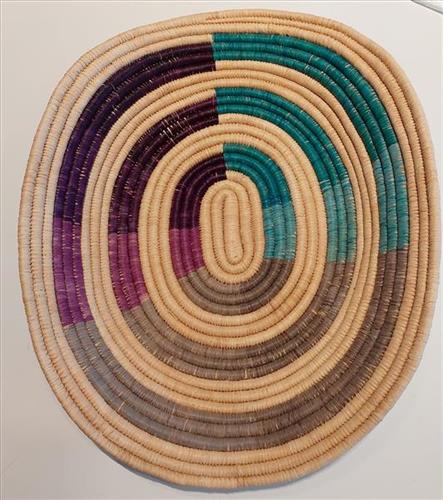
Coolamon

This art piece was created to represent our wooden coolamon’s which are unique tools for Aboriginal people. It is a multi-purpose dish which can be used to carry bush tucker and babies. So I created one out of raffia.

222082171371


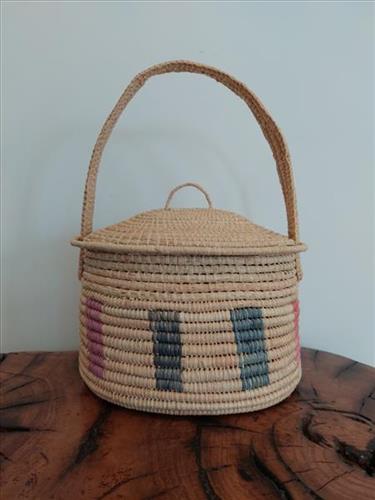
Past, Present and Future


I never knew weaving was an essential tool!  Never thought about it.  Today everything is instant.

Upon learning to weave some five years ago, one strong memory dawned on me after seeing an old photograph of an Aboriginal woman, holding a woven basket with the handle and lid attached to it. 
I was around 5 years of age, and I remember a basket woven exactly like the one in the photograph, at my grandparents house.  I remember trying to cut the lid away from the handle, because I thought it did not belong there.   I remember the strong fibre, I remember it being too strong to cut and thought it was so weird to make something like that.

Ever since I learned my cultural weaving, a practice that was once forbidden, I think about what the world was like for my ancestors.  The designs.  The trade. The teaching.  The usage. The accomplishment.

Since then, it became a dream to recreate a basket just like the basket in the photograph, just like the one I tried to cut!  This piece, unfortunately is not made with the traditional grasses, that is my future when knowledge and resources are more readily available. 

222082171307


Dragonfly Dreams v

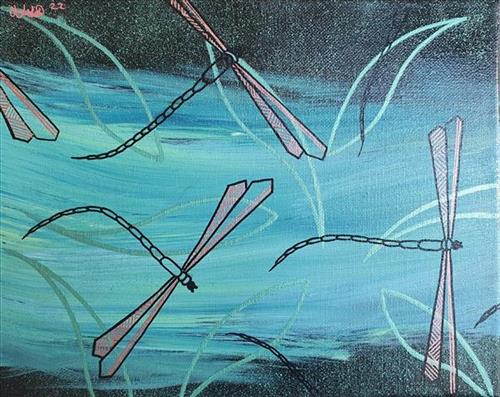
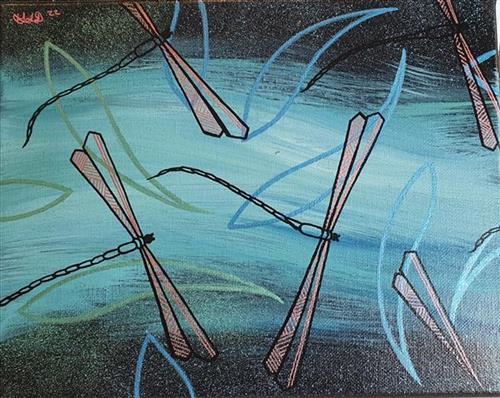
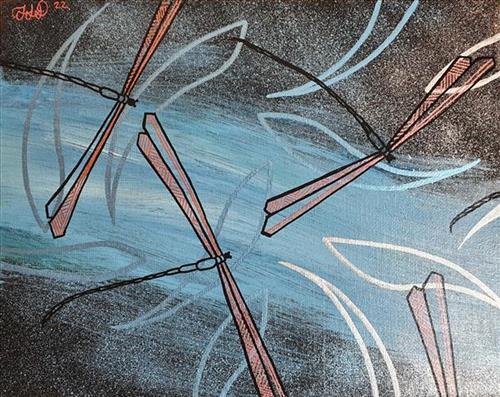
Dragonflies are purposely my favourite insects. They symbolise change and transformation, especially with the mind, soul and spirit of oneself.

222082171303


Dragonfly Dreams iv

Dragonflies are purposely my favourite insects. They symbolise change and transformation, especially with the mind, soul and spirit of oneself.

222082171295


Dragonfly Dream iii

Dragonflies are purposely my favourite insects. They symbolise change and transformation, especially with the mind, soul and spirit of oneself.