111582241162
Bankia Hill (lock up)
111582241110
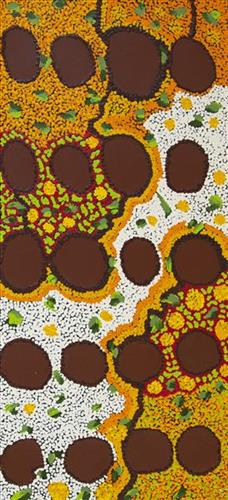
Linyji (claypan)
This work depicts a linyji (claypan) within the artists’ ngurra (home Country, camp), typically represented with circular forms. Claypans were visited more often during the wet seasons as they filled with water.
During the pujiman (traditional, desert dwelling) period, knowledge of water sources was critical for survival, and today Martu Country is still defined in terms of the location and type of water. Each of the hundreds of claypans, rockholes, waterholes, soaks and springs found in the Martu desert homelands is known through real life experience and the recounting of Jukurrpa (Dreaming) narratives by name, location, quality and seasonal availability. This encyclopedic knowledge extends even to the nature and movement of arterial waterways, and sustained Martu as they travelled across their Country, hunting and gathering, visiting family, and fulfilling ceremonial obligations. They would traverse very large distances annually, visiting specific areas in the dry and wet season depending on the availability of water and the corresponding cycles of plant and animal life on which hunting and gathering bush tucker was reliant.
111582241107
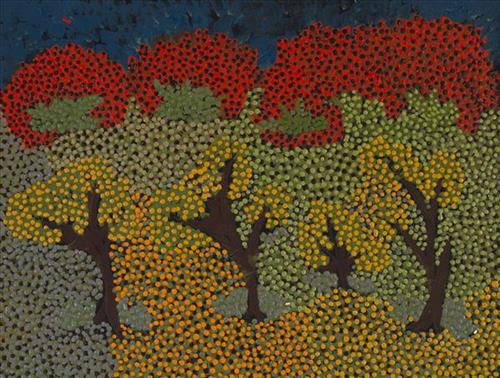
Nyurnma (Freshly Burnt Country)
Martu artists paint Country in all it’s different seasonal stages. Important to Martu, and to Martu Country, is the practice of waru (fire burning); a practice that assists with hunting, regenerates growth, and encourages greater diversity in plant and animal life. When Martu Country burns, mosaic fire scars are left on the Country, and patches of regeneration form a kind of mosaic pattern across the land. This is called nyurnma – burnt Country. Waru is typically burnt in small, controlled areas, leaving a defined patchwork pattern of nyurnma in the land, across tali (sand hills), linyji (clay pans), parulyukurru (spinifex country) and pila (sandy plains). This patterning is clearly visible in Martumili Artists works, where they paint Country from an aerial perspective.
111582241094
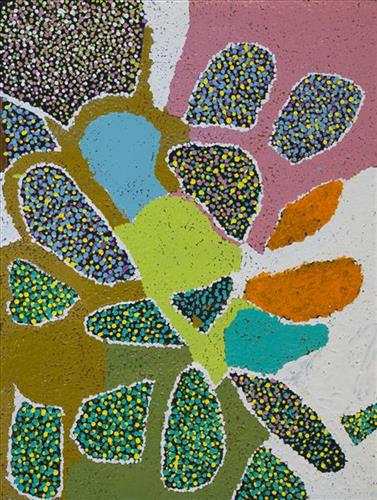
Wantili (Warntili, Canning Stock Route Well 25) – Lynette Rowlands
“That’s my jamu (grandfather) and nanna’s Country. I always go on a ranger trip there with my mum, Thelma Judson, and my little baby brothers, Junior and Jamie Rowlands.”
– Lynette Rowlands
Wantili (Warntili, Canning Stock Route Well 25) is a large round jurnu (soak) and linyji (claypan) near Well 25 on the Canning Stock Route. This site is Kuru’s birthplace, and as such forms an integral part of her ngurra. The area is dominated by claypans surrounded by tuwa (sandhills), and Nyilangkurr, a prominent yapu (hill) is located on the edge of the claypan. Following rain the typically dry claypans are filled with water, with the overflow from nearby waterholes flowing to Wantili. At that time, Wantili becomes an important place for obtaining fresh water for drinking and bathing. Wantili is significant for the fact that at this site Kartujarra, Manyjilyjarra, Putijarra and Warnman people would all come together for ceremonies during the pujiman era. Many jiwa (stones used by women for grinding seeds) from these times can still be found there today.
Wantili is an incredibly important cultural site, ‘where the creation started.’ (Cyril Whyoulter). In this creation story, the world was initially dark, and people were like rocks, with no arms or legs. Following the sun’s first rising, life-forms become increasingly complex while particular features in the land were created. Beyond these details much of the Jukurrpa (Dreaming) narrative relating to Wantili is ngurlu (sacred, taboo), and only for Martu, but the site is open, and anyone can go there.
Wantili is also one of the many sites featured in the epic Minyipuru (Jakulyukulyu, Seven Sisters) Jukurrpa story. Minyipuru is a central Jukurrpa narrative for Martu, Ngaanyatjarra, Pitjantjatjara and Yankunytjatjara people that is associated with the seasonal Pleiades star constellation. Relayed in song, dance, stories and paintings, Minyipuru serves as a creation narrative, a source of information relating to the physical properties of the land, and an embodiment of Aboriginal cultural laws. The story follows the movement of a group of women travelling all the way across the desert, beginning at Roebourne on the coast of Western Australia, as they are pursued by Yurla, a lustful old man. As the women travelled, they stopped to rest at many sites to eat, dance, rest and sing, on the way leaving behind an assortment of articles that became formations in the land, such as groupings of rocks and trees, grinding stones and seeds. The sisters rested at Wantili before throwing seeds, then continued their journey far to the east and beyond Martu Country, stopping at various sites through central and South Australia.
The intersection of the Canning Stock Route with Wantili also made this a site of early contact with Europeans for many Martu then living a pujiman life in the desert. Following the route’s construction, Martu encountered Europeans and other Martu working as cattle drovers as they would travel up and down the Stock Route from water source to water source. Increasingly, pujimanpa (desert dwellers) followed the route to newly established ration depots, mission and pastoral stations. They were drawn to the route in search of food, by a sense of curiosity, or by loneliness. By the late 1950s and early 1960s, most of the desert family groups had left the desert. Eventually, these factors combined with an extreme and prolonged drought in the 1960s to prompt the few remaining pujimanpa to move in from the desert.

222082240636
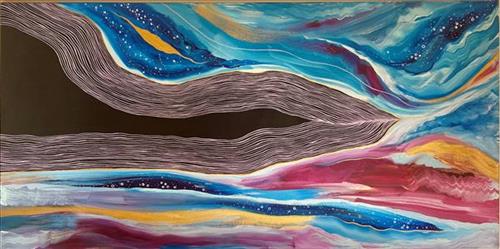
Celestial
A sparkling representation of the cosmic creation of myself, a celestial entity made of stardust, full of infinite possibilities, potential and glowing with magic. Beautiful and complex, made of everything that ever was and will be.
Just as the universe is constantly evolving and expanding, so too is my individual journey of self-discovery and growth.
115682240664
Woven Mat
Traditionally, Nganiyal (conical mats) were used as an insect screen when erected, and as a sitting mat when folded. They are used in Ceremony as well as a functional item.
Nowadays, artists weave many different shapes including flat, round and oblong.
115682240663
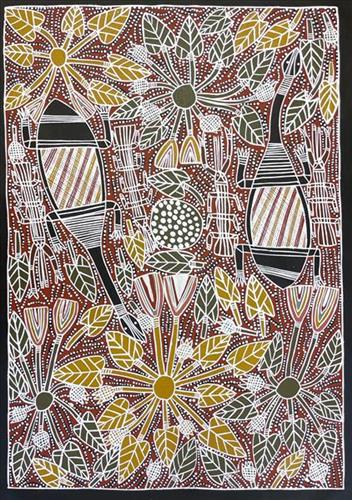
Ganalbingu – Banda (Long Necked Turtle)
The long necked turtle is a dreaming totem for the freshwater people, the Ganalbingu, whose country includes the World Heritage listed, Arafura Wetlands in Central Arnhem Land, Northern Territory
The Yolngu (people) of Arnhem Land originate from a spiritual source, fixed in a particular place in their land or the sea. These ‘Spiritual Reservoirs’ are often in the form of special waterholes made by Wangga (Creator Beings), long ago close to the beginning of time. These creator beings moved across the country side, shaping the land and implanting in each tract of country, the spiritual life force for the people who were to own it.
These creator spirits took many forms. When they gave the land to each group they also gave songs, dances, ceremony, the associated laws and language. The Creation story for Ganalbingu people took place near the middle section of the Glyde River where it becomes the Goyder River. Their land, Ngaliyindi, sits astride the Arafura Swamp in Central Arnhem Land. Some of their major Creative Beings include Banda (freshwater long neck turtle) and Yalman (water lilies).
115682240642
Woven Mat
Traditionally, Nganiyal (conical mats) were used as an insect screen when erected, and as a sitting mat when folded. They are used in Ceremony as well as a functional item.
Nowadays, artists weave many different shapes including flat, round and oblong.
225682240668
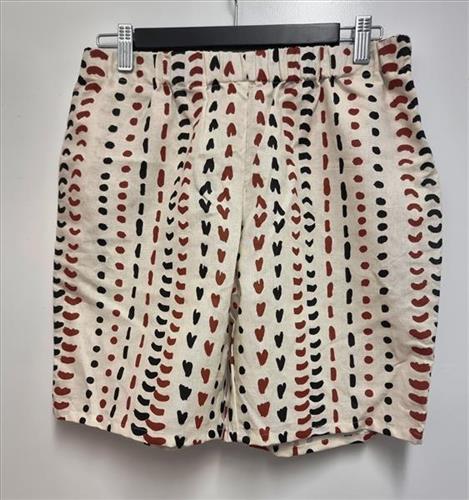
KAMBI – Fashion Collection, Lila Creek – Baral Print
I am a Nyungkul woman from Shipton’s Flat, my mother’s Country. My dad was a Kaanju man from the Coen area.
This fabric print represents Baral which means tracks and what animals are travelling around. Some of the tracks we see are from kurriyala- snake, walkarr- lizard and kadar- wallaby.
Bana Yirriji are currently collaborating with Fashion Designer, Shannon Brett -To create a collection of garments – as wearable art pieces – that promote the work of the artists of Bana Yirriji Art Centre, and the beautiful community of Wujal Wujal.
Shannon Brett is a Wakka Wakka, Gooreng Gooreng, Butchulla artist,
designer and educator, with many years of experience as a fashion designer and textile artist who has worked with numerous studios and art centres internationally.
Shannon has also worked with Bana Yirriji Art Centre for many years as an arts facilitator, and this year we are delighted to collaborate on our first fashion collection KAMBI.