377810582289133


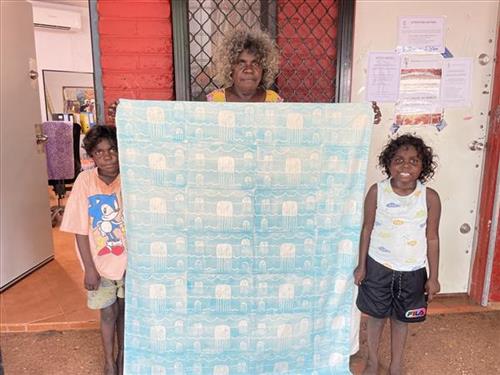
Mábbarla (Jelly Fish)

Mábbarla means Jelly Fish in Ndjébbana.

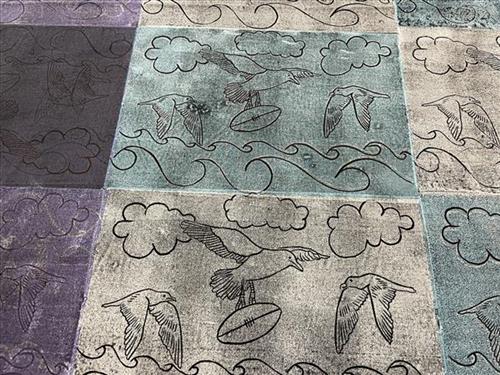
‘My homeland is Entrance island, Haulround island and Juda point. I really like Haulround island and that’s where we collect barruar (seagull egg). Entrance island is my favourite camping area, I go across with boat. Balanda (non-Aboriginal or European people) can’t go into those islands or Juda point without permission from me. We have a sacred totem ngaduma (palm tree) at those places and if people destroy it, we will have a strong wind and maybe a cyclone.’ Marilyn James 2021

377810582289185


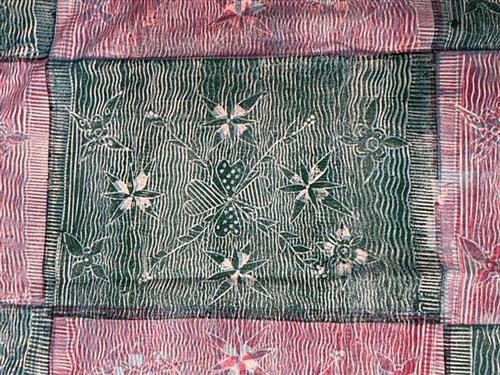
Bush Flowers

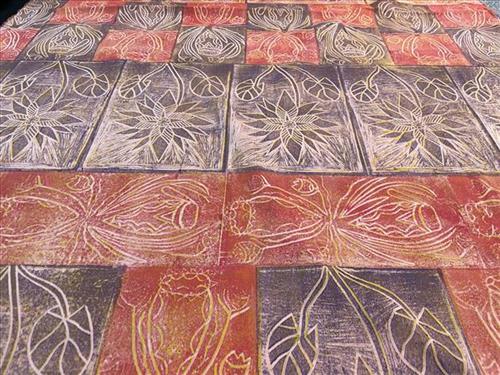
This fabric was created using the linocut printing technique. The lino tile has been carved by the artist in Maningrida, and has been printed by hand using a variety of colours and layers. The linocut technique ensures each textile piece is a one-off, limited edition piece. Bábbarra Women’s Centre supports the economic independence of Indigenous women in the Arnhem Land community of Maningrida, Northern Territory, Australia. Designs created by the women at Bábbarra reflect strong cultural knowledge, which is passed down to younger generations through their textile design practice.

377810582289176


Kunmadj and bush flower

Kunmadj is the Kuninjku term for large woven collecting baskets, known as dillybags.

They are often made from the burney vine (Malaisia scandens), a strong, pliable plant that grows along the ground and into the canopy of monsoon vine thickets. The baskets are used to collect a variety of heavy foods, such as fish caught in conical fish traps or a good harvest of yams. As well as being of practical use, dillybags are of cultural significance to Arnhem Land people. Dillybags are totemic objects and they are associated with particular sites in the landscape.

111982289172


Wak Wak

This painting depicts a sacred site at ‘Kurrurldul’, an outstation south of Maningrida.

The ‘rarrk’, or abstract crosshatching, on this work represents the design for the crow totem ancestor called ‘Djimarr’. Today this being exists in the form of a rock, which is permanently submerged at the bottom of Kurrurldul Creek. The ‘Djimarr’ rock in the stream at Kurrurldul is said to move around and call out in a soft hooting tone at night. Both the stone itself and the area around it are considered sacred.

The imagery represents the rock mentioned above at the bottom of Kurrurldul creek, which is the final transmutation of the dreaming ancestor ‘Djimarr’. Finally, the pattern used here is also the crow design used in the sacred ‘Mardayin’ ceremony, which is a large regional patri-moiety ceremony now rarely conducted in central and eastern Arnhem Land.

111982289171


Yok (Bandicoot)

The ancestral site for yok (bandicoot) is a hill called kordeme near Buluhkaduru outstation. It is a restricted place. People used to hunt yok regularly, however they are rarely seen anymore. Lena Yarinkura explains that in the past djungkay (cultural managers) would perform rituals at the site, calling out all different kured (country): Korlobidahdah, Mankorlod, Buluhkaduru, Ankadbarrbirri, Malyarngak, Ramingining, Ji-balbal, Ji-be – na. Baby yok would then spread throughout these areas. However, today there are fewer yok as djungkay have not been able to perform these rituals as often. Yok also has a powerful inside essence, mardayin, but this work is an ‘out – side’, public story.

111982289170


Yok (Bandicoot)

The ancestral site for yok (bandicoot) is a hill called kordeme near Buluhkaduru outstation. It is a restricted place. People used to hunt yok regularly, however they are rarely seen anymore. Lena Yarinkura explains that in the past djungkay (cultural managers) would perform rituals at the site, calling out all different kured (country): Korlobidahdah, Mankorlod, Buluhkaduru, Ankadbarrbirri, Malyarngak, Ramingining, Ji-balbal, Ji-be – na. Baby yok would then spread throughout these areas. However, today there are fewer yok as djungkay have not been able to perform these rituals as often. Yok also has a powerful inside essence, mardayin, but this work is an ‘out – side’, public story.

111982289169


Yok (Bandicoot)

The ancestral site for yok (bandicoot) is a hill called kordeme near Buluhkaduru outstation. It is a restricted place. People used to hunt yok regularly, however they are rarely seen anymore. Lena Yarinkura explains that in the past djungkay (cultural managers) would perform rituals at the site, calling out all different kured (country): Korlobidahdah, Mankorlod, Buluhkaduru, Ankadbarrbirri, Malyarngak, Ramingining, Ji-balbal, Ji-be – na. Baby yok would then spread throughout these areas. However, today there are fewer yok as djungkay have not been able to perform these rituals as often. Yok also has a powerful inside essence, mardayin, but this work is an ‘out – side’, public story.

111982289167


Yok (Bandicoot)

The ancestral site for yok (bandicoot) is a hill called kordeme near Buluhkaduru outstation. It is a restricted place. People used to hunt yok regularly, however they are rarely seen anymore. Lena Yarinkura explains that in the past djungkay (cultural managers) would perform rituals at the site, calling out all different kured (country): Korlobidahdah, Mankorlod, Buluhkaduru, Ankadbarrbirri, Malyarngak, Ramingining, Ji-balbal, Ji-be – na. Baby yok would then spread throughout these areas. However, today there are fewer yok as djungkay have not been able to perform these rituals as often. Yok also has a powerful inside essence, mardayin, but this work is an ‘out – side’, public story.

377810582289155


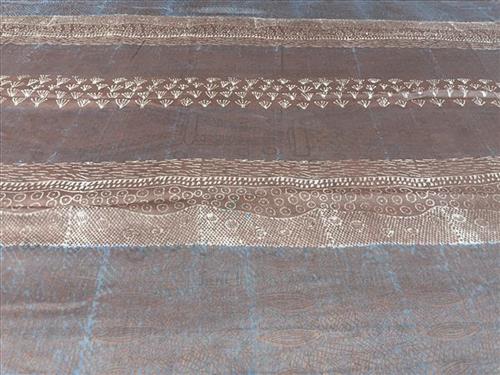
Kundalk (Grasses) and Kunred (Country) – Woodblock

A beautiful indigo discharge dyed silk sari featuring woodblock designs created in 2023 during a special workshop with Tharangini Studio in Bangalore. This fabric features the following block designs:

Kunred (Country) by Janet Marawarr)

Kundalk (Grasses) by Deborah Wurrkidj 

Printed in India by Tharangini Studio – Bangalore. This is a limited edition cotton yardage created as a result of workshops in India in January 2023. As part of their visit to India to open their exhibition, Jarracharra (dry season wind), Janet Marawarr and Deborah Wurrkidj visited Tharangini Studio, Bangalore’s oldest heritage textile studio. Established in 1977, Tharangini is woman-owned and specialises in organic, sustainable woodblock printed textiles. Tharangini’s skilled artisans worked closely with Babbarra in 2022 to hand carve some of babbarra designs old, Lino cut designs into woodblock. This initiative was supported by Kinaway Chamber of Commerce, Victoria and Bawinanga Aboriginal Corporation.

‘I’m excited to see my Lino design made into woodblock. We are going to spend Saturday printing with Tharangini studio. We are going to learn woodblock printing. I’ve been working Bábbarra Women’s Centre for 37 years since it started. I’ve been printing Lino on fabric.’ Janet Marawarr 2023

‘Tomorrow we do printing Yawkyawk (mermaid spirit) and Ngalyod (rainbow serpent). My design is together with my sister. Together we started working at the Women’s Centre and Maningrida Arts and Culture, taught by our mother and grandmother. My sister is a sick one and she pass on her story to me – Ngalyod (rainbow serpent). I help my sister, I help carry the knowledge for her. That’s why we both have designs being made into woodblock.’ Deborah Wurrkidj 2022