111982303108


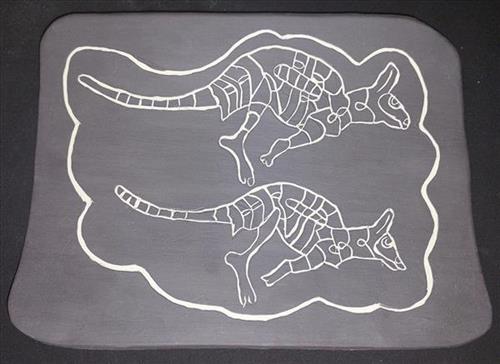
Wak Wak

This painting depicts a sacred site at ‘Kurrurldul’, an outstation south of Maningrida.

The ‘rarrk’, or abstract crosshatching, on this work represents the design for the crow totem ancestor called ‘Djimarr’. Today this being exists in the form of a rock, which is permanently submerged at the bottom of Kurrurldul Creek. The ‘Djimarr’ rock in the stream at Kurrurldul is said to move around and call out in a soft hooting tone at night. Both the stone itself and the area around it are considered sacred.

The imagery represents the rock mentioned above at the bottom of Kurrurldul creek, which is the final transmutation of the dreaming ancestor ‘Djimarr’. Finally, the pattern used here is also the crow design used in the sacred ‘Mardayin’ ceremony, which is a large regional patri-moiety ceremony now rarely conducted in central and eastern Arnhem Land.
111982303083


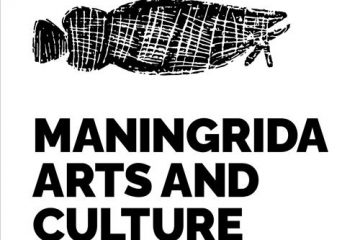
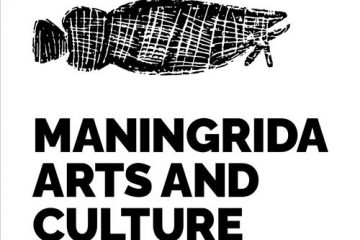
An-gujechiya (Fish Trap)

To make fish traps and fish net fences artists firstly get vine (mirlarl) from the jungle and they put it in water for one night to make it soft. Next they start weaving it; they make rings for the inside to keep the fish trap’s shape. Artists work for three or four weeks on the fish trap. They also make string from kurrajong (burdaga) to attach the hibiscus (bardainy) rings and to tie the conical end of the fish trap. This fish trap is used in saltwater and freshwater. People also use fish net fences called mun-dirra. A long time ago they would put the mun-dirra across rivers and creeks. In the middle they would place the an-gujechiya. They also used small things like sticks, rocks, mud and grass to block the fish from going through. People would then catch fish like saltwater barramundi rajarra, freshwater barramundi (janambal), small black freshwater catfish (buliya), bonefish (an-guwirrpiya), and sand bass (dalakan) in these fish traps.

111982303082


An-gujechiya (Fish Trap)

To make fish traps and fish net fences artists firstly get vine (mirlarl) from the jungle and they put it in water for one night to make it soft. Next they start weaving it; they make rings for the inside to keep the fish trap’s shape. Artists work for three or four weeks on the fish trap. They also make string from kurrajong (burdaga) to attach the hibiscus (bardainy) rings and to tie the conical end of the fish trap. This fish trap is used in saltwater and freshwater. People also use fish net fences called mun-dirra. A long time ago they would put the mun-dirra across rivers and creeks. In the middle they would place the an-gujechiya. They also used small things like sticks, rocks, mud and grass to block the fish from going through. People would then catch fish like saltwater barramundi rajarra, freshwater barramundi (janambal), small black freshwater catfish (buliya), bonefish (an-guwirrpiya), and sand bass (dalakan) in these fish traps.

111982303078


Warrawarra Clan

This clan consists of Martay Burarra speakers and relates to the country called Gamurra Gu-yurra which lies between Maningrida and Ramingining in central Arnhem Land.
Thoes totemic animals are ‘gorraporda’ or darter, here depicted with it’s eggs in the nest. Further there is a saltwater crocodile ‘marrchila’, slatwater catfish ‘ganyjal’, a mullet ‘gurndarra’ and a barramundi called ‘rajarra’. As all thoes animals indicate it must be a country with salt and fresh water access. Infact there are many waterholes in this area and the scenery can be imagined as little lakes with waterlilies swimming on top with many sea birds feeding and green grass around.

111982303076


Kun-madj – large dillybag vine

Kun-madj, or dilly bag, is a large woven collecting basket. These large bags are often made from the vine ‘Malasia scandens’, a strong pliable plant which grows along the floor and into the canopy of monsoon vine thickets. The bags are used to collect any kind of large numbers of heavy foods such as fish caught in conical fish traps or large collections of yams.

They can also be made from Pandanus spiralis, a plant which grows in many areas of Arnhem Land. These dilly bags are a tightly woven collecting basket, very finely made. These dilly bags are often used to collect sugarbag, the native honey

As well as being of practical use, dilly bags are also of religious significance to Arnhem Land people. Dilly bags are said to be totemic objects and associated with particular sites in the landscape.

111982303074


Kun-madj – large dillybag vine

Kun-madj, or dilly bag, is a large woven collecting basket. These large bags are often made from the vine ‘Malasia scandens’, a strong pliable plant which grows along the floor and into the canopy of monsoon vine thickets. The bags are used to collect any kind of large numbers of heavy foods such as fish caught in conical fish traps or large collections of yams.

They can also be made from Pandanus spiralis, a plant which grows in many areas of Arnhem Land. These dilly bags are a tightly woven collecting basket, very finely made. These dilly bags are often used to collect sugarbag, the native honey

As well as being of practical use, dilly bags are also of religious significance to Arnhem Land people. Dilly bags are said to be totemic objects and associated with particular sites in the landscape.

225182303401


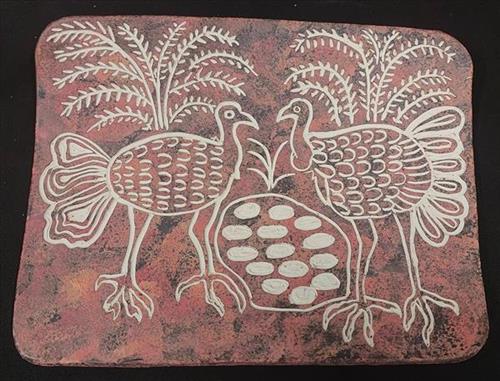
Diwan (Scrub Turkey)

Diwan are bush food – an important source of meat. We also eat the eggs. They are a delicacy. The male bird looks after the nest and will not go far, as he has to protect the nest from bush goanna’s. If they come around, he will send out an alarm call to other Diwan to alert therm. The nesting time for Diwan is September to December. The bush goanna knows when the eggs will be ready to hatch. When the goannas start hanging around, this is a good sign that the eggs are ready. We dig for eggs with digging sticks or by hand. The nest is very deep and when you can feel the warmth with your hands, you know that the eggs are close-by. The eggs are very good for health and make you strong.

225182303349


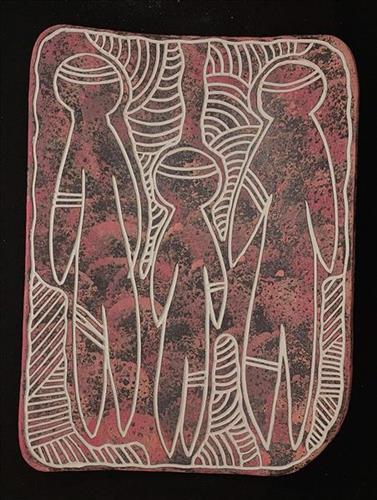
Murrugu (Family)

Family is very important to me. Whenever I draw my family design in clay, on fabric or on paper, it makes me think about the many good experiences I had when growing up. I enjoyed being out on country, going hunting and fishing, collecting plant foods and camping. I also have fond memories of listening to traditional music and learning our cultural dances.  My family design keeps all these personal memories alive like a flame, and like my ancestors before me, I try to create similar happy times with my children and grandchildren.