Alangkwe – Bush Banana
Alangkwe – Bush Banana Dreaming.

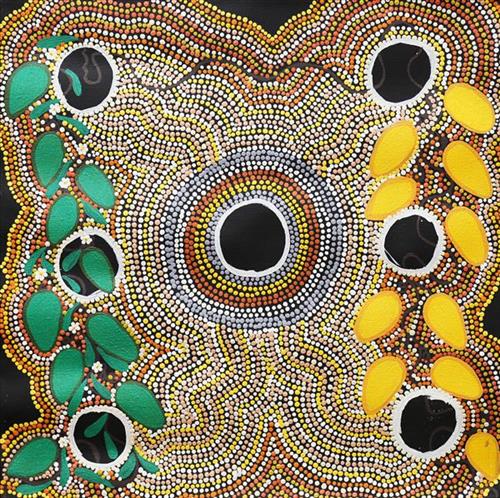
Alangkwe – Bush Banana Dreaming.

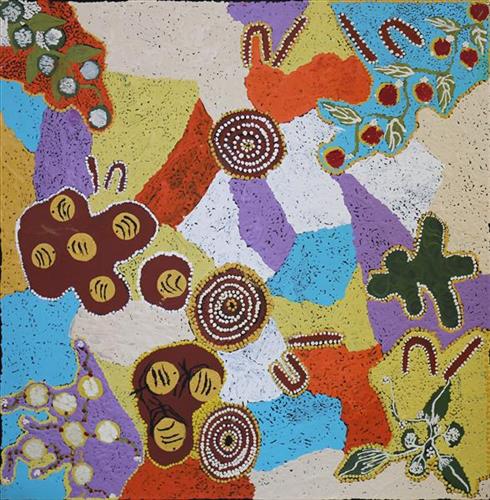
Women talking about collecting bush food – where the best places are and the best times, whether seasonal or dependent on rain events – All the women sit with their digging sticks and piti’s [coolamons] around the hearth to talk about these aspects of collecting bush food.
The community of Ampilatwatja made a conscious decision not to paint ‘altyerr’ dreaming stories. The artists paint their country where those stories sit.
Rosie has painted her Father’s country, where she can always find bush tucker and bush medicine. She is very happy when out bush hunting and gathering, as it brings back memories of her childhood when she used to live traditionally off of the land with her family.
Rosie uses these hunting trips as her inspiration for her artworks, each one reflecting the layered landscape and various colours as she has seen them. “They are always changing, with the light of day and the seasons of the year
Rosie enjoys and understands the importance of painting bush medicine plants. They help in the healing of her people and it keeps the tradition and knowledge strong. These particular plants are very plentiful after rain and can be used for numerous conditions, such as skin irritations, flu, coughs and infections.
Rosie’s dreaming is the “Araluta” or kangaroo plant. This bush is a rich source of food for the kangaroos and keeps them fat and healthy and good for hunting.

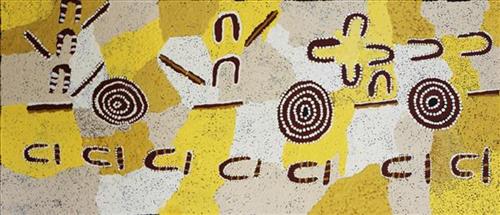
Kungka Inma – Women’s Ceremony – all the women dancing ceremony, all painted up and dancing to the singing.
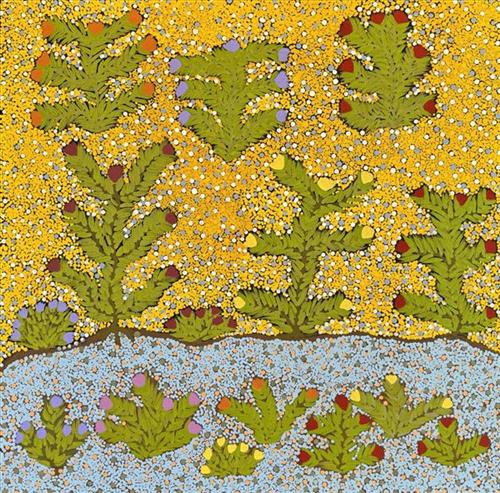
The artists of Ampilatwatja made a conscious decision not to paint ‘altyerr’ dreaming stories. The artists paint their country where those stories sit.
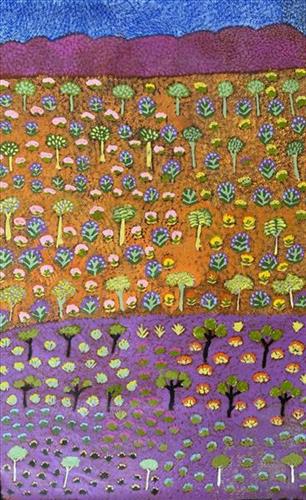
These bush flowers grow seasonly in Alyawarr country, some of which are also used in bush medicine remedies.
“When I go out hunting, I like to see all the bush flowers that are flowering and then when I come back, I paint them.”
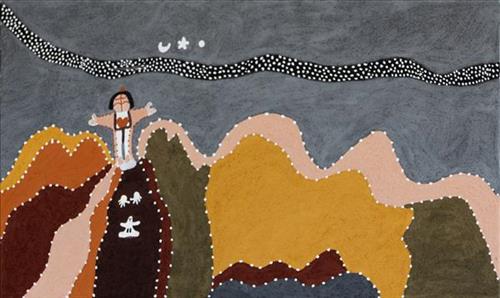
This image is of the Holy Spirit being in the land with the Milky Way in the skies.

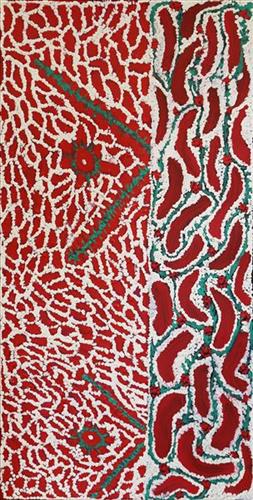
Bush flowers

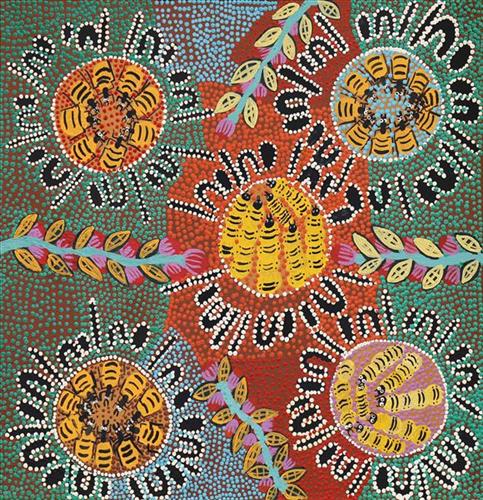
Women talking about collecting bush food – where the best places are and the best times, whether seasonal or dependent on rain events – All the women sit with their digging sticks and piti’s [coolamons] around the hearth to talk about these aspects of collecting bush food.

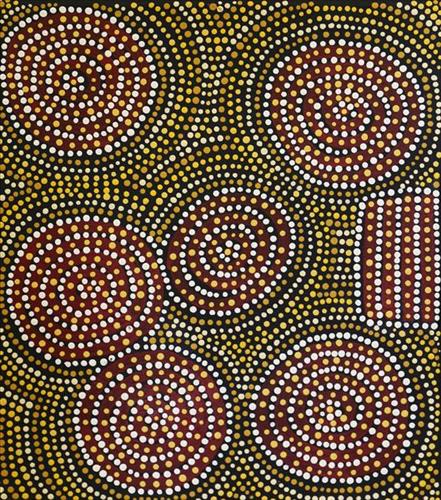
‘This painting is about the way women hunt Wardapi – that sand goanna. He digs holes in the dunes, makes his nest deep inside. Many of the holes all join up. Women hunt Wardapi in the dunes by digging out the holes. Sometimes cover one, and Wardapi runs out other one. Need to hunt him together. Find all the holes. Dig them at the same time. Someone going to get him that way.’
The Wardapi Jukurrpa [Varanus Gouldii Goanna] belongs to the Spencer Sisters. It comes from Yarripilangku [aka Yinyiripalangu], south-west of Yuendumu. A group of Warlpiri Karnta [women] are sitting down in a circle when a Japangardi Wati [man] from Puturlu [Mt Theo], called Wamaru came upon them. He wants to take one of them, named Yurlkurinyi, of Nungarrayi skin, which is the wrong skin for him. He takes the Nungarrayi woman up a hill, where they make love. In response, the earth on top of the hill turns to Ngunjungunju [white ochre], and yellow and red ochre. The yellow is for Karnta and the red for Wati. The ochre is used by Warlpiri people for love magic and ceremonial decoration. The Wati turns all the Karnta and himself into Wardapi, aka Varanus Gouldii goannas. This Jukurrpa belongs to the Napaljarri/Japaljarri and Nungarrayi /Jungarrayi subsections, and the Japanangka/Napanangka, Japangardi/Napangardi subsections of Puturlu. The women are often represented by ‘U’ shapes. Concentric circles may illustrate Wardapi holes, or their droppings left behind them, and Wardapi tracks are usually represented by ‘W’ shapes and wavy lines.

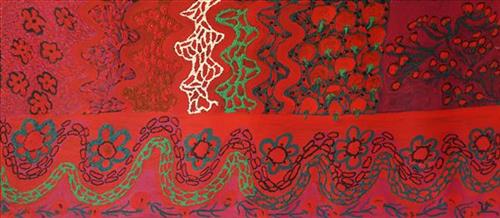
Mangarta or Bush tomato (lower left) and Wayanu or bush plum, bush peach or Quandong, along the edge. They growing amongst different bush flowers. Always go looking for them with family during their season. Everyone’s got their favourite places. I showed my family where to go get them out bush (near homelands). Spring is good season for them.