220282308762


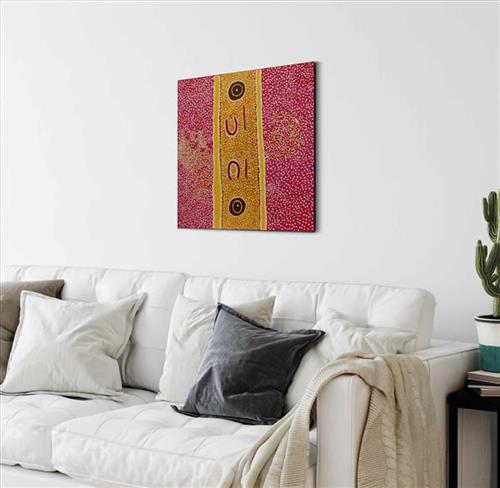
Kungka Kotara Tjukurrpa (Two Women Story)

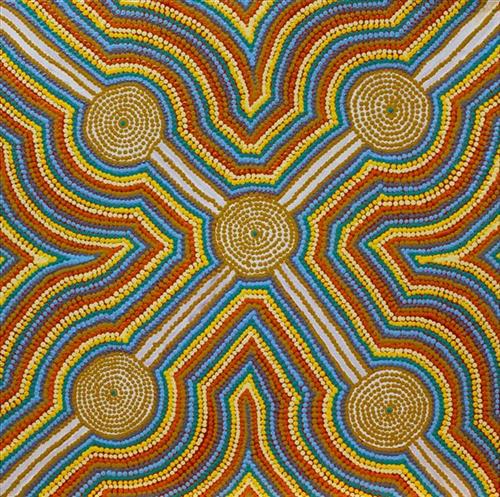
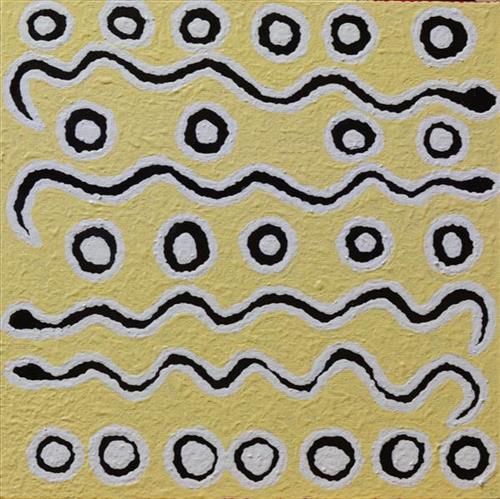
Two women were travelling to Walungurru (Kintore) from Kalkukatjarra (Docker River). They were two sisters – one older and one younger. They were hunting on their travels for all bush fruit, vegetables and small game, including goanna. During these travels they also used to sing their Tjukurrpa. They stopped at Walungurru and saw ceremonial men. Out of shame they turned into rock on the other side of the big hill next to Walungurru. We can still see them today. It reminds us not to look at ceremonial men (all painted up) today.

220282312444


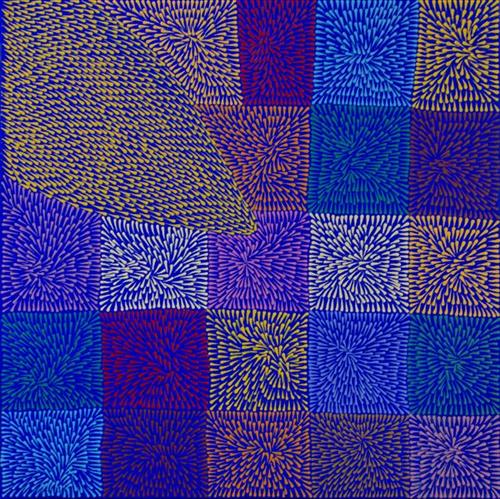
Ininti at Muruntji

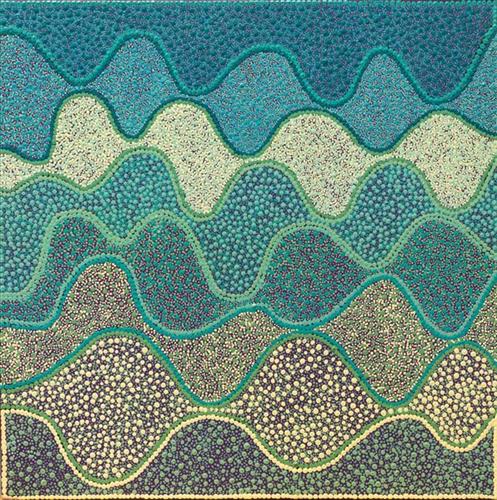
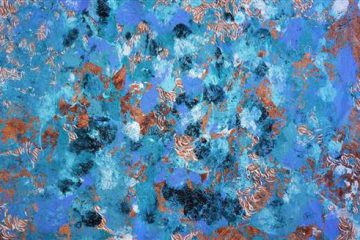
This painting depicts the bush seeds that come from the ininti tree (batwinged coral tree).  The tree is native to the Western Desert of Central Australia, growing in sand around creek beds. The ininti grow abundantly in Muruntji country where the artist has spent much time collecting the seeds. Muruntji is west of Kungkayunti (Browns Bore), the outstation where the artist’s family is from. Both Patricia Multa, and her daughter Virgillia Multa paint the ininti at Muruntji, expressing the colours and movement of the ininti tree and its seeds and flowers throughout the seasons. Patricia remembers collecting the seeds when she was a child and making them into necklaces. The seeds can be found in the sand, or inside the pods still on the trees. The seeds naturally grow in varying colours from dark reds to light yellows. The flowers are equally vibrant, ranging from rich oranges into reds. Ininti are still collected today and made into jewellery at Ikuntji Artists. 

220282312442


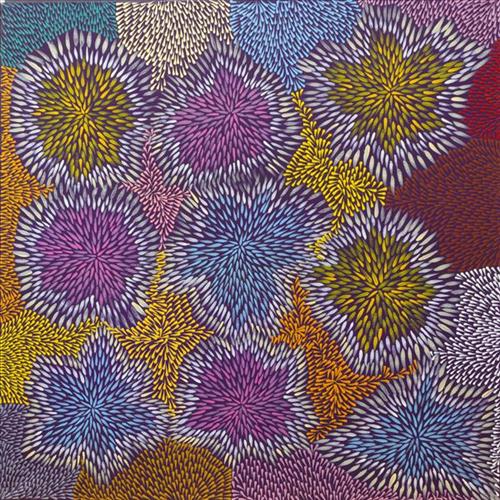
Ininti at Muruntji

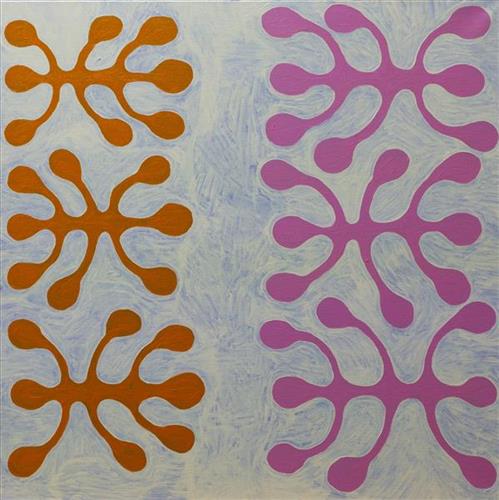
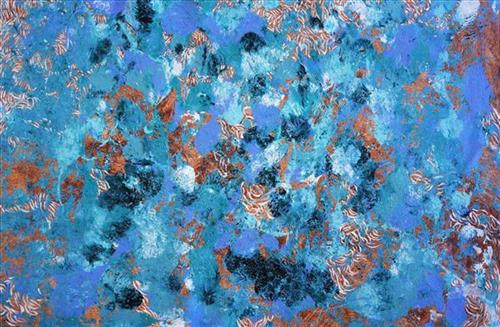
This painting depicts the bush seeds that come from the ininti tree (batwinged coral tree).  The tree is native to the Western Desert of Central Australia, growing in sand around creek beds. The ininti grow abundantly in Muruntji country where the artist has spent much time collecting the seeds. Muruntji is west of Kungkayunti (Browns Bore), the outstation where the artist’s family is from. Both Patricia Multa, and her daughter Virgillia Multa paint the ininti at Muruntji, expressing the colours and movement of the ininti tree and its seeds and flowers throughout the seasons. Patricia remembers collecting the seeds when she was a child and making them into necklaces. The seeds can be found in the sand, or inside the pods still on the trees. The seeds naturally grow in varying colours from dark reds to light yellows. The flowers are equally vibrant, ranging from rich oranges into reds. Ininti are still collected today and made into jewellery at Ikuntji Artists. 

220282313216


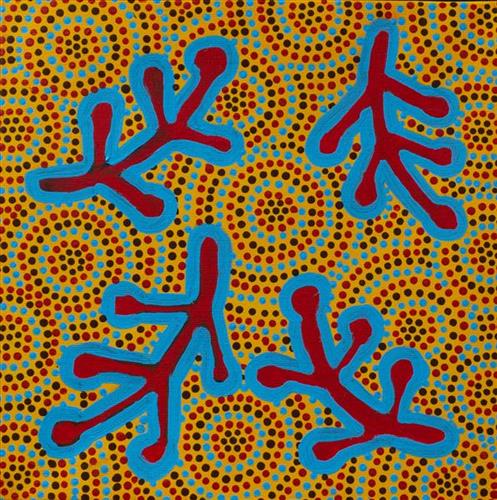
Yultukunpa – Honey Grevillea

Yultukunpa, honey grevillea is locally called bush lolly. It flowers soon after the rain in the sandhills and has a very sweet taste. The painting refers to the artist’s mother’s Dreaming west of Kintore.

220282314805


‘Kurpulungu’ Ngapa Tjukurrpa – Water Snake Dreaming

This painting depicts the travelling Ngapa Tjukurrpa (Water Dreaming) at Kurpulungu, located close to Mt Liebig. Joseph inherited this Tjukurrpa from his father, Phillip Lane. This is the travelling Dreaming of ‘Kulpununtu’, a water snake that travelled through Phillip Creek, Warumungu country (50km north of Tennant Creek). While in Phillip creek the snake met an emu. The snake then travelled west of Yuendumu to Intukumanu. In Intukumanu, it dug a big hole, forming a waterhole. The waterhole is named Kulpununtu, after the snake. After creating the waterhole, the snake changed form into a Walra, a flying animal that is unlike anything that exists today. The Walra then flew east back past Phillip Creek. It continued to fly back to where it originally came from, its origins are unknown. There is a song associated with this Tjukurrpa. Phillip Lane, Joseph’s father says that when the song is sung it brings big rains, sometimes lasting for months.

220282315892


Karrkurutinja – Lake Macdonald

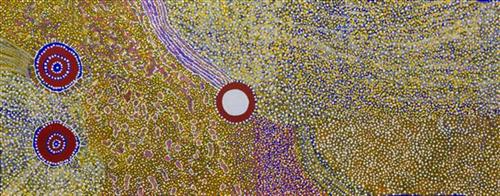
This painting shows Karrkurrutintja (Lake Mcdonald in Pintpui), located west of Kintore along the Western Australia/Northern Territory border. This country is an important site of the Pilkati (snake) Tjukurrpa (Dreaming) of Kuniya Kutjarra (two carpet snakes, two brothers, two Tjangalas). This is the place where the snake lives and from which it travels to Haasts Bluff sometimes.

This is the country and Tjukurrpa of the artist’s grandmother, Narputta Nangala Jugadai, who was born there. Narputta was passed down this story from her father, Talaku Tjampitjinpa.  Narputta was one of the founding members of Ikuntji Artists, and has been painting since the beginning of the desert painting movement in the 1970s.

Kuniya Kitjarra (Two carpet snakes) as told by Narputta,

 “Two Tjangalas were travelling, looking for meat. Their grandfather, Tiwil Tjangala, asked them for kaniya (carpet snake). They hid the snake under their feet, ‘No, We’ve got no meat.’ Tiwil turned around to make a fire and the two Tjangalas ran off with the snake. They were confronted by their father, Talaku Tjampitjinpa, and he said, ‘You boys are mad to play games with your grandfather’. The grandfather ht them both on the head with a stone axe, and killed them. They’re loying on their bellies, at Karrkurrutintj, near Lampintja, in the salt lake (the older brother in front, the younger brother behind). That’s the story I put on the canvas. The colours that I put on remind me of this story.”

220282315838


Kakalyalya Tjukurrpa – White Cocky Dreaming

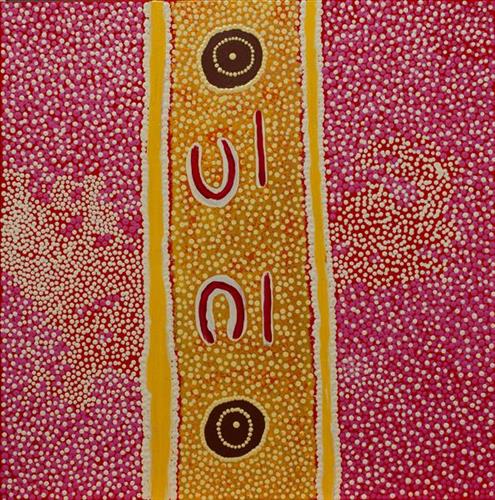
In the artist’s words: This is the story in my father’s country of Pirrupa Kaala. It is the story of the white cocky (circle middle on top) with mako (witchetty grubs) in its mouth. The eagle (left bottom) brought malo (kangaroo) meat (circle left top) for the white cocky as she had a broken wing. But a crow (circle right side bottom) chased the white cocky all over the country because the white cocky had such a big mob of mako. The crow started to hit the white cocky with a nulla nulla and called her greedy. The eagle helped the cocky and chased the crow away. So it happend that the eagle came to stay with white cocky for a little while. But on day he said: ”Oh, I am going home to find another place to stay”, and left the white cocky behind to stay there by herself for good.

The blue colour shows the tracks from the water running into the deep water holes in the sand after the rain. The red colour shows the little mountains where the water comes from and goes into the creek flowing south.

220282315837


Uwulkari – Watiya Tjuta

Mitjili paints her fathers Tjukurrpa, the ceremonial spear straightening in Uwalkari country (Gibson desert region). The Watiya Tjuta (Acacia Trees) are the trees that are used to make these spears. Uwalkari country is abundant with Watiya Tjuta, as well as sand hills and other plants. Mitjili paints the motif of the Watiya Tjuta, carrying on the recurring motif as her mother used to draw in the sand. Her mother passed on this Dreaming to her. 

Napurrula’s father, Tupa Tjakamarra gave her the right to paint works related to Ilyingaungau in the Gibson Desert. This site, south of Walungurru (Kintore), some 520 kilometres west of Mparntwe (Alice Springs), is where the artist’s Mutikatjirri ancestors assembled their kulata (spears) for a conflict with the Tjukula men. Allusive works that refer to the straightening of kulata by Tjupurrula are among the landmark paintings of the Ikuntji Artists movement’s 30-year history. The paintings of Napurrula and her husband, Long Tom Tjapanangka, have come to be understood as archetypical of Ikuntji art since they began to work with the arts centre in 1993. Napurrula remembers, ‘ … After I got married, my mother taught me my father’s Tjukurrpa in the sand, that’s what I’m painting on the canvas’. The white pigment eddies around abstract forms that refer to the spearwood trees. The tightly structured patterning of the key motifs and bold use of colour demonstrates the artist’s confidence in her individual artistic vision within a family of superlative artists – and the cultural heritage that continues to inform the myriad expressions of Western Desert artists.

116482316961


Tide Going Out

When the tide goes out it drags back the water and leaves behind patterns in the sand. This painting represents the water and the sand. I like to paint my country from a bird’s eye view, looking down. I love the different textures and shapes of the landscape. They inspire my artworks.

220282317004


Wanampi – Rainbow Serpent

This painting tells about the artist’s father’s Dreaming which is situated in the Warlpiri country. The rainbow serpent is travelling from Karrinyarra (Mount Wedge) to Western Australia (West of Kiwirrkura) into a salt lake, where it stays. This salt lake is Lake Mackay.