220282317957


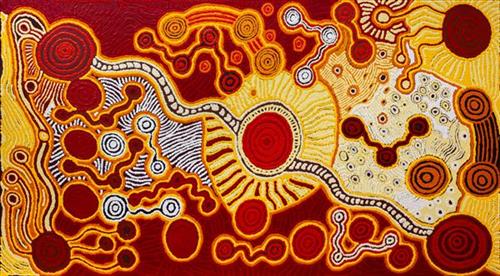
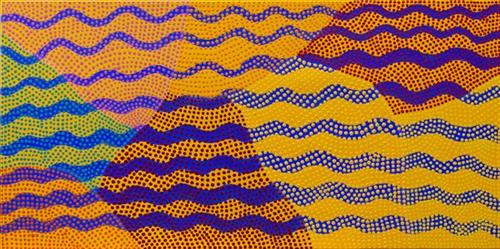
Karinyarra (Mt Wedge)

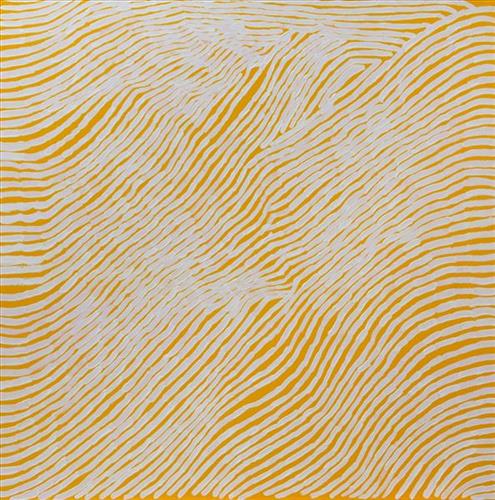
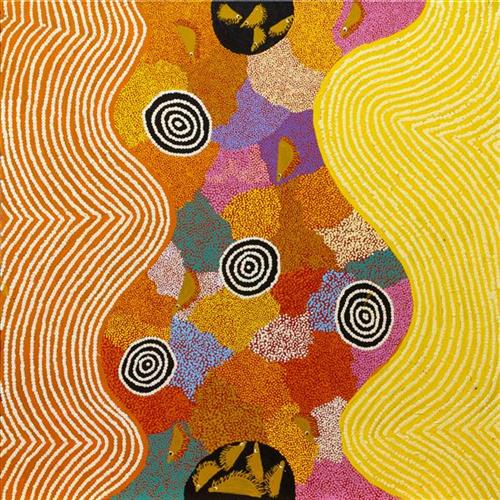
Dorothy depicts her mother’s story of Karinyarra (Mt Wedge), located half way between Papunya and Yuendumu North of Haasts Bluff. In the Dreamtime, the fresh water flowed from these rock holes and into the lake where it become salt water. The rock holes are a place of bush onion dreaming (yalka). Here, the women dig for bush onions. Karinyarra is surrounded by many sacred sites.

Dorothy was passed down the rights to paint her great-grandmother’s Tjukurrpa from this country from her father, Timmy Jugadai.

The rainbow snake came down to Mt Wedge from the north/east. When it arrived at Mt Wedge it covered some or the waterholes and made big sandhills. Now there is only one waterhole that sometimes has water in it. This is because the snake remains there and can take and put back the water. The Nakamarra women are the traditional owners of this country and it is with their song that they can sing up the snake to bring water again. 
220282317956


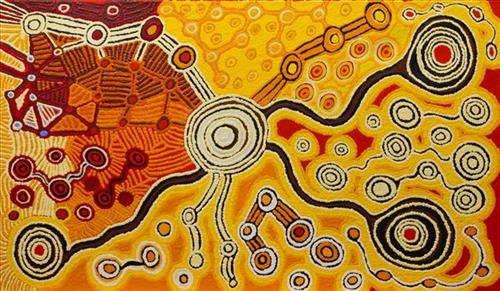
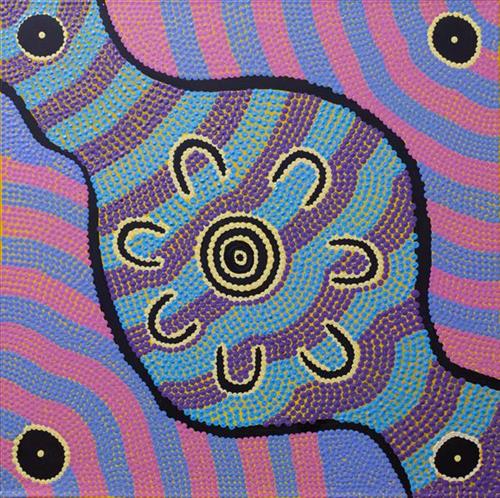
Claypan at Karrinyarra

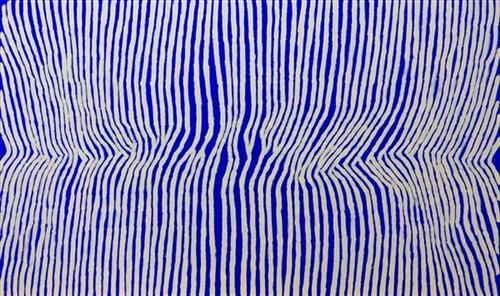
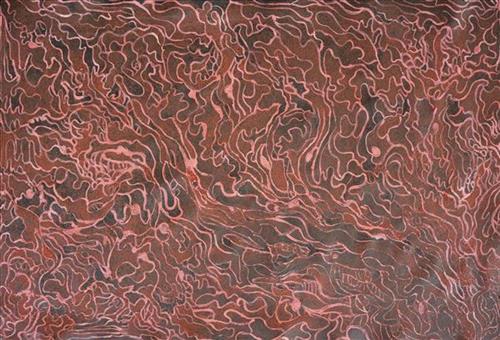
This work shows a claypan at Karrinyarra after rain with bush onion (yalka) growing. Karrinyarra is two hours’ drive from Haasts Bluff and is the country of the Napaltjarri women and Japaltjarri men. After rain, bush onion (yalka) plants will grow on the claypan. Bush onion is used for food and bush medicine. Bush onions grow all year round and can be found near rockholes and water sources. Women harvest yalka by digging in the ground with a stick until it is soft, then pulling out the onion.

220282320862


Yalka – Bush Onion

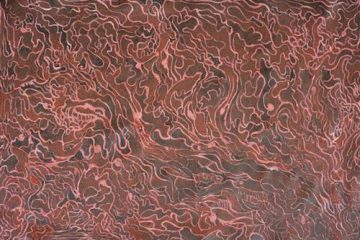
This painting shows the Yalka Dreaming (bush onion) which is situated in a place called Analy, close to Town Bore Outstation. Bush onions grow after the rain and are collected by all the women. The yalka are found underneath the surface and can be eaten raw or cooked in the hot sand next to the campfire. Paintings referring to this Dreaming show diverse motifs such as plants, leaves, seeds, layers or roots.

Yalka Tjukurrpa at Analy. Jillian’s mother and artist Anmanari Napanangka Nolan told her to start painting this story. This is the Dreaming and country of her father, Lionel Kantawarra Tjupurrula. Lionel was a Kukatja (Western Australia) man, born in 1932. He lived at Haasts Bluff in the mid 1980s and painted intermittently for Papunya Tula Artists (NT). He passed away in 1988. Lionel painted his own Yalka Tjukurrpa (Bush onion Dreaming).

220282321053


Kuruyultu

In this painting Eunice depicts her grandmother’s father’s Tjukurrpa (Dreaming). It shows the country at Kuruyultu, near Tjukurrla in Western Australia.

Eunice Napanangka Jack, her grandmother, says about the artwork:

‘This is my country. I can’t remember how it all happened, because it happened before I was born. I have a scar on my back from it. My grandfather speared a wallaby at Kuruyultu. That night he ate that wallaby. At the same time my mother could feel me moving inside her. She was heavily pregnant with me. That next morning, after my grandfather had speared the wallaby, killed it and eaten it, I was born. I was born at Kuruyultu, near the rockhole there. I can’t remember my grandfather or my grandmother. I was still a little baby. We left that place, Kuruyultu. My father, my mother, my big sister and my father’s brother, we all left together and went to Haasts Bluff. I grew up in Haasts Bluff. I have been back to Kuruyultu for visits but I never lived there again in my country. I think about it every day. Only my father knows all the stories for that country and he painted them too… all the men’s stories. I know the story of the wallaby mother and daughter which left me with a birthmark. That’s what I paint: the wallaby mother and daughter.’


220282321051


Kuruyultu

In this painting Eunice depicts her grandmother’s father’s Tjukurrpa (Dreaming). It shows the country at Kuruyultu, near Tjukurrla in Western Australia.

Eunice Napanangka Jack, her grandmother, says about the artwork:

‘This is my country. I can’t remember how it all happened, because it happened before I was born. I have a scar on my back from it. My grandfather speared a wallaby at Kuruyultu. That night he ate that wallaby. At the same time my mother could feel me moving inside her. She was heavily pregnant with me. That next morning, after my grandfather had speared the wallaby, killed it and eaten it, I was born. I was born at Kuruyultu, near the rockhole there. I can’t remember my grandfather or my grandmother. I was still a little baby. We left that place, Kuruyultu. My father, my mother, my big sister and my father’s brother, we all left together and went to Haasts Bluff. I grew up in Haasts Bluff. I have been back to Kuruyultu for visits but I never lived there again in my country. I think about it every day. Only my father knows all the stories for that country and he painted them too… all the men’s stories. I know the story of the wallaby mother and daughter which left me with a birthmark. That’s what I paint: the wallaby mother and daughter.’


116482330196


Marni

The Pilbara is a land of many beautiful colours. Its’ beauty blends into the mother earth and against the red, purple hills in the distance. In time and season, the yellow wattles, Mulla and Sturt Pea bloom and the country comes alive with the wildflowers watered by the rain and heavy dew during the night.The land and our country also tells a wonderful story about our ancestor’s. They walk and lived on the land always gathering food such as fish from the river, hunting kangaroo’s, tracking goanna’s and also gathering bush fruits and medicine.

220282336345


Mintjinperri

This painting depicts the Papa Tjukurrpa (Dog Dreaming) in Mintjinperri, located East of Kintore. Mintjinperri is Pintupi country, owned by the Nungarrayi women. Mintjinperri is a site for woman’s business, where they gather for ceremony, using leaves to brush the earth. In this Tjukurrpa the Papas are walking around, searching for Kapi (waterholes). As they walk amongst the tali (sandhills) and Puli (rocks) they leave footprints behind them. Today you can still see those footprints in the sand. This Tjukurrpa was passed down to Kelly from her mother, Alice Nampitjinpa Dixon, who received it from her mother, Panaria Nungarrayi. Panaria, Kellys maternal grandmother, is from Mintjinperri, this is her country and Tjukurrpa.

220282336343


Waru at Watarru

In this painting, the artist depicts the Waru Tjukurrpa (Fire Dreaming) at Watarru. Watarru is located in the Anangu Pitjantjatjara Yankunytjatjara Lands (APY Lands) in the north west of South Australia close to Kanpi, Piplitjara, Maralinga and Ochre Valley. This Tjukurrpa is from the artist’s own country at Watarru.

The Tjukurrpa tells of two Tjangala travelling from Yuendumu, Northern Territory, down South to Watarru, carrying the fire with them. Once they arrived at Watarru, they threw the fire stick on the ground and created a big hole and mountain. The two Tjangalas created everything at Watarru, afterwards they went back to Yuendumu. This is part of a big Tjukurrpa from Yuendumu, called Warlukurlangu.

The two Tjangalas left many Ngangkari (traditional healer) spirits in this place, which all the children hold. The artist often depicts these children sitting down on country with their mothers, surrounded by puli puli (rocks) and kapi (rock holes). 

220282336340


Waru at Watarru

In this painting, the artist depicts the Waru Tjukurrpa (Fire Dreaming) at Watarru. Watarru is located in the Anangu Pitjantjatjara Yankunytjatjara Lands (APY Lands) in the north west of South Australia close to Kanpi, Piplitjara, Maralinga and Ochre Valley. This Tjukurrpa is from the artist’s own country at Watarru.

The Tjukurrpa tells of two Tjangala travelling from Yuendumu, Northern Territory, down South to Watarru, carrying the fire with them. Once they arrived at Watarru, they threw the fire stick on the ground and created a big hole and mountain. The two Tjangalas created everything at Watarru, afterwards they went back to Yuendumu. This is part of a big Tjukurrpa from Yuendumu, called Warlukurlangu.

The two Tjangalas left many Ngangkari (traditional healer) spirits in this place, which all the children hold. The artist often depicts these children sitting down on country with their mothers, surrounded by puli puli (rocks) and kapi (rock holes). 

220282336338


Pirrnpirrnga – Desert Bore

This painting depicts the ‘pin pin’ desert bore outstation near Kintore. This is her father’s Tjukurrpa and country. Pirrnpirrnga has mountains, rocks and a big rock hole, where there is always water. In the Tjukurrpa the snakes are travelling around the sand hill country, looking for water. Ann remembers visiting this country and seeing her aunty singing by those rock holes.