220282368215


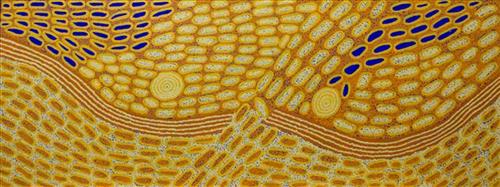
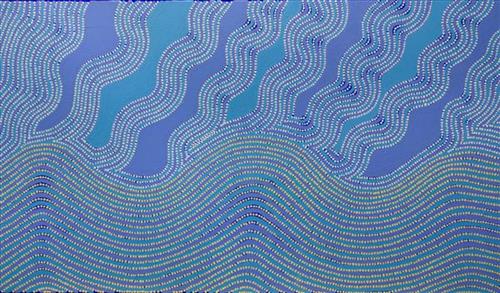
Tali at Kungkayunti

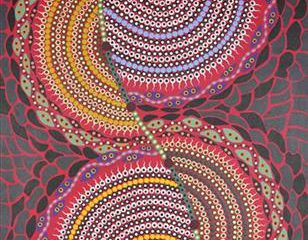
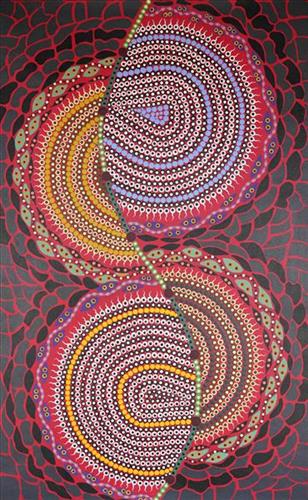
This painting shows the birds eye view of the tali tali (sandhills) at Kungkayunti (Brown’s Bore). This is the country of Joe Tjakamarra Multa, the father of Douglas Multa, Agnes Multa, Lisa Multa, Alison Multa, Rephina Multa, Benita Multa and Patricia Multa and the grandfather to their children. The tali tali are a short walk from where the family lived and the children of Joe grew up.

Lisa remembers walking up the tali tali with her sister, Agnes Multa, who was the same age as her. When Lisa got married she brought her partner to see those tali tali. From the tali tali, a 360-degree view can be seen of the surrounding country. The area is abundant with bush tucker, especially bush tomatoes and bush banana.

Kungkayunti is an important place for the travelling Tjukurrpa of the ancestral Arrernte women who travelled 600 kms from Ntaria (Hermannsburg) to Kintore, past Kulpitarra (Outstation) to attend to women’s business. Kungkayunti is the place where the women first camped. On their long journey, the women stopped at Kunkayunti (Brown’s Bore) to camp, rest, eat and dance. When the women reached their destination, they danced, shared their stories and renewed their law. Those women turned into stone and can be seen today. Annual events continue today to strengthen this Tjukurrpa.
220282368205


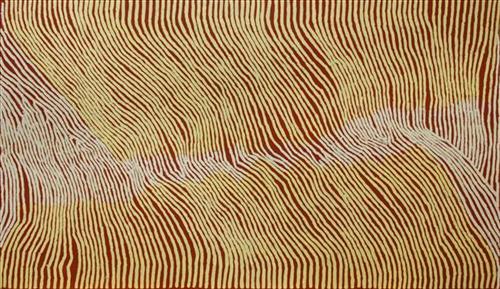
Kuruyultu

In this painting Young Eunice depicts her great grandfather’s Tjukurrpa (Dreaming). It shows the country at Kuruyultu, near Tjukurrla in Western Australia.

Her grandmother, Eunice Napanangka Jack says about the artwork:

‘This is my country. I can’t remember how it all happened, because it happened before I was born. I have a scar on my back from it. My grandfather speared a wallaby at Kuruyultu. That night he ate that wallaby. At the same time my mother could feel me moving inside her. She was heavily pregnant with me. That next morning, after my grandfather had speared the wallaby, killed it and eaten it, I was born. I was born at Kuruyultu, near the rockhole there. I can’t remember my grandfather or my grandmother. I was still a little baby. We left that place, Kuruyultu. My father, my mother, my big sister and my father’s brother, we all left together and went to Haasts Bluff. I grew up in Haasts Bluff. I have been back to Kuruyultu for visits but I never lived there again in my country. I think about it every day. Only my father knows all the stories for that country and he painted them too… all the men’s stories. I know the story of the wallaby mother and daughter which left me with a birthmark. That’s what I paint: the wallaby mother and daughter.’


220282368195


Mintjinperri

This painting depicts the Papa Tjukurrpa (Dog Dreaming) in Mintjinperri, located East of Kintore. Mintjinperri is Pintupi country, owned by the Nungarrayi women. Mintjinperri is a site for woman’s business, where they gather for ceremony, using leaves to brush the earth. In this Tjukurrpa the Papas are walking around, searching for Kapi (waterholes). As they walk amongst the tali (sandhills) and Puli (rocks) they leave footprints behind them. Today you can still see those footprints in the sand. This Tjukurrpa was passed down to Kelly from her mother, Alice Nampitjinpa Dixon, who received it from her mother, Panaria Nungarrayi. Panaria, Kellys maternal grandmother, is from Mintjinperri, this is her country and Tjukurrpa.

115682368856


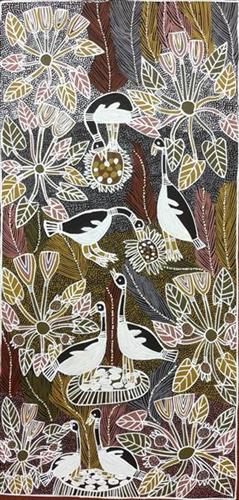
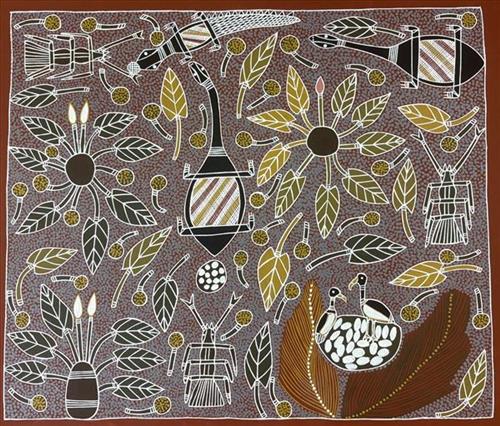
Gumang (Magpie Geese)

The Yolngu people of Arnhem Land originate from a spiritual source, fixed in a particular place in their land or the sea. These ‘Spiritual Reservoirs’ are often in the form of special waterholes made by Wangarr (Creative Beings) long ago close to the beginning of time.

The creator beings moved across the country side, shaping the land and implanting in each tract of country, the spiritual life force for the people who were to own it. These Creative Spirits took many forms. When they gave the land to each group they also gave songs, dances, ceremony, the associated laws and language. The Creation story for Ganalbingu people took place near the middle section of the Glyde River where it becomes the Goyder River. Their land, Ngaliyindi, sits astride the Arafura Swamp in Central Arnhem Land.

In this painting, the artist has depicted Gumang (magpie geese), which are sacred to the Ganalbingu people. To the east of the Arafura Swamp is a freshwater billabong which is said to have been made by the Goose Spirit and is in the shape of a goose nest. As a result, geese, their eggs and their nests are sacred.

115682368812


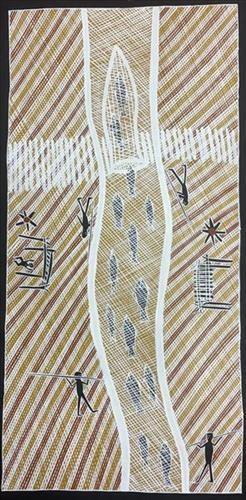
Hunting Story

Johnny’s painting depicts and old way of life- hunting next to the river. You can see Yolngu are spearing the fish, and have also places a fish trap in the water. He has also paintings two camps- with a shelter and a fire.

115682368811


Raypiny Dhawu (Fresh Water Story)

All Aboriginal people originate from a spiritual source, fixed in a particular place in their land or the sea. These ‘spiritual reservoirs’ are often in the form of special waterholes made by Wangarr (creative spirits) that were created long ago close to the beginning of time. These creator beings moved across the countryside, shaping the land and implanting in each tract of country, the spiritual life force for the people who were to own it. These creative spirits took many forms and when they gave the land to each group, they also gave songs, dances, ceremony, the associated laws and language.


The creation story for Ganalbingu people took place near the middle section of the Glyde River where it becomes the Goyder River. Their land, Ngaliyindi, sits astride the Arafura Swamp in Central Arnhem Land. Many Ganalbingu artists paint totemic species significant to their clan. These can include baru (crocodile), banda (long necked turtle), buliya (catfish), yalman (waterlilies), gumang (magpie geese), dakawa (fresh water yabby), ratjuk (barramundi), warrnyu (flying fox) and more.


116482369051


Skin Groups

This painting is about our four skin groups Banaga, Balyirri, Burungu and Garimarra. Without understanding skin groups it would be hard for other groups in the Pilbara region to know who you are and where you are from so it is very important for us Yinjibarndi people to learn their own skin colour.

115682369646


Bak ‘bididi (frogs)

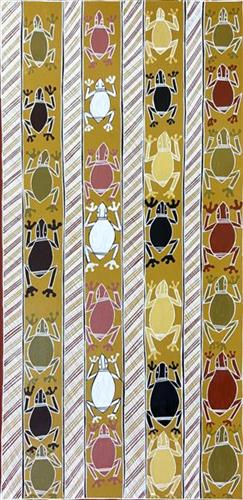
This painting represents Bak’bididi (frogs) sitting around a billabong. The Arafura wetlands across East Arnhem Land are filled with billabongs during the wet season, providing the perfect living conditions for bak’bididi. Their calls you can hear far and wide during the day and night. 


220982370272


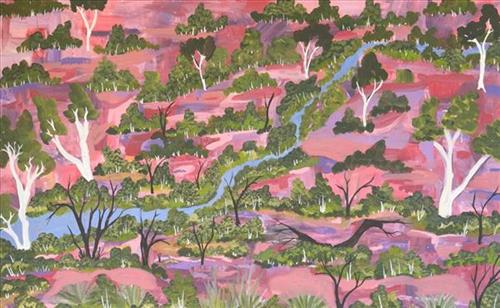
Elizabeth Ngwarraye Bonney – My Grandmothers Country

I still hunt my Grand Mothers country for goanna, bush medicine and yams.

I hunt all year round, hunting and walking through the country makes me happy.  When I look at the distant hills I can feel my grandmother.  Bush flowers are everywhere.

Painting and printing my grandmother’s country reminds about those times.

220982370778


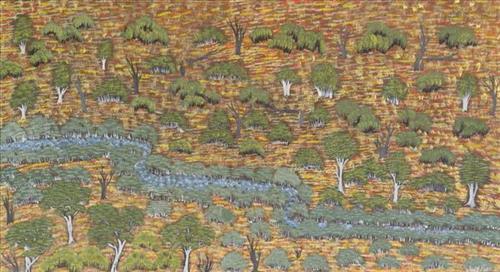
Yvonne Ngwarraye Bonney – My Hunting Country

Yvonne has painted her favourite hunting country after rain. “This is when the storm ants come and make the goannas nice and fat, the ground is soft for digging honey ants and it’s when the bush foods and grasses come up and grow strong. The country is normally bare with small stones and rocks everywhere, but after rain, everything comes alive.”

Yvonne is a tremendous hunter, she is skilled in reading tracks and reading the land. Painting hunting country is important and special to her. 

The community of Ampilatwatja made a conscious decision not to paint ‘altyerr’(dreaming stories). The artists paint their country where those stories sit.