377810582374950


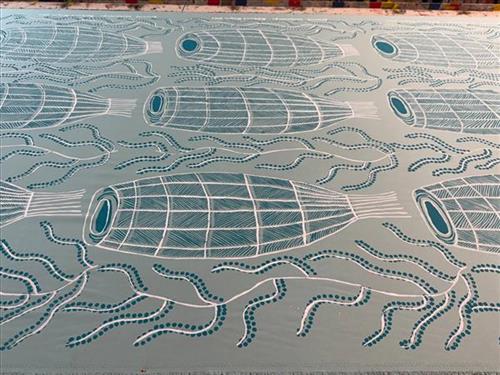
An-gujechiya (fishtrap)

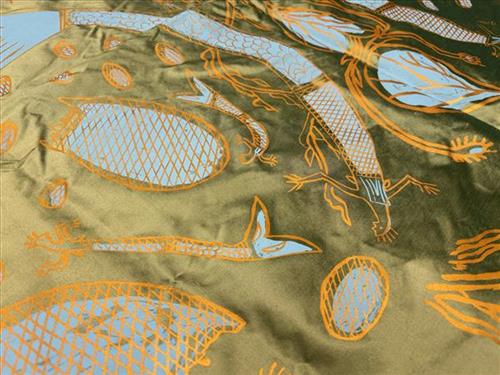
An-gujechiya is the word for fish trap in the Burarra language, which is one of the languages that continue to be spoken in the Djelk Indigenous Protected Region. Wullunmingu’s childhood home in Gupanga, Arnhem Land, is a saltwater estuary that is a great place for collecting crabs and edible shellfish such as the delicacy mud mussel.

In the early wet season, fish swim upstream to breed in creeks and billabongs, then downstream to spend the dry season in larger rivers. An-gujechiya (fish trap) would be set to face the oncoming fish, with woven fencing either side. Within the mouth of the trap is a woven funnel that guides the fish inside and prevents their escape. The clever design ensures that only adult fish are caught as smaller fish can escape through the weaving or even through the funnel. The fish that are caught can survive in the trap for up to two months. Once the trap is removed, the end is untied to remove the fish.

Wullunmingu’s eye for detail runs in her family. Her mother, Doris Gingingara, was an illustrator for the iconic Desert Designs label in the 1980s. In addition to designing outfits for the 2018 Commonwealth Games, Wullunmingu’s work has been featured in high-profile fashion and homeware licensing collaborations, including with Kip&Co x Bábbarra in 2020 and a stunning collaboration with ethical milliner, Helen Kaminski 2024.

 

377810582374949


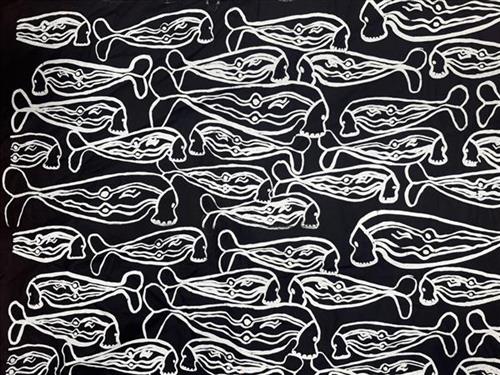
Murnun (dugong)

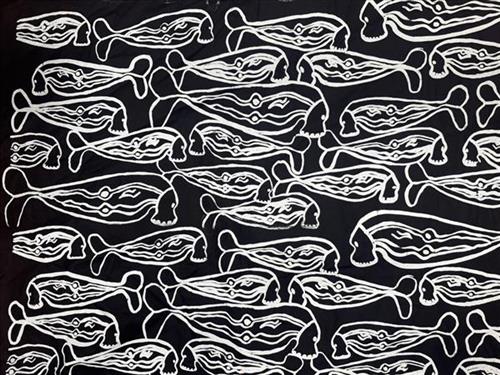
This design is murnun (dugong). Josephine grew up on the coastal area of Maningrida. She is a Kunibidji woman, a Gurgoni and Ndjébbana language speaker. 

‘In the olden times they used to go on canoe to look for murnun (dungong), fish (yokkara) ,turtle (makéddja) and stingray (marnan djupa (sp?)). They used a spear and net during the day and sometimes at night. The fishermen were mostly men. I remember my grandfather used to go hunting, that’s Joy’s (Garlbin)  father. HIs name was Jimmy. We used to go out with him on the boat to kill makéddja (turtle) and murnun (dugong) for yalaba (bush tucker). 


377810582374948


Murnun (dugong)

This design is murnun (dugong). Josephine grew up on the coastal area of Maningrida. She is a Kunibidji woman, a Gurgoni and Ndjébbana language speaker. 

‘In the olden times they used to go on canoe to look for murnun (dungong), fish (yokkara) ,turtle (makéddja) and stingray (marnan djupa (sp?)). They used a spear and net during the day and sometimes at night. The fishermen were mostly men. I remember my grandfather used to go hunting, that’s Joy’s (Garlbin)  father. HIs name was Jimmy. We used to go out with him on the boat to kill makéddja (turtle) and murnun (dugong) for yalaba (bush tucker). 


377810582374933


Djomi (Fresh Water Spirit)

This design depicts the story of the artist’s ancestral dreaming, the Djómi (Fresh Water Spirit).

The Djómi figure is a mermaid-like spirit with fish tail that lives in the freshwater stream that flows out to the sea cliff near Maningrida. Djómi is known to be a very powerful fertility symbol.

“If you go there, you can get pregnant easily. Djómi has babies, and they can give other babies too. The Djómi spirit is so powerful, that women can end up with multiple babies at once, twins or sometimes even more. The Djómi spirits lay eggs near the sacred freshwater stream in Maningrida. Inside the eggs are human babies as well as young Djómi. Men do not go near that swamp, because Djomi is so powerful that men might get pregnant there too. So men are too scared of that Djómi. When we visit the Djómi freshwater spring, we can hear young Djómi  crying. They sound like normal babies crying, those Djómi spirits. They are looking for a mother. This Djómi is my dreaming, I got permission from my djungkay (ritual manager) to paint this Djómi design. For me I always ask my djunguy permission to paint, because that is our cultural way. This design also depicts the freshwater lily leaves and seaweed from the base of the sea floor.” Joy Galrbin

377810582374923


Kukurlk Kare (Going Underground)

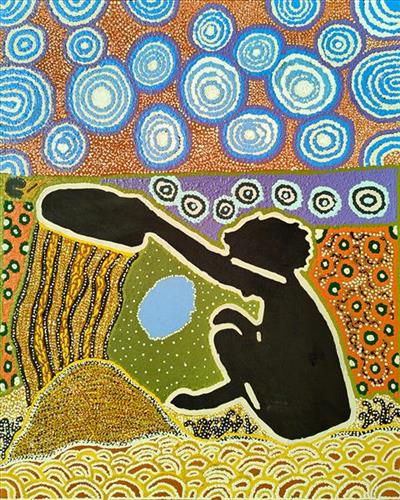
Karrinung kukurlk kare, karrijare manme (we are going underground looking for food).

“This is my country. In this painting, I’m looking at her little bit different way. This is what we see when we’re kukurlk kare (going underground)

Man-kurndalh (Black plum) I call mother. It is my mother’s Djang/Dreaming. The bush onion (kulumuduk) is white, the same as onions you buy at the store. We don’t eat this one though, it’s poison.

Wayuk is the water lily, with the big root growing in the earth. This is when that water is drying up a bit. There are worms and beetles- this is what we see underground, when we are digging for manme.”

-Jennifer Wurrkidj


114182374914


Kungkarrangkalpa (Seven Sisters)

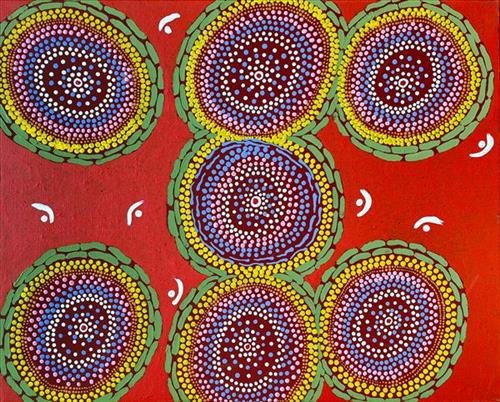
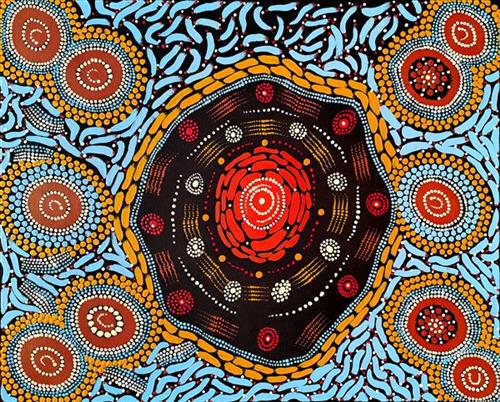
‘Kungkarrangkalpa’ (The Seven Sisters or Pleaides) is significant Tjukurrpa (dreamtime). Its origins you may be familiar with in astronomy and its connection to ‘Wati Nyiru’ (Magic Man or Orion).  The roots of this dreaming stems across indigenous groups around the world. The Australian Aboriginal songline is one part to the whole dreaming which can be traced all around the world. The ladies of the Ngaanyatjarra Lands depict their significant chapter and understanding of the journey of the sisters. The different versions of this story depend on where you live and the significance’s of local Tjukurrpa places.

Nyiru fell in love with the sisters but he was of the wrong skin group to marry, but he still pursued them on their journey. The sisters travel across the land to escape Nyiru’s unwanted attentions, but he is persistent and always finds them. There are significant land forms which can be sited today that evidence this dreaming. As Nyiru is chasing the sisters he tries to catch them by using magic to turn into the most tempting kampurarrpa (bush tomato) and the most beautiful Yirli (wild fig tree), for them to eat and camp under. However, the sisters are knowledgeable of his magic and too clever for Nyiru who they outwit again and again. They go hungry and run through the night rather than be caught by him. As the journey continues, Nyiru gets so frustrated at the wit of the sisters that he uses his magic to make the oldest sister sick to try and get closer to her. The other sisters rescue the big sister and nurse her back to health. It is said he also captures the youngest sister, but with the help of the oldest sister, she escapes back to her sisters who are waiting for her. Eventually, the sisters fly into the sky to escape Nyiru, forming the constellation. Nyiru felt lonely, longing for the sisters who were so far away. Nyiru used his magic to go to the sky, forever in pursuit.

114182374913


Kungkarrangkalpa (Seven Sisters)

‘Kungkarrangkalpa’ (The Seven Sisters or Pleaides) is significant Tjukurrpa (dreamtime). Its origins you may be familiar with in astronomy and its connection to ‘Wati Nyiru’ (Magic Man or Orion).  The roots of this dreaming stems across indigenous groups around the world. The Australian Aboriginal songline is one part to the whole dreaming which can be traced all around the world. The ladies of the Ngaanyatjarra Lands depict their significant chapter and understanding of the journey of the sisters. The different versions of this story depend on where you live and the significance’s of local Tjukurrpa places.

Nyiru fell in love with the sisters but he was of the wrong skin group to marry, but he still pursued them on their journey. The sisters travel across the land to escape Nyiru’s unwanted attentions, but he is persistent and always finds them. There are significant land forms which can be sited today that evidence this dreaming. As Nyiru is chasing the sisters he tries to catch them by using magic to turn into the most tempting kampurarrpa (bush tomato) and the most beautiful Yirli (wild fig tree), for them to eat and camp under. However, the sisters are knowledgeable of his magic and too clever for Nyiru who they outwit again and again. They go hungry and run through the night rather than be caught by him. As the journey continues, Nyiru gets so frustrated at the wit of the sisters that he uses his magic to make the oldest sister sick to try and get closer to her. The other sisters rescue the big sister and nurse her back to health. It is said he also captures the youngest sister, but with the help of the oldest sister, she escapes back to her sisters who are waiting for her. Eventually, the sisters fly into the sky to escape Nyiru, forming the constellation. Nyiru felt lonely, longing for the sisters who were so far away. Nyiru used his magic to go to the sky, forever in pursuit.

114182374910


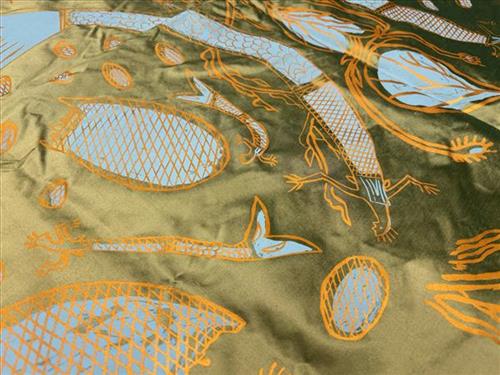
Wati kutjara – The goanna men

This is the story of two powerful magicians who came to the Ngaanyatjarra Lands from far away to the west;

‘These two men are always together, always camping together. They do all sorts of tricks when they travel across the lands as they stop from place to place. When they reached ‘Wirtapi Wara’ (Long Black or Blackstone Range) they argued about which way to go around. One went around the south side and the other the north side.

At a distance it seemed they didn’t recognise each other or perhaps they were just pretending not to recognise each other! It is also said that at Papulankutja they tricked each other by changing their appearance at the same time so they had no chance to recognise each other. The name Papulankutja comes from the Ngaanyatjarra word meaning, ‘to stare without recognising each other’.

114182374908


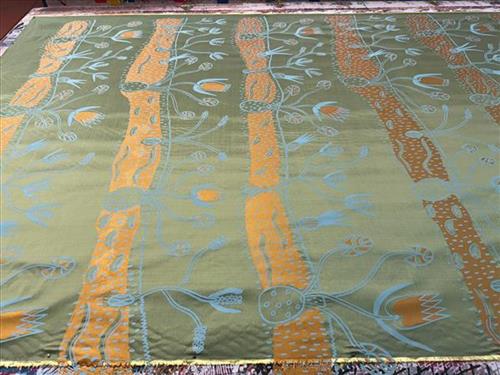
Women collecting bush foods

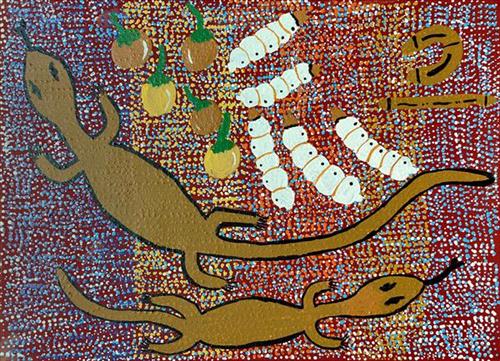
The Anangu people travelled vast desert landscapes, following the seasons for food and shelter, deeply attuned to the rhythms of the land. This resilience and wisdom embedded in traditional bush foods that sustained them across generations.

Maku (Witchety Grubs), with their creamy, nutty flavour, represent survival and the resourcefulness to draw nourishment from deep within tree roots. Kampurarrpa (Desert Raisins), small and tangy, add brightness and essential nutrients to desert diets, thriving under intense sun.

Ipalu (Bush Banana), a climbing vine with crisp, slender fruits, offers fibre and hydration—a refreshing staple in arid climates. Ili (Bush Figs), with their mild sweetness, grow from rugged trees, offering a delicate treat in the harsh terrain.

Through vibrant colours and intricate designs, these bush foods embody the spirit of Ngaanyatjarra culture, each a testament to the land’s gifts and the knowledge passed through generations.

377810582374907


Djomi (Fresh Water Spirit)

This design depicts the story of the artist’s ancestral dreaming, the Djómi (Fresh Water Spirit).

The Djómi figure is a mermaid-like spirit with fish tail that lives in the freshwater stream that flows out to the sea cliff near Maningrida. Djómi is known to be a very powerful fertility symbol.

“If you go there, you can get pregnant easily. Djómi has babies, and they can give other babies too. The Djómi spirit is so powerful, that women can end up with multiple babies at once, twins or sometimes even more. The Djómi spirits lay eggs near the sacred freshwater stream in Maningrida. Inside the eggs are human babies as well as young Djómi. Men do not go near that swamp, because Djomi is so powerful that men might get pregnant there too. So men are too scared of that Djómi. When we visit the Djómi freshwater spring, we can hear young Djómi  crying. They sound like normal babies crying, those Djómi spirits. They are looking for a mother. This Djómi is my dreaming, I got permission from my djungkay (ritual manager) to paint this Djómi design. For me I always ask my djunguy permission to paint, because that is our cultural way. This design also depicts the freshwater lily leaves and seaweed from the base of the sea floor.” Joy Galrbin