377815582393328


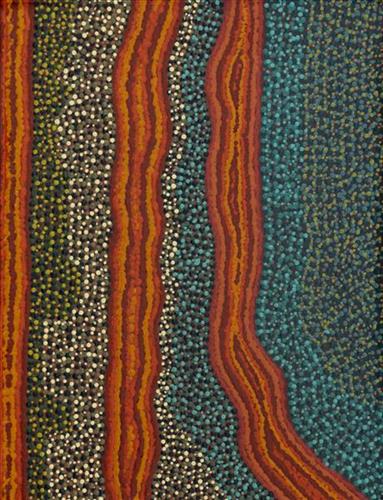
Kulyakartu

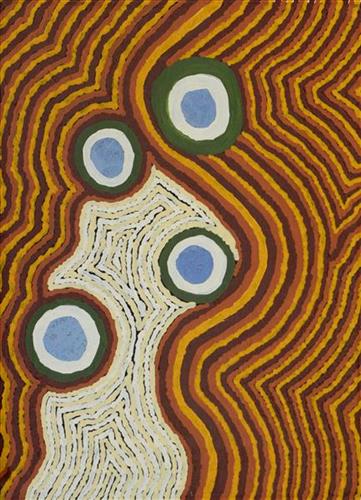
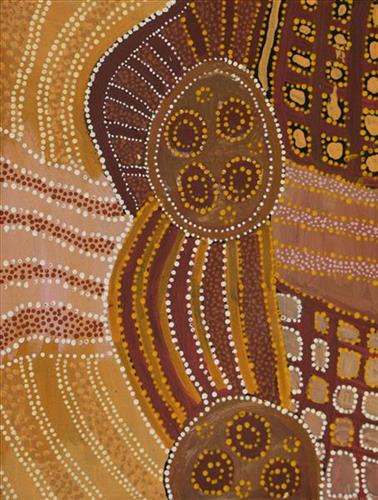
This painting is about the landscape, bushfire (waru), and bush foods. Seeing the difference after the waru burns, it leaves some patches on the ground, and when the regrowth of the bush plants come back to life, it leaves a mark.

Well, I learnt that story from my grandmother—going out bush, learning about the different sides of burning. Talking about before burning and after burning, and how people go hunting after burning, looking for goanna. Teaching the younger generation where and when to hunt for goanna.

I learnt painting from my grandmother (Nola Taylor) and my grandfathers (Muuki Taylor, Wokka Taylor) by going out on Country, sharing stories, and learning from them about bush plants and bush food. I painted before, but going to Parnngurr and being around old people really opened my mind—seeing them paint and the colours they used. My daughter started painting with the old people too, and now she watches me paint their stories. I’d like to be an inspiration to her and to young people.
377815582393327


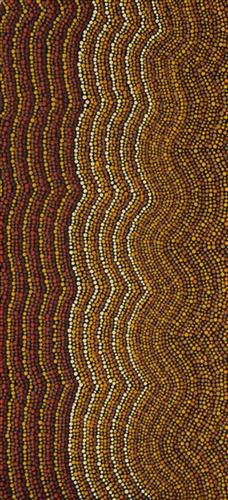
Sand dunes

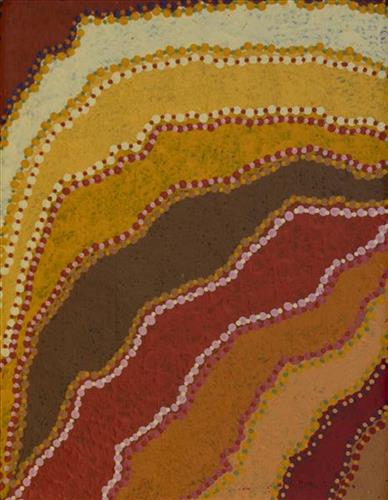
This painting represents the rocky outcrop and all the different areas of claypans, and the dark area represents all the jurnga (sands) in the cool time, warri (translation needed). All the light yellowish colour represents the paru (spinifex).


I like to go out working with the rangers and all the elders, I go out Country with them and they show me all the places, all mapped out with GPS. We mark out all the other places for next time. Sometimes I go out in the rangers vehicle and walk around the country and look around for goanna holes. We try to keep an eye on the animals, [monitoring them,] look out for all the bilby and skinks and everything with the Nyangumarta rangers. I go in my spare time because I’m busy you know, I’m busy with my artwork and council meetings.


In the cool dry time, when it’s a little bit warm, and cool in the morning, that’s when we do the fire patch burning. When we doing it also depends on the wind, the warngal, which way its blowing. We do that because it’s a big part of controlled fired. Wild fires, we don’t want them, they destroy the animals and their living area, destroy the Country. We do it too for the regrowth. When I went back to Country a couple of weeks ago, all the burned up area had a little bit of regrowth after a little bit of rain.

377815582393326


Untitled

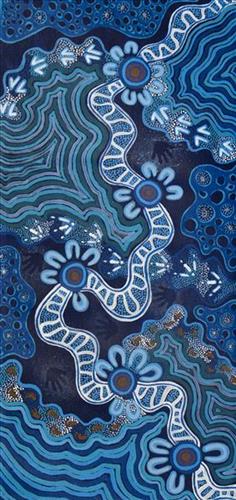
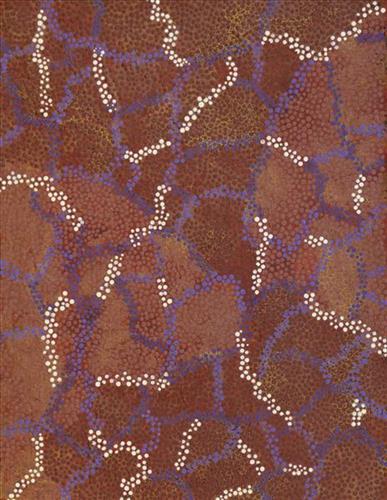
 This artwork showcases the artist’s skillful use of colour, texture, and technique, reflecting a deep connection to their environment and culture. Each detail embodies the unique identity of Bidyadanga Artists, where the original five language groups—Nyangumarta, Mangala, Yulparija, Juwaliny, and Karrajarri—come together to create art that speaks to the heart of Country. Over time, the community and Art Centre has grown to include people from other Kimberley tribes, fostering a space where diverse cultural knowledge and practices come together. Situated where the desert meets the sea, artists draw inspiration from their ancestral Country and personal journeys. The artist captures the vibrant beauty of both desert and coastal landscapes, blending earthy reds, deep blues, and intricate patterns distinctive to their cultural heritage. The themes and composition invite viewers into the artist’s world, offering a glimpse of the rich, intertwined histories and the enduring connection to land and spirit that define the Bidyadanga community.

377815582393325


Untitled

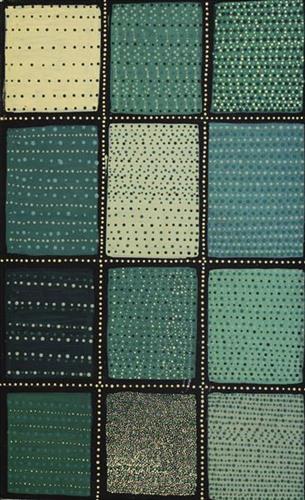
 This artwork showcases the artist’s skillful use of colour, texture, and technique, reflecting a deep connection to their environment and culture. Each detail embodies the unique identity of Bidyadanga Artists, where the original five language groups—Nyangumarta, Mangala, Yulparija, Juwaliny, and Karrajarri—come together to create art that speaks to the heart of Country. Over time, the community and Art Centre has grown to include people from other Kimberley tribes, fostering a space where diverse cultural knowledge and practices come together. Situated where the desert meets the sea, artists draw inspiration from their ancestral Country and personal journeys. The artist captures the vibrant beauty of both desert and coastal landscapes, blending earthy reds, deep blues, and intricate patterns distinctive to their cultural heritage. The themes and composition invite viewers into the artist’s world, offering a glimpse of the rich, intertwined histories and the enduring connection to land and spirit that define the Bidyadanga community.

377815582393324


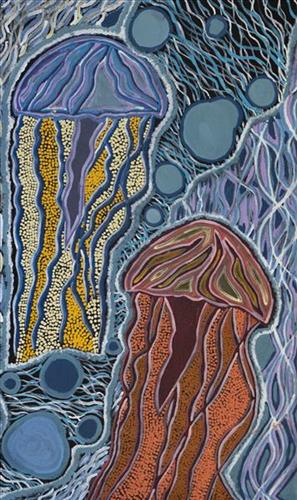
Sea Life

“All the fish – barramundi, salmon, dugong, turtle and jellyfish. I paint what I see and eat. Fish of the sea. I paint the right season for them, so if something is in season, I paint it. The threadfin salmon and blue nose salmon come in wintertime. Barramundi is in the hot time, when the jellyfish come out. Dugong is after the rainy season.

I am a ranger and I look after the land and the sea. When it’s hot season, we see jellyfish on the sand and beach – that means it’s the right time for hunting turtles. They’re fat from eating the seagrass and jellyfish. When we see the yellow flowers (wattle) blooming, we know the barramundi are good for catching.

The barramundi stole the pearl shells from the desert and made the creek called Waru Creek, near 80 Mile Beach. There are old fishing camps down that way, and we go with the rangers to do salmon surveys and monitor how healthy they are. When you see the flying clouds and the full moon, it’s the right time for turtle nesting and turtle monitoring. In June and July, they lay their eggs.”

– Elliot Hunter

Elliot is also a Nyangumarta Ranger, working to protect both land and sea. Nyangumarta Country stretches across the coastline and inland desert of the northwest, from 80 Mile Beach through the Great Sandy Desert. It is a vast landscape of red sand dunes, claypans, salt marshes, and long stretches of coastal waters rich with sealife. Fishing is not only part of Elliot’s everyday life but also an important cultural practice that connects him to Country and community. Through his paintings, he brings together his knowledge as a ranger and his lived experience of fishing, showing how the seasons guide when and what to hunt. His artworks celebrate the richness of sea life while sharing stories that have been passed down.


377815582393323


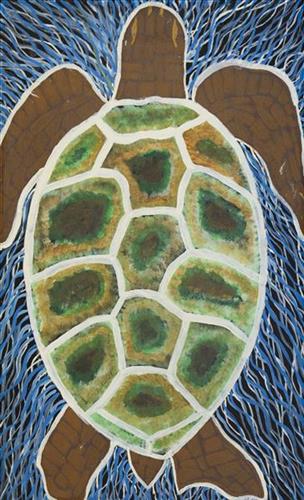
Sea Life

“All the fish – barramundi, salmon, dugong, turtle and jellyfish. I paint what I see and eat. Fish of the sea. I paint the right season for them, so if something is in season, I paint it. The threadfin salmon and blue nose salmon come in wintertime. Barramundi is in the hot time, when the jellyfish come out. Dugong is after the rainy season.

I am a ranger and I look after the land and the sea. When it’s hot season, we see jellyfish on the sand and beach – that means it’s the right time for hunting turtles. They’re fat from eating the seagrass and jellyfish. When we see the yellow flowers (wattle) blooming, we know the barramundi are good for catching.

The barramundi stole the pearl shells from the desert and made the creek called Waru Creek, near 80 Mile Beach. There are old fishing camps down that way, and we go with the rangers to do salmon surveys and monitor how healthy they are. When you see the flying clouds and the full moon, it’s the right time for turtle nesting and turtle monitoring. In June and July, they lay their eggs.”

– Elliot Hunter

Elliot is also a Nyangumarta Ranger, working to protect both land and sea. Nyangumarta Country stretches across the coastline and inland desert of the northwest, from 80 Mile Beach through the Great Sandy Desert. It is a vast landscape of red sand dunes, claypans, salt marshes, and long stretches of coastal waters rich with sealife. Fishing is not only part of Elliot’s everyday life but also an important cultural practice that connects him to Country and community. Through his paintings, he brings together his knowledge as a ranger and his lived experience of fishing, showing how the seasons guide when and what to hunt. His artworks celebrate the richness of sea life while sharing stories that have been passed down.


377815582393322


Nyangumarta Warrarn (Country)

This painting represents the rocky outcrop and all the different areas of claypans, and the dark area represents all the jurnga (sands) in the cool time, warri (translation needed). All the light yellowish colour represents the paru (spinifex).


I like to go out working with the rangers and all the elders, I go out Country with them and they show me all the places, all mapped out with GPS. We mark out all the other places for next time. Sometimes I go out in the rangers vehicle and walk around the country and look around for goanna holes. We try to keep an eye on the animals, [monitoring them,] look out for all the bilby and skinks and everything with the Nyangumarta rangers. I go in my spare time because I’m busy you know, I’m busy with my artwork and council meetings.


In the cool dry time, when it’s a little bit warm, and cool in the morning, that’s when we do the fire patch burning. When we doing it also depends on the wind, the warngal, which way its blowing. We do that because it’s a big part of controlled fired. Wild fires, we don’t want them, they destroy the animals and their living area, destroy the Country. We do it too for the regrowth. When I went back to Country a couple of weeks ago, all the burned up area had a little bit of regrowth after a little bit of rain.

377815582393321


Untitled

 This artwork showcases the artist’s skillful use of colour, texture, and technique, reflecting a deep connection to their environment and culture. Each detail embodies the unique identity of Bidyadanga Artists, where the original five language groups—Nyangumarta, Mangala, Yulparija, Juwaliny, and Karrajarri—come together to create art that speaks to the heart of Country. Over time, the community and Art Centre has grown to include people from other Kimberley tribes, fostering a space where diverse cultural knowledge and practices come together. Situated where the desert meets the sea, artists draw inspiration from their ancestral Country and personal journeys. The artist captures the vibrant beauty of both desert and coastal landscapes, blending earthy reds, deep blues, and intricate patterns distinctive to their cultural heritage. The themes and composition invite viewers into the artist’s world, offering a glimpse of the rich, intertwined histories and the enduring connection to land and spirit that define the Bidyadanga community.

377815582393320


Red Sand and Hills

This painting is about the red desert sand in The Great Sandy Desert and the hills. I love the colours of the desert.

This painting shows the Artists Grandfathers country where they used to walk around in circles searching for bush tucker and water from the waterholes. When our ancestors came out from the Canning Stock route, they used to see big mob of sand dunes and flowers.

377815582393319


Untitled

 This artwork showcases the artist’s skillful use of colour, texture, and technique, reflecting a deep connection to their environment and culture. Each detail embodies the unique identity of Bidyadanga Artists, where the original five language groups—Nyangumarta, Mangala, Yulparija, Juwaliny, and Karrajarri—come together to create art that speaks to the heart of Country. Over time, the community and Art Centre has grown to include people from other Kimberley tribes, fostering a space where diverse cultural knowledge and practices come together. Situated where the desert meets the sea, artists draw inspiration from their ancestral Country and personal journeys. The artist captures the vibrant beauty of both desert and coastal landscapes, blending earthy reds, deep blues, and intricate patterns distinctive to their cultural heritage. The themes and composition invite viewers into the artist’s world, offering a glimpse of the rich, intertwined histories and the enduring connection to land and spirit that define the Bidyadanga community.