377815582393318


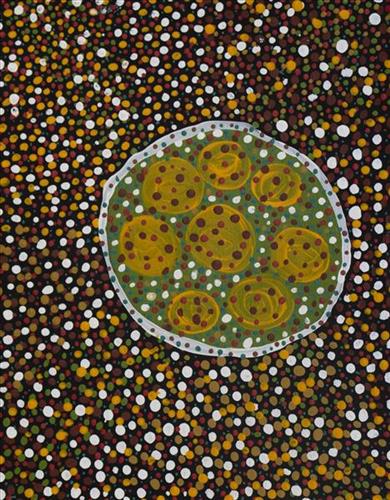
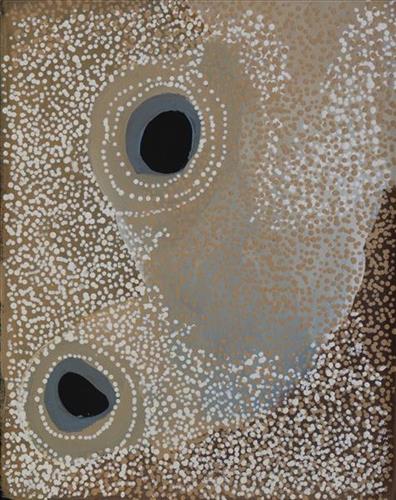
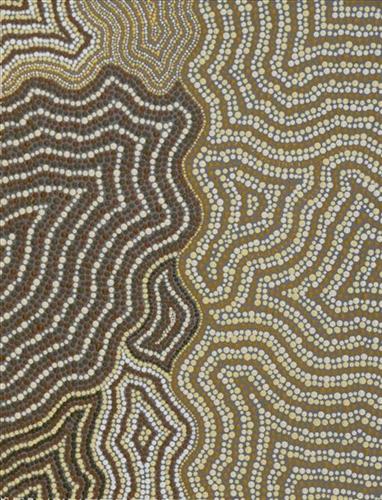
Clay pans

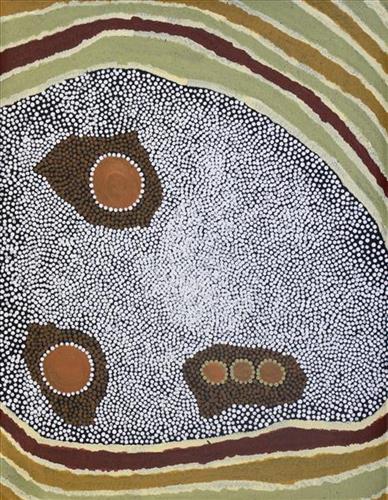
This paining is about the claypans and spinifex in the dry season time, when spinifex, the native plants and the country gets dry. When the rain comes it makes the country green again. Some animals love dry season for hunting. Some times we go hunting for animals for our families


With the Paru (spinifex) we pull out the whole plant, roots and all and then we twist it around to make a flat basket (Jitatu) like a donut ring. Then this sits on the head and you can carry water for example. The water is in a Kapara like a shallow bowl which you make from the hard wood of a tree like Parntal (Owenia Reticulata)
377815582393317


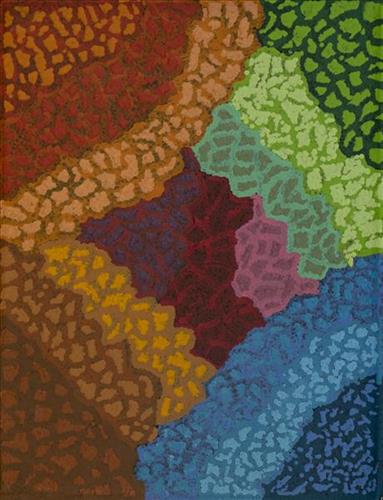
Untitled

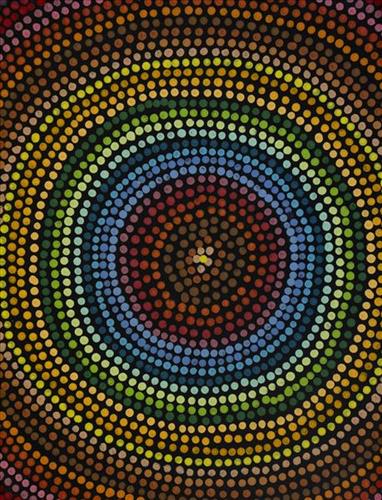
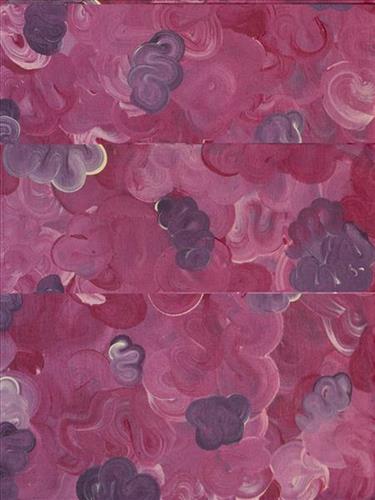
 This artwork showcases the artist’s skillful use of colour, texture, and technique, reflecting a deep connection to their environment and culture. Each detail embodies the unique identity of Bidyadanga Artists, where the original five language groups—Nyangumarta, Mangala, Yulparija, Juwaliny, and Karrajarri—come together to create art that speaks to the heart of Country. Over time, the community and Art Centre has grown to include people from other Kimberley tribes, fostering a space where diverse cultural knowledge and practices come together. Situated where the desert meets the sea, artists draw inspiration from their ancestral Country and personal journeys. The artist captures the vibrant beauty of both desert and coastal landscapes, blending earthy reds, deep blues, and intricate patterns distinctive to their cultural heritage. The themes and composition invite viewers into the artist’s world, offering a glimpse of the rich, intertwined histories and the enduring connection to land and spirit that define the Bidyadanga community.

377815582393316


Untitled

 This artwork showcases the artist’s skillful use of colour, texture, and technique, reflecting a deep connection to their environment and culture. Each detail embodies the unique identity of Bidyadanga Artists, where the original five language groups—Nyangumarta, Mangala, Yulparija, Juwaliny, and Karrajarri—come together to create art that speaks to the heart of Country. Over time, the community and Art Centre has grown to include people from other Kimberley tribes, fostering a space where diverse cultural knowledge and practices come together. Situated where the desert meets the sea, artists draw inspiration from their ancestral Country and personal journeys. The artist captures the vibrant beauty of both desert and coastal landscapes, blending earthy reds, deep blues, and intricate patterns distinctive to their cultural heritage. The themes and composition invite viewers into the artist’s world, offering a glimpse of the rich, intertwined histories and the enduring connection to land and spirit that define the Bidyadanga community.

377815582393315


Untitled

 This artwork showcases the artist’s skillful use of colour, texture, and technique, reflecting a deep connection to their environment and culture. Each detail embodies the unique identity of Bidyadanga Artists, where the original five language groups—Nyangumarta, Mangala, Yulparija, Juwaliny, and Karrajarri—come together to create art that speaks to the heart of Country. Over time, the community and Art Centre has grown to include people from other Kimberley tribes, fostering a space where diverse cultural knowledge and practices come together. Situated where the desert meets the sea, artists draw inspiration from their ancestral Country and personal journeys. The artist captures the vibrant beauty of both desert and coastal landscapes, blending earthy reds, deep blues, and intricate patterns distinctive to their cultural heritage. The themes and composition invite viewers into the artist’s world, offering a glimpse of the rich, intertwined histories and the enduring connection to land and spirit that define the Bidyadanga community.

377815582393314


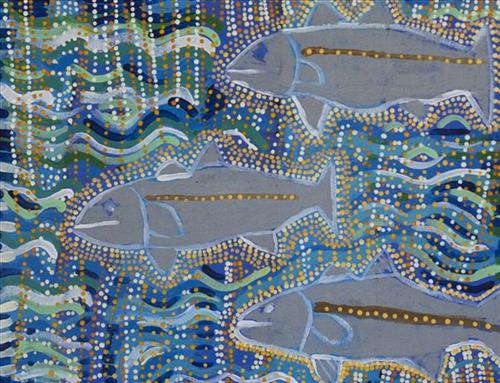
Fishing at Japulu

“I paint about fish, stingray and crab. I paint any kind of fish.  I use blue, green, white and purple to represent the water. We catch fish to cook up and eat. When we get fish, we also share it with families. People are happy to receive it and to eat it. One time I caught a big salmon at Japulu beach, straight down from Bidyadanga. That was the biggest fish I ever caught. I cooked it up on the fire.”

– Tamara Hunter

Japulu beach got its name from the old priest at La Grange Mission because he used to walk down there. It is close to Bidyadanga Community and is an easy walk or drive away. The beach is a special place for fishing, swimming, and spending time with family. For Tamara, it carries good memories of catching and cooking fish, and it inspires the sea life she paints in her artworks.

377815582393313


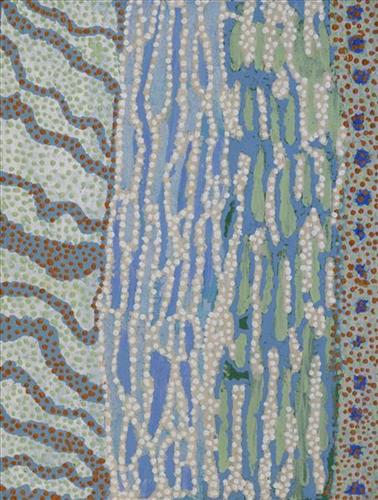
Mangala Country

“My painting is a landscape of my father’s Country, Mangala Country. The running river (Jila) and all the dots are rocks and green grass. Blue one Stream with the green grass and white rocks. I have been there a couple of years ago with our people, the Mangala. We went to go see the Country, and it cleared and opened my mind. I felt happy and sad at the same time. I felt the spirit around the Country.”

-Veronica Yanawana

Mangala Country lies at the top of the Great Sandy Desert of Western Australia. It is a vast landscape of red sand, spinifex, waterholes and salt lakes. This Country holds strong stories, and for Veronica, painting it is a way of keeping her connection alive and sharing her father’s Country with others.

377815582393312


Untitled

 This artwork showcases the artist’s skillful use of colour, texture, and technique, reflecting a deep connection to their environment and culture. Each detail embodies the unique identity of Bidyadanga Artists, where the original five language groups—Nyangumarta, Mangala, Yulparija, Juwaliny, and Karrajarri—come together to create art that speaks to the heart of Country. Over time, the community and Art Centre has grown to include people from other Kimberley tribes, fostering a space where diverse cultural knowledge and practices come together. Situated where the desert meets the sea, artists draw inspiration from their ancestral Country and personal journeys. The artist captures the vibrant beauty of both desert and coastal landscapes, blending earthy reds, deep blues, and intricate patterns distinctive to their cultural heritage. The themes and composition invite viewers into the artist’s world, offering a glimpse of the rich, intertwined histories and the enduring connection to land and spirit that define the Bidyadanga community.

377815582393310


Untitled

 This artwork showcases the artist’s skillful use of colour, texture, and technique, reflecting a deep connection to their environment and culture. Each detail embodies the unique identity of Bidyadanga Artists, where the original five language groups—Nyangumarta, Mangala, Yulparija, Juwaliny, and Karrajarri—come together to create art that speaks to the heart of Country. Over time, the community and Art Centre has grown to include people from other Kimberley tribes, fostering a space where diverse cultural knowledge and practices come together. Situated where the desert meets the sea, artists draw inspiration from their ancestral Country and personal journeys. The artist captures the vibrant beauty of both desert and coastal landscapes, blending earthy reds, deep blues, and intricate patterns distinctive to their cultural heritage. The themes and composition invite viewers into the artist’s world, offering a glimpse of the rich, intertwined histories and the enduring connection to land and spirit that define the Bidyadanga community.

377815582393309


Connecting to Country

Expressing yourself through your art. Because all you’ve got is expressing yourself through art and connecting to Country.

I was watching my sister paint, and she told me to paint. I thought, I don’t know how to paint or anything. Then I thought about my father, why he painted, and how he was thinking about his birthplace and Country.

The colours bloom too when you see them firsthand on Country. And when we go to Country, I see everything and try to remember it—all the colours, I take it in.

Now, when I paint, I’m thinking about my old people and how they walked down from the Walmajarri area towards the Western Desert.