222082414545


Fed Up

“This piece was created from a deep exhaustion – an exhaustion with being Aboriginal and with the complicated reality of being “white-passing”. There are moments when my indigeneity becomes public property, when I’m treated like a walking library: expected to educate, explain, argue, defend and perform knowledge on demand. Carrying that emotional load is heavy, and sometimes the urge to “turn it off” feels tempting to stay quiet, to lie, to rest. But that thought is quickly followed by guilt. The ability to rest from your identity, even momentarily, is a privilege and wanting it can feel selfish. It is also impossible to turn “it” off because, I “am”. Being light comes with another burden. It creates a false sense of safety for others, people reveal their racism freely, assuming I am not Indigenous. In those moments, you see the truth of how comfortable some people are with being cruel when they think no one is watching. The goanna in this piece represents my Wiradjuri totem. He is fat, overfed, sluggish and fed up, both literally and metaphorically. He carries the weight of being what he is, unable to change himself no matter how tired or gross he is made to feel inside. I painted him in a deliberately basic AI style, paired with the word “yuck,” because that was the honest reaction I felt while making this work. It’s also a response to the overuse of AI in Indigenous spaces, and the hollow repetition of phrases like “rich tapestry,” which flatten culture into something consumable. This piece sits in that discomfort resentment, guilt, fatigue and refuses to dress it up nicely.”

221382414683


Handwoven Bag

Fibre Art is an ancient Aboriginal women’s craft that is still made today using the same techniques as their ancestors. Making fibre art is labour intensive and much care and fine needlework is required to ensure the finished object is both functional and beautiful. Fibre art from Ghunmarn Culture Centre includes dilly bags, floor mats, bush fans, woven creatures found in the landscape, plants such as yams (bush potato), baskets, place mats, and spirit figures such as mermaids and Mukuys. Natural pandanus fibre (Mukarra), is used to make much of the fibre art produced by the artists of Djilpin Arts. Women collect the pandanus by pulling from the top of the pandanus tree, then stripping and drying the leaves before they are dyed with natural bush colour collected from the Beswick surrounds.

221382414680


Handwoven Bag

Fibre Art is an ancient Aboriginal women’s craft that is still made today using the same techniques as their ancestors. Making fibre art is labour intensive and much care and fine needlework is required to ensure the finished object is both functional and beautiful. Fibre art from Ghunmarn Culture Centre includes dilly bags, floor mats, bush fans, woven creatures found in the landscape, plants such as yams (bush potato), baskets, place mats, and spirit figures such as mermaids and Mukuys. Natural pandanus fibre (Mukarra), is used to make much of the fibre art produced by the artists of Djilpin Arts. Women collect the pandanus by pulling from the top of the pandanus tree, then stripping and drying the leaves before they are dyed with natural bush colour collected from the Beswick surrounds.

221382414678


File snakes and water lillies

In this painting are three file snakes among the waterlillies. They are good bush tucker from the billabong.

115682414565


Djang’kawu sisters Creation Story featuring lizards

This painting is part of the Djang’kawu sisters Creation Story. The details of this story can vary according to clan and/or country, but the central story is the same, which is one of fertility and procreation.

The Djang’kawu sisters gave birth to all the Dhuwa Moeity clans giving them language, land, law/lore, ceremony, songs and dances. As they travelled westward from Yirrkala, they travelled through all the dhuwa lands naming all the plants and animals and showed people how to use them. At the Glyde River, they hung their sacred dilly bags on a tree whilst they hunted. Men came and took the dilly bags and learnt all the songs and dnaces. Now the men condiuct all the ceremonies. The sisters decided to accept this as they (women) always retain their power as the bearer of children.

This painting is part of this story, it is a saltwater story featuring water lizard and a drinking hole.

115682414547


Woven Mat

Yolŋu weavers of Arnhem Land create utilitarian, ceremonial, and decorative pieces using naturally sourced materials. This mat is made from young Pandanus spiralis leaves, harvested with a wooden hook, stripped of prickles, and dried to create strong, resilient fibres. These fibres are then twisted, coiled, or woven using traditional techniques to produce both functional and decorative mats.

Bula’bula weavers exclusively use natural dyes, derived from locally sourced roots, leaves and grasses. These pigments are extracted and infused into pandanus fibres by boiling over an open fire, producing the rich, vibrant colours characteristic of contemporary Yolŋu weavings.

Traditionally, Nganiyal (conical mats) functioned as insect screens when erected and as seating mats when folded, playing an important role in both daily life and ceremonial practices. Today, Yolŋu artists create a variety of shapes, including flat, round, and oblong mats. These non-traditional styles and the use of bright colours became more common after Missionaries began commissioning pieces in this style.

115682414544


Woven Mat

Yolŋu weavers of Arnhem Land create utilitarian, ceremonial, and decorative pieces using naturally sourced materials. This mat is made from young Pandanus spiralis leaves, harvested with a wooden hook, stripped of prickles, and dried to create strong, resilient fibres. These fibres are then twisted, coiled, or woven using traditional techniques to produce both functional and decorative mats.

Bula’bula weavers exclusively use natural dyes, derived from locally sourced roots, leaves and grasses. These pigments are extracted and infused into pandanus fibres by boiling over an open fire, producing the rich, vibrant colours characteristic of contemporary Yolŋu weavings.

Traditionally, Nganiyal (conical mats) functioned as insect screens when erected and as seating mats when folded, playing an important role in both daily life and ceremonial practices. Today, Yolŋu artists create a variety of shapes, including flat, round, and oblong mats. These non-traditional styles and the use of bright colours became more common after Missionaries began commissioning pieces in this style.

377810582414543


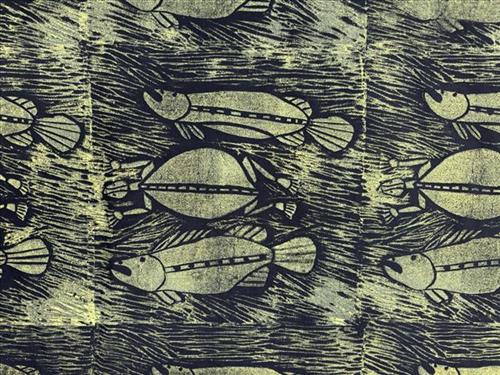
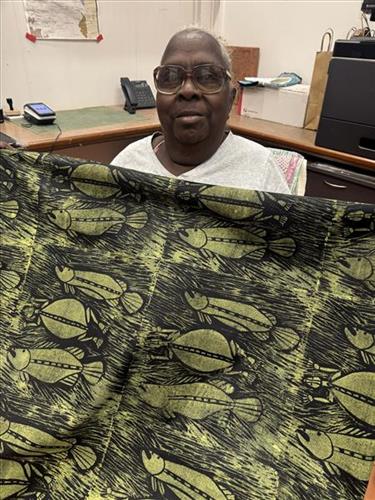
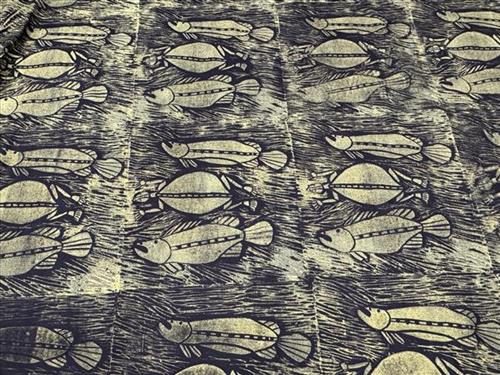
Short neck turtle and saratoga

A textured design featuring short neck turtle, saratoga and barramundi swimming together in a freshwater billabong.

Yellow ink on black cotton fabric. 

115682414541


Martjirr (bush bag)

Martjirr (bush bag) are primarily made from the bark of Baḻgurr (Red-flowered Kurrajong – Brachychiton megaphyllus) but sometimes Banyan tree (Ficus virens) and Cocky Apple tree (Planchonia careya). Sections of the tree are cut, and depending on the size, whole portions or part portions from the trunk. The inner bark is beaten or chewed to soften then dyed with natural bush dyes. Once softened and dyed, parts of the fibre are separated into fine strips and woven. The fibres can also be then rolled on the thigh to create a rope otherwise known as bush string. Martjirr (bush bag) were used for everyday utilitarian purposes, particularly collecting bush foods such as bäḻtji (yam).

115682414539


Martjirr (bush bag)

Martjirr (bush bag) are primarily made from the bark of Baḻgurr (Red-flowered Kurrajong – Brachychiton megaphyllus) but sometimes Banyan tree (Ficus virens) and Cocky Apple tree (Planchonia careya). Sections of the tree are cut, and depending on the size, whole portions or part portions from the trunk. The inner bark is beaten or chewed to soften then dyed with natural bush dyes. Once softened and dyed, parts of the fibre are separated into fine strips and woven. The fibres can also be then rolled on the thigh to create a rope otherwise known as bush string. Martjirr (bush bag) were used for everyday utilitarian purposes, particularly collecting bush foods such as bäḻtji (yam).