377816082414449


Secret Garden

nspired by The Secret Garden, this work reflects a hidden place of growth, colour, and quiet magic. The woven forms sit like blooming flowers, each holding its own story while contributing to a shared sense of wonder. It speaks to imagination, renewal, and the beauty found when care and creativity are given space to grow.

377810582414448


Murnun (dugong)

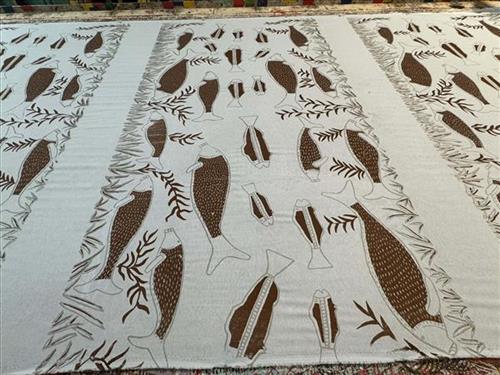
This design is murnun (dugong). Josephine grew up on the coastal area of Maningrida. She is a Kunibidji woman, a Gurgoni and Ndjébbana language speaker. 

‘In the olden times they used to go on canoe to look for murnun (dungong), fish (yokkara) ,turtle (makéddja) and stingray (marnan djupa (sp?)). They used a spear and net during the day and sometimes at night. The fishermen were mostly men. I remember my grandfather used to go hunting, that’s Joy’s (Garlbin)  father. HIs name was Jimmy. We used to go out with him on the boat to kill makéddja (turtle) and murnun (dugong) for yalaba (bush tucker). 


377816082414447


Weaving Community

This work reflects many communities coming together — different in identity, story, and experience, yet connected through shared space, relationships, and care for one another. Like the woven form itself, each part holds its own strength, while the whole is created through connection. The circular shape speaks to continuity, gathering, and the ongoing weaving of community across time.

377810582414446


Murnun (dugong)

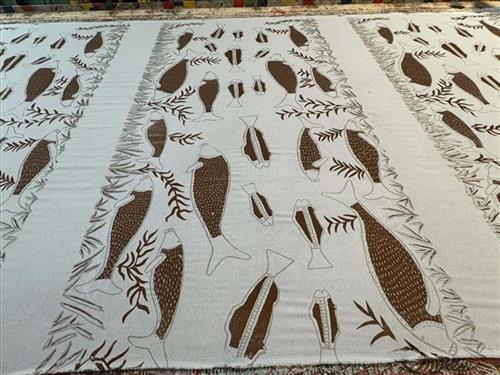
This design is murnun (dugong). Josephine grew up on the coastal area of Maningrida. She is a Kunibidji woman, a Gurgoni and Ndjébbana language speaker. 

‘In the olden times they used to go on canoe to look for murnun (dungong), fish (yokkara) ,turtle (makéddja) and stingray (marnan djupa (sp?)). They used a spear and net during the day and sometimes at night. The fishermen were mostly men. I remember my grandfather used to go hunting, that’s Joy’s (Garlbin)  father. HIs name was Jimmy. We used to go out with him on the boat to kill makéddja (turtle) and murnun (dugong) for yalaba (bush tucker). 


377810582414444


Murnun (dugong)

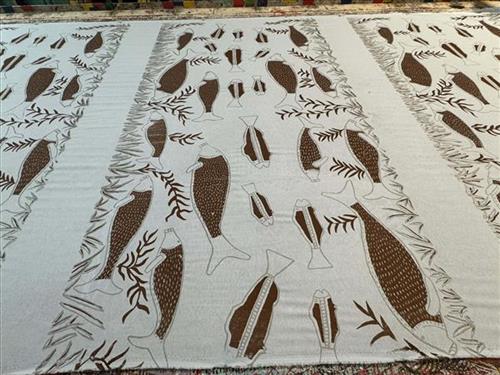
This design is murnun (dugong). Josephine grew up on the coastal area of Maningrida. She is a Kunibidji woman, a Gurgoni and Ndjébbana language speaker. 

‘In the olden times they used to go on canoe to look for murnun (dungong), fish (yokkara) ,turtle (makéddja) and stingray (marnan djupa (sp?)). They used a spear and net during the day and sometimes at night. The fishermen were mostly men. I remember my grandfather used to go hunting, that’s Joy’s (Garlbin)  father. HIs name was Jimmy. We used to go out with him on the boat to kill makéddja (turtle) and murnun (dugong) for yalaba (bush tucker). 


377810582414443


Murnun (dugong)

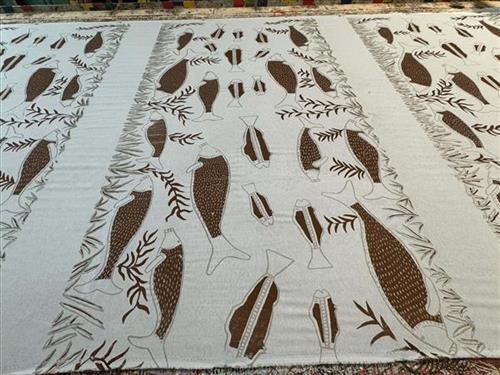
This design is murnun (dugong). Josephine grew up on the coastal area of Maningrida. She is a Kunibidji woman, a Gurgoni and Ndjébbana language speaker. 

‘In the olden times they used to go on canoe to look for murnun (dungong), fish (yokkara) ,turtle (makéddja) and stingray (marnan djupa (sp?)). They used a spear and net during the day and sometimes at night. The fishermen were mostly men. I remember my grandfather used to go hunting, that’s Joy’s (Garlbin)  father. HIs name was Jimmy. We used to go out with him on the boat to kill makéddja (turtle) and murnun (dugong) for yalaba (bush tucker). 


377810582414440


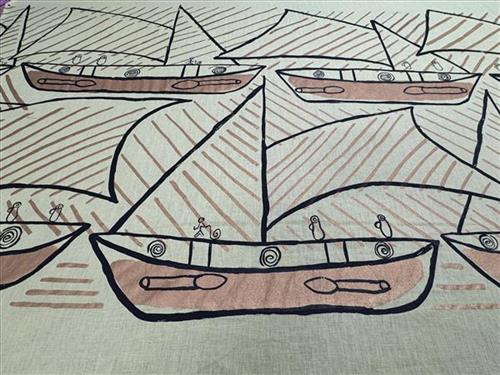
Makassan Boat with Bottles and Rope

“Wubbunj is our traditional canoe. This design is the old history story of how people came to live in this place we call Maningrida. Two old people were staying on the other side of the saltwater, in Narlarrambarr area. The old people slept in a paper bark shelter and hunted on the water using their canoe. A long time ago our people carved these canoes from the big paperbark trees. They had paddles with one person at the front, one at back, and other kids and passengers in the middle. Kunkot (paper bark) was used to make the sails which they would stand up and catch the wind.

One day these old people saw a new boat in their waters, which belonged to the Makassans (Indonesians). Those two old men saw the big Makassan boat coming in, and decided to paddle their canoe from Narlarrambarr to the other side (modern day Maningrida). We were scared of the Makassans, they gave us tobacco and tea, but they took many of our women.

In this design I have painted the Makassan’s rope, smoking pipe and the pottery vessels they bought with them on a boat. Our people had never seen these things before they bought them across from Indonesia.

When those two old people tasted that water at Maningrida from the Djomi spring, it was sweet freshwater and they decided to stay here. People here had no clothes in those time, we were just wearing string morkoi (loin cloths). Seven tribes were here then, but now in Maningrida there are lots more languages.” – Raylene Bonson

222082414561


Squirrel glider (Petaurus norfolcensis)

This big eyed little fellow is a nocternal gliding possum, Thought to be extinct in South Australia since 1939 until DNA tests showed they still inhabit the area. They live in woodland and forest region in parts of Victoria

222082414555


Emu (Kalthi)

My memory was when I was 13 years old attending my great grandmothers funeral. For the wake we had emu in a hole cooked the traditinal way. I remember loving it, rich dark meat with yellow fat. My nan talked about the best way to cook emu and how to know when to cook. My favourite memory is telling me about leaving the head out. When the steam comes out of the mouth it was cooked.

222082414553


Rakali (Hydromys Chrysogaster)

The less flattering name is water rat. This is our largest nature rodent. Walking around the shepparton lake at dusk, I saw 3 of these cute little fellows. They life in fresh and blackish water, eating fish, frogs, mussels, crustations and small branches. They are nocturnal.