114182417564


‘Kungkarrangkalpa’ (The Seven Sisters / Pleiades) – Angela Lyons

‘Kungkarrangkalpa’ (The Seven Sisters / Pleiades) is an important Tjukurrpa (Dreaming) across the Ngaanyatjarra Lands. Many families hold knowledge for different parts of this story, and each community paints its own chapter according to Country and ancestral responsibility.

Angela’s paintings focus on the celestial aspect of the story — the moment the sisters move from the earth into the sky. The star cluster becomes the seven bright forms she paints: six surrounding one, often arranged like a shield pattern. This reflects the way the sisters move together, protect each other, and travel as a tight group while fleeing Wati Nyiru, who appears in the sky as Orion’s Belt.

Nyiru follows the sisters across Country, disguising himself with magic — turning into kampurarrpa (bush tomato), a yirli (wild fig), or even a tree — trying to tempt them. But the sisters see through his tricks, outwit him, and keep running. When the chase becomes too much, they rise into the sky, forming the Pleiades. Nyiru follows them, always behind, never close enough.

Angela expresses this story using bold, high-contrast colours and strong circular forms. Her shield-like shapes represent the sisters’ strength and unity, while the central star often marks the eldest sister — the one the others protect along the journey. Through her palette and composition, Angela brings the energy, movement, and brightness of the sky-world into her canvas.

This painting is a contemporary interpretation of a cultural story carried across generations, connecting sky, Country, and ancestral memory.

116482417524


Ngarndu Ngurra (My Yindjibarndi Country)

My childhood is filled with memories of a beautiful place called the Pilbara. It is a land that has always offered so much to our people. Our ancestors walked this Country with strength and wisdom, reading the riverbeds, knowing where to gather food, when to fish, and where to rest beneath cool shade. They understood the rhythms of the seasons and trusted in the land. When the rains come, the Country transforms. Wildflowers in purple and pink, shoots push through red earth, and the landscape breathes. There are many hidden treasures; plants that are food and bush medicines that carried our people through sickness and hard times. Survival was knowledge and respect.Today, the Country still hold its beauty through every season. Even in drought, Country remains Country. It is everything to me. It continues to provide, to teach, and to sustain us. Mining companies have transformed parts of the landscape in the Pilbara from how we remember it, but these changes have not stopped us from living our culture. We still go out bush with our families. We fish, swim, and camp together. We continue to practise our traditions in our own ways.Our memories remain strong, including those of our ancestors who have passed on. We always carry them in our hearts. We teach the younger generation about the early days so they can continue the journey. We teach them about tribal group boundaries and the importance of knowing place, the stories in the hills and the rivers. We tell them about who belonged before us and what those places mean.These memories of Country are our identity, our strength, and our future.

377810582417567


Collecting Manme (Bush Food)

‘All that jungle around Mumeka, on the other side of the river.. that’s where we go looking for manme (bush food) like manyawok (cheeky yam) and karrbarda (long yam). The yawk yawk (young woman spirit) is holding a kunkaninj (digging stick), kun-madj (dilly bag) and all that manme.’ Jennifer Wurrkidj 2021

377810582417566


Collecting Manme (Bush Food)

‘All that jungle around Mumeka, on the other side of the river.. that’s where we go looking for manme (bush food) like manyawok (cheeky yam) and karrbarda (long yam). The yawk yawk (young woman spirit) is holding a kunkaninj (digging stick), kun-madj (dilly bag) and all that manme.’ Jennifer Wurrkidj 2021

377815582417543


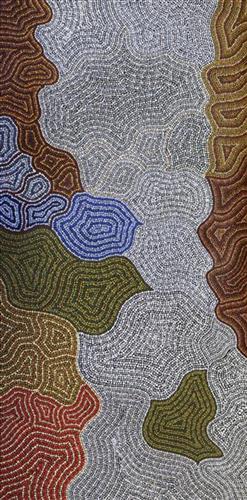
Nyangumarta Warrarn (Country)

“This painting represents the rocky outcrop and all the different areas of claypans, and the dark area represents all the jurnga (sands) in the cool time, warri. All the light yellowish colour represents the paru (spinifex).

I like to go out working with the rangers and all the elders. I go out Country with them and they show me all the places, all mapped out with GPS. We mark out all the other places for next time. Sometimes I go out in the ranger’s vehicle and walk around the Country and look around for goanna holes. We try to keep an eye on the animals, look out for all the bilby and skinks and everything with the Nyangumarta Rangers. I go in my spare time because I’m busy you know, I’m busy with my artwork and council meetings.

In the cool dry time, when it’s a little bit warm and cool in the morning, that’s when we do the fire patch burning. When we doing it also depends on the wind, the warngal, which way it’s blowing. We do that because it’s a big part of controlled fires. Wild fires, we don’t want them, they destroy the animals and their living area, destroy the Country. We do it too for the regrowth. When I went back to Country a couple of weeks ago, all the burned up area had a little bit of regrowth after a little bit of rain.”
 – Edward Badal

This artwork honours Nyangumarta Country — from the long sweep of Eighty Mile Beach and coastal flats to the rolling sand dunes and salt lakes of the Great Sandy Desert. It holds the movement between saltwater and desert: tides, reefs and mangroves to the west; dunes, claypans and waterholes to the east.

Lines flow like wind across spinifex and waves in the ocean; dots gather where waters sit after rain; colours shift from deep blues to desert reds and whites of saltpan. The painting also reflects the ongoing work of Nyangumarta families and rangers to look after Country — sea and land — guided by community plans and Indigenous Protected Area management.