377815582418472


Seasons

Tracey Thomas

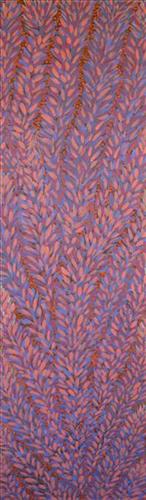
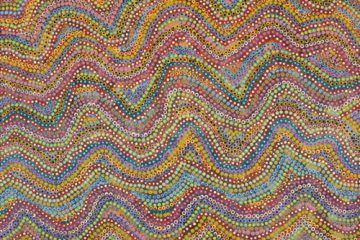
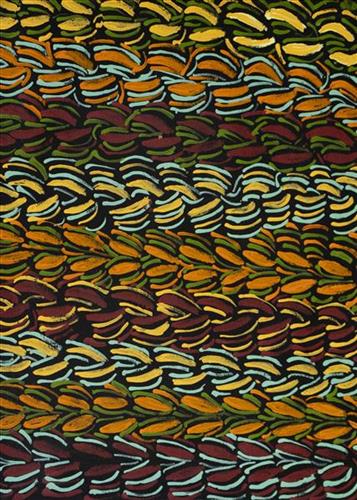
Seasons or Spinifex – Tracey Thomas

“Yellow is for the fruits when they’re ripe, and blue is for the water.
This time I’m going to do one for the hot time – like red and orangey colour for the burning.”

– Tracey Thomas

This artwork reflects the changing seasons across Country, showing how life shifts with the dry and wet. In Bidyadanga and the surrounding desert and coastal lands, the rhythm of the year guides movement, gathering, hunting, and time spent with family on Country.

As the dry season arrives, the land opens up again — red dunes, salt flats, and long beaches shining in the heat. Winds change, tides get bigger, and rangers burn Country to look after it, clearing grass, making space for new growth, and keeping the land healthy. Bush turkeys, goannas, fish, stingray, turtle, and shellfish are hunted, and families camp, share stories, and travel between desert and coast.

When the wet season return, big clouds roll in, storms build over the sea, and lightning cracks across the land. Country comes alive — water fills the waterholes and claypans, flowers and grasses grow, and birds, bush foods, and animals become abundant.

Through colour, pattern, and rhythm, the artist captures the cycle of seasons and the knowledge passed down — knowing when to gather certain foods, when animals are fat, when storms are coming, and how to care for Country through fire and everyday living. The work celebrates the constant relationship between people, weather, land, and sea, honouring the strength and continuity of cultural life.


Dimensions: 46 x 61cm
377815582418469


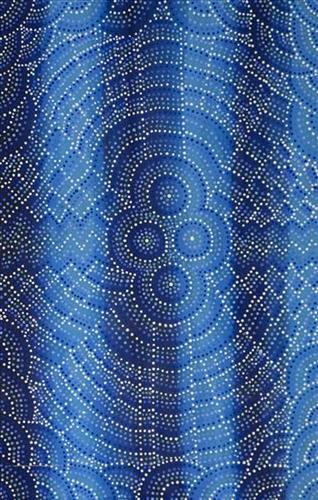
Mangala Country

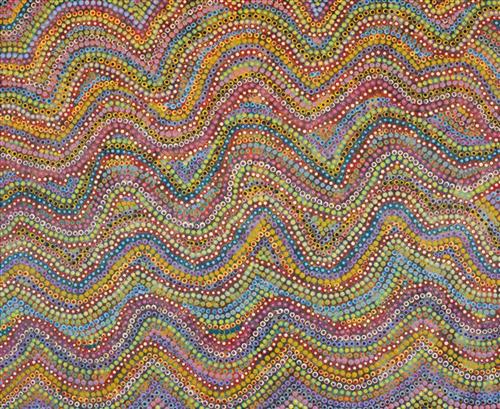
“I paint Mangala Country because my family are Mangala people, and they were the last bush people to come out from the bush. This place I paint is Mangala Country, where my mum and family drank water in these places. They camped around, hunting and gathering food around this Country — Matuku and Pikarangu. That’s what inspired me to paint Country, to see Country with my old people. That’s my story.”
 – Lindsay Bal Bal

This artwork honours Mangala Country and the families who carry its stories — walking, camping, hunting and gathering across desert edges, river systems and claypans. It remembers old people moving between soaks and sandhills, and later travelling to La Grange Mission (now Bidyadanga), keeping language, law and family strong.

Patterns trace tracks of animals and people; dots and lines follow water after rain; maps, camps, soaks and sandhills. The work also reflects the way caring for Country continues today — through ranger work and community leadership that bring together cultural knowledge and science to look after land and water.


Dimensions: 46 x 61cm
377815582418466


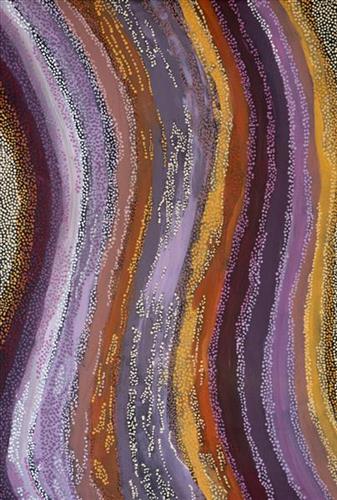
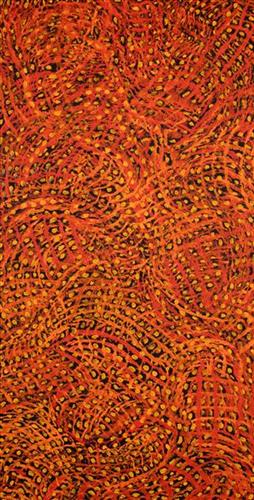
Seasons

“Rain, dry, hot, cold. In the wet season everything goes green. When we were young we would go hunting for goanna and turkey. You go fishing in the river — you can catch barramundi when the river is running from the rain. They call it Warrampa, in Looma side.

Dry season, Lulga season. Hot season. After the water has settled you can go swimming. Catch the same thing. And jarrumpa (cherabin, giant freshwater prawn).

The flowers come out after the rain, between the hot and cold.”
– Rose (Glenys) Butt

This artwork reflects the changing seasons across Country, showing how life shifts with the dry and wet. In Bidyadanga and the surrounding desert and coastal lands, the rhythm of the year guides movement, gathering, hunting, and time spent with family on Country.

As the dry season arrives, the land opens up again — red dunes, salt flats, and long beaches shining in the heat. Winds change, tides get bigger, and rangers burn Country to look after it, clearing grass, making space for new growth, and keeping the land healthy. Bush turkeys, goannas, fish, stingray, turtle, and shellfish are hunted, and families camp, share stories, and travel between desert and coast.

When the wet season return, big clouds roll in, storms build over the sea, and lightning cracks across the land. Country comes alive — water fills the waterholes and claypans, flowers and grasses grow, and birds, bush foods, and animals become abundant.

Through colour, pattern, and rhythm, the artist captures the cycle of seasons and the knowledge passed down — knowing when to gather certain foods, when animals are fat, when storms are coming, and how to care for Country through fire and everyday living. The work celebrates the constant relationship between people, weather, land, and sea, honouring the strength and continuity of cultural life.


Dimensions: 61 x 91cm

377815582418463


Wili (My Grandfather’s Country)

“This painting shows my Grandfather’s Country (Wili), where they used to walk around in circles searching for bush tucker and water from the waterholes. When our ancestors came out from the Canning Stock Route, they used to see big mob of sand dunes and flowers. This painting is about waterholes and the red desert sand. The different colours represent the wildflowers, the brown is the sand dunes and the circles are the waterholes.”
 – Bibianna Tumbler

This artwork depicts Country in and around the Great Sandy Desert — an immense area stretching from the edges of the Kimberley near Bidyadanga and Eighty Mile Beach, east through Walyarta (Mandora Marsh) and Percival Lakes, and down toward Kulyakartu, Kunawarritji (Well 33) and the Canning Stock Route. It is a vast landscape of dunes, claypans, salt lakes and waterholes.

For many families connected to Bidyadanga, this is ancestral land and holds places and significant sites where the old people lived pujiman (traditional desert-dwelling) lives before travelling to the coast.

The Great Sandy Desert is not empty — it is full of life, memory and movement. Soft sandhills rise and fall like waves, spinifex shimmers in the wind, flowers bloom after rain, and jila (living waterholes) lie hidden beneath the surface. People hunted goanna, bush turkey and small animals, dug for water, gathered bush foods, and camped beside claypans. Families walked long distances between soaks, teaching others how to read the land, follow tracks and travel safely.

In painting, the desert becomes a map of belonging — circles showing water and camps, lines following walking tracks and dunes, and soft patterns recalling plants, sand ridges and the glow of sunsets across wide skies. Colours shift between deep reds, ochres, warm sand tones and the greens that come after rain.


Dimensions: 61 x 91cm

377815582418459


Kulyakartu

“I paint about Kulyukartu. It’s my grandmother’s Country. I love painting about that Country. I went on a trip doing fire burning, cleaning the waterholes, and walking around looking where my grandmothers carved the rocks and things. I went with my mum Emily, and SJ (Nuriah Jadai). You turn before 80 Mile Beach and just go straight.

I feel good when I’m there — it feels like home when I paint it. I learnt to paint from my grandfather (Wokka Taylor, dec.). When we went to 33 (Kunawarritji, Well 33) and back to Punmu, we were just watching them. He told me to get a brush, and then he told me to start painting. I think him and Dunjan (Thelma Judson) were painting a big one, and I came to help him. He told me, ‘One day you should go to Kulyukartu,’ and so I went there.”
 – Kiarah Mandijalu-Jadai

This artwork shares the story of Kulyakartu, a vast and peaceful area north-east of the community, on the edge of Nyangumarta and Martu Country. Kulyakartu is a place of wide open skies, long claypans, sandhills and soft grasses that come alive after rain.

Families remember camping there, visiting waterholes, looking for goanna and bush foods, watching birds, and travelling with old people who knew every dune, track and soak. The painting celebrates the beauty and calm of Kulyakartu, often shown through soft lines and dots that follow the movement of water and sand. It honours the knowledge of where to find water, how to move across Country, and the deep belonging felt when returning to ancestral places.

Through this work, the artist invites viewers to feel that stillness and connection — the strength of Country, memory and family.


Dimensions: 61 x 91cm

377815582418457


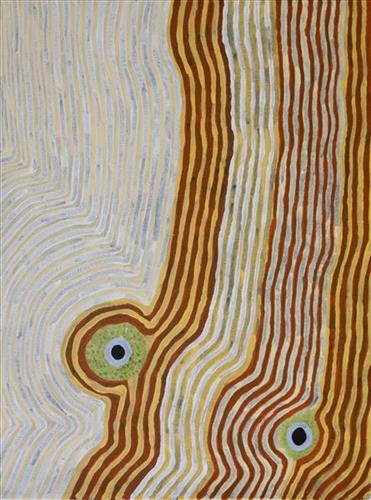
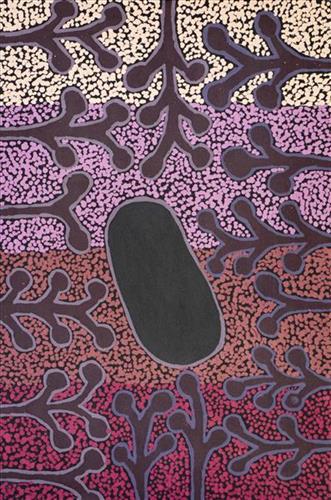
Bush Medicine

“This is a painting about bush medicine. It’s been boiled up. You boil it up and it turns into a burgundy sort of colour. Smells like eucalyptus. It is used for sores, rash, any skin condition. It’s a white gum tree.”
– Georgina Walbidi

This artwork honours the plants and practices of bush medicine — the healing Country provides, the old-people’s knowledge, and the living connection between land and body.

The artist reflects on the medicines found across Country: bark that soothes, leaves for infusions, roots dug after the rains, plants that grow in shade, and wood burnt down to ash for healing. These works often come from memories of learning and walking with elders — watching, smelling, collecting, and preparing medicine with care.

It reminds us that caring for Country is caring for ourselves. Gathering medicine is a cultural act — a moment of respect, listening, and moving gently on Country. This knowledge has been passed down across generations and must continue to be held, practised, and shared.

The painting invites the viewer into gratitude — for the plants, for the Country, for the knowledge keepers, and for the ongoing practice of looking after all life


Dimensions: 61 x 91cm

114182418668


Tjitji kutjarra – Two boys

This is the story of the two boys, though some say it was two brothers or a brother and sister, living around Mantamaru (Jameson). One day they saw the track of a big snake, they followed and eventually caught and ate. Unbeknownst, the brothers they had eaten a spirit or magical snake.

The next day the brothers felt unwell. Any task became hard and their walking slowed down. Gradually they became slower and slower until they reach the top of a hill where no longer able to move they turned to stone.  

Driving east from Jameson (on your left) you can see two lonely up-right rocks, one smaller than the other on the top of a hill which are called Tjitji (child) Kutjarra (two).


Dimensions: 56 x 76cm

116482419439


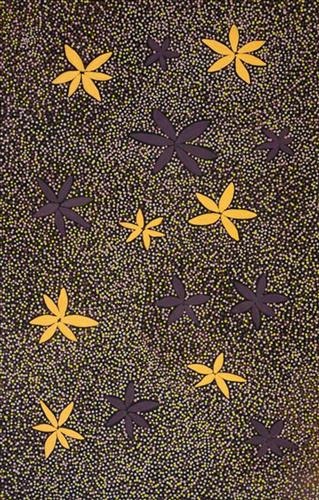
Mulla Mulla

The purple Mulla Mulla, called Gumbarli in Yindjibarndi. It’s a bright purple flower that grows all over our Country, lining the roads and spreading wide after the seasons change. I love seeing this strong colour across the land when it comes into bloom.

Dimensions: 29 x94cm

116482419423


Emu Seeds

In this painting I have depicted the pods of a shrub which is common in the Pilbara area. It is a smallish bush which comes into seed in September, when the Emu is visible in the Milky Way. This is the time the emu chicks hatch and it is one of their main sources of food. When the pod opens the parent emus feed the little black seeds to their chicks. The seed pod, which is about the size and the shape of a cockroach, turns from orange to yellow, so when all the bushes are in pod at different stages, there is a brilliant display of orange and yellow colours throughout the country. The official name of this annual shrub is Senna notabilis, but, due to the oblong, flat shape and the glossy golden brown colour of its pods, it is known commonly as Cockroach Bush. It has a little round fruit, a berry, that starts of green and turns red when it is ripe, but it’s poisonous. The shrub starts off as a light green colour and then, as it matures, it gets darker. The flowers are a yellowy orange and they, too, get darker with a bit of black as they are fading away.

Dimensions: 60 x 30cm