221382426793


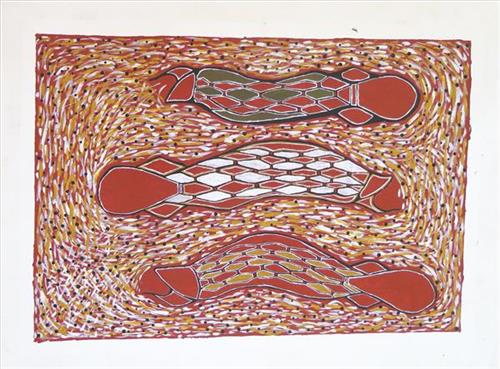
Three Barramundi

This painting depicts three barramundi swimming in freshwater. The ones at the top and the bottom are freshwater barramundi, and the one in the middle is from the saltwater.

Djilpin Arts is a not for profit Aboriginal Corporation that promotes the maintenance, development and transmission of traditional cultural knowledge systems.

For two decades, Djilpin Arts has been working on country with kin and culture, across generations. Our activities are rich in spirit, bringing, healing to the community and linking traditional knowledge with modern enterprise. Our Centre features galleries, museum collection and award winning accommodation for visitors.

Meet local people and artists, learn about traditional life and culture, browse and buy artworks, stay with us and experience seasonal cultural events, tours and immersions.

All artworks are made by local artists living in the community. Artwork reflects the traditional songs and stories that have been passed down through the generations with a contemporary edge: from paintings, prints, fibre art, carvings and dijeridu together to contemporary design prducts and fine woven wire jewellery.

221382426785


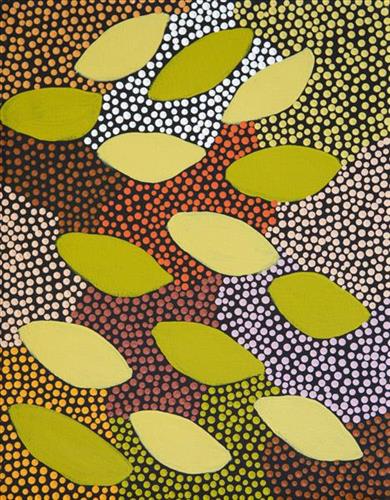
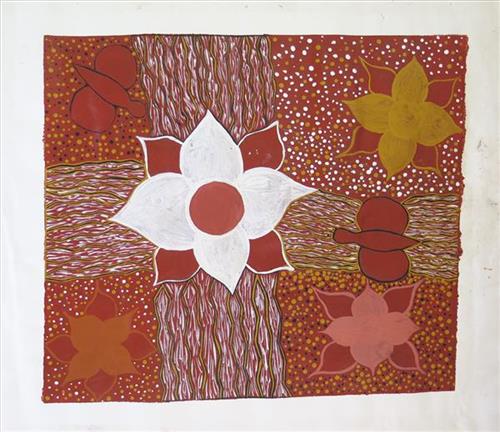
Butterlies

This painting depicts butterflies flying where the freshwater and springwater cross each other.

Djilpin Arts is a not for profit Aboriginal Corporation that promotes the maintenance, development and transmission of traditional cultural knowledge systems.

For two decades, Djilpin Arts has been working on country with kin and culture, across generations. Our activities are rich in spirit, bringing, healing to the community and linking traditional knowledge with modern enterprise. Our Centre features galleries, museum collection and award winning accommodation for visitors.

Meet local people and artists, learn about traditional life and culture, browse and buy artworks, stay with us and experience seasonal cultural events, tours and immersions.

All artworks are made by local artists living in the community. Artwork reflects the traditional songs and stories that have been passed down through the generations with a contemporary edge: from paintings, prints, fibre art, carvings and dijeridu together to contemporary design prducts and fine woven wire jewellery.

221382426782


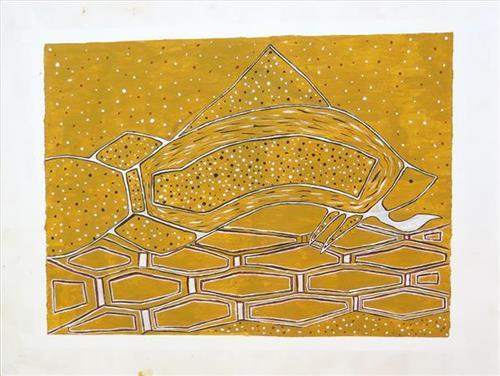
Black Bream on Flat Rock

This is a freshwater black and white bream on flat rock. We make the flat rock with stone.

Djilpin Arts is a not for profit Aboriginal Corporation that promotes the maintenance, development and transmission of traditional cultural knowledge systems.

For two decades, Djilpin Arts has been working on country with kin and culture, across generations. Our activities are rich in spirit, bringing, healing to the community and linking traditional knowledge with modern enterprise. Our Centre features galleries, museum collection and award winning accommodation for visitors.

Meet local people and artists, learn about traditional life and culture, browse and buy artworks, stay with us and experience seasonal cultural events, tours and immersions.

All artworks are made by local artists living in the community. Artwork reflects the traditional songs and stories that have been passed down through the generations with a contemporary edge: from paintings, prints, fibre art, carvings and dijeridu together to contemporary design prducts and fine woven wire jewellery.
221382426779


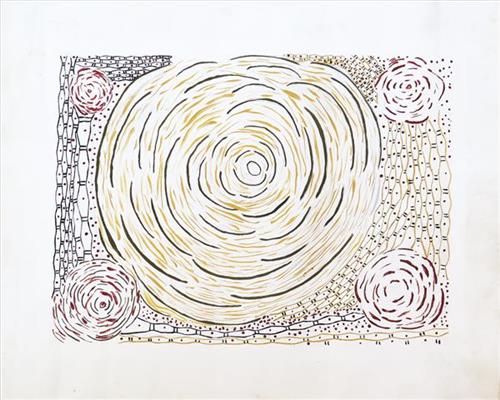
Whirlpool

This is the saltwater spinning around and around – like a cyclone. The red ones and red dots are all eyes. The lines are paddles travelling through tunnels around the whirlpool.

Djilpin Arts is a not for profit Aboriginal Corporation that promotes the maintenance, development and transmission of traditional cultural knowledge systems.

For two decades, Djilpin Arts has been working on country with kin and culture, across generations. Our activities are rich in spirit, bringing, healing to the community and linking traditional knowledge with modern enterprise. Our Centre features galleries, museum collection and award winning accommodation for visitors.

Meet local people and artists, learn about traditional life and culture, browse and buy artworks, stay with us and experience seasonal cultural events, tours and immersions.

All artworks are made by local artists living in the community. Artwork reflects the traditional songs and stories that have been passed down through the generations with a contemporary edge: from paintings, prints, fibre art, carvings and dijeridu together to contemporary design prducts and fine woven wire jewellery.

111582426933


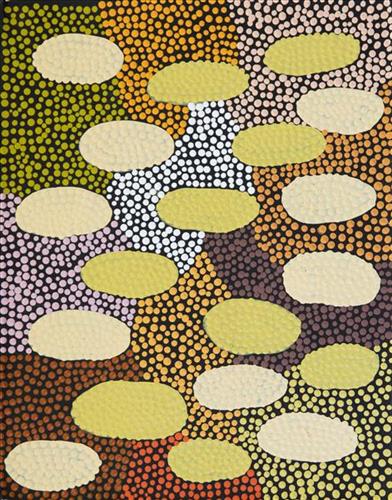
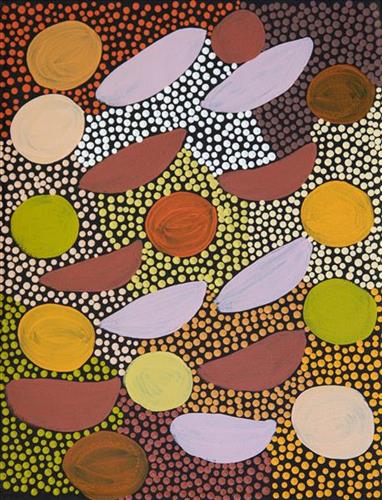
Bush banana

“It’s at the creek in Summer, Springtime. I remember going to the creek and you can eat it. Taste like yellow banana but a bit softer. At any river. I paint the bush banana because it’s nice and good to eat.”

– Raelene Sambo


Karlkula (bush banana, silky pear or native pear) is a vine found throughout the dry regions of Western Australia and Central Australia. From November to April, and following rains, the plant produces fruit. When young, the green fruit is eaten raw. Older fruits are cooked and the seeds eaten.

During the pujiman (traditional, desert dwelling) period, Martu would traverse very large distances annually in small family groups, moving seasonally from water source to water source, and hunting and gathering bush tucker as they went. Whilst desert life has moved away from mobile hunter-gatherer subsistence throughout the course of the twentieth century, bush tucker continues to be a significant component of the modern Martu diet. Hunting and gathering bush tucker remain equally valuable as an important cultural practice that is passed on intergenerationally.


111582426931


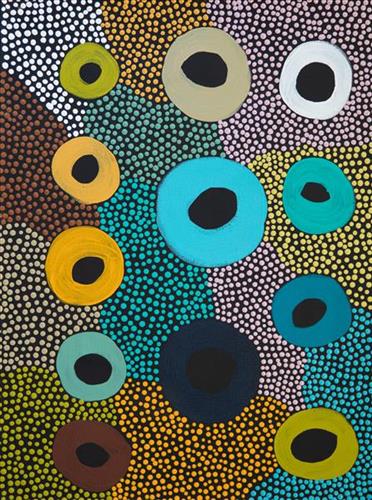
Waterhole

“Waterholes in redrock side. Other side of Mulyie [Station]. The river, when you go past that station (Mulgi Station). Close to Warralong. Go swimming and fishing there. From a long time ago. At school time. Sometimes we still go there.”


– Raelene Sambo


This work depicts a waterhole within Raylene’s ngurra (home Country, camp), typically represented with circular forms. Waterholes are sites that require maintenance, including digging to increase flow, clearing out surrounding growth, and cleaning up after sullying by camels or cattle.

During the pujiman (traditional, desert dwelling) period, knowledge of water sources was critical for survival, and today Martu Country is still defined in terms of the location and type of water. Each of the hundreds of claypans, rockholes, waterholes, soaks and springs found in the Martu desert homelands is known through real life experience and the recounting of Jukurrpa (Dreaming) narratives by name, location, quality and seasonal availability. This encyclopedic knowledge extends even to the nature and movement of arterial waterways, and sustained Martu as they travelled across their Country, hunting and gathering, visiting family, and fulfilling ceremonial obligations. They would traverse very large distances annually, visiting specific areas in the dry and wet season depending on the availability of water and the corresponding cycles of plant and animal life on which hunting and gathering bush tucker was reliant.

111582426930


Bush banana

“It’s at the creek in Summer, Springtime. I remember going to the creek and you can eat it. Taste like yellow banana but a bit softer. At any river. I paint the bush banana because it’s nice and good to eat.”

– Raelene Sambo


Karlkula (bush banana, silky pear or native pear) is a vine found throughout the dry regions of Western Australia and Central Australia. From November to April, and following rains, the plant produces fruit. When young, the green fruit is eaten raw. Older fruits are cooked and the seeds eaten.

During the pujiman (traditional, desert dwelling) period, Martu would traverse very large distances annually in small family groups, moving seasonally from water source to water source, and hunting and gathering bush tucker as they went. Whilst desert life has moved away from mobile hunter-gatherer subsistence throughout the course of the twentieth century, bush tucker continues to be a significant component of the modern Martu diet. Hunting and gathering bush tucker remain equally valuable as an important cultural practice that is passed on intergenerationally.


111582426929


Bush banana

“It’s at the creek in Summer, Springtime. I remember going to the creek and you can eat it. Taste like yellow banana but a bit softer. At any river. I paint the bush banana because it’s nice and good to eat.”

– Raelene Sambo


Karlkula (bush banana, silky pear or native pear) is a vine found throughout the dry regions of Western Australia and Central Australia. From November to April, and following rains, the plant produces fruit. When young, the green fruit is eaten raw. Older fruits are cooked and the seeds eaten.

During the pujiman (traditional, desert dwelling) period, Martu would traverse very large distances annually in small family groups, moving seasonally from water source to water source, and hunting and gathering bush tucker as they went. Whilst desert life has moved away from mobile hunter-gatherer subsistence throughout the course of the twentieth century, bush tucker continues to be a significant component of the modern Martu diet. Hunting and gathering bush tucker remain equally valuable as an important cultural practice that is passed on intergenerationally.