111582426713


Basket

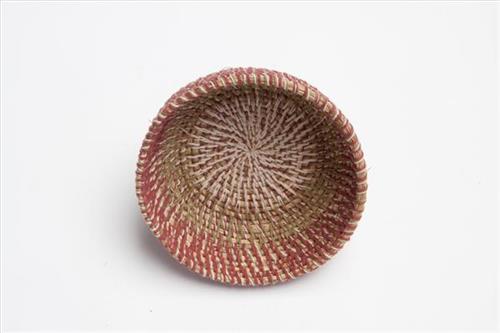
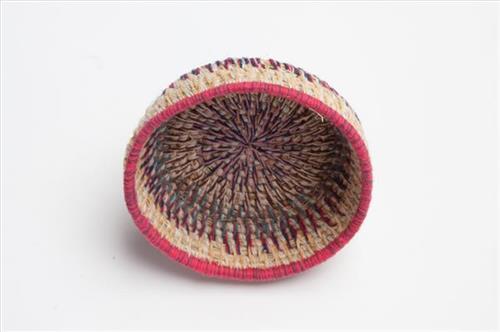
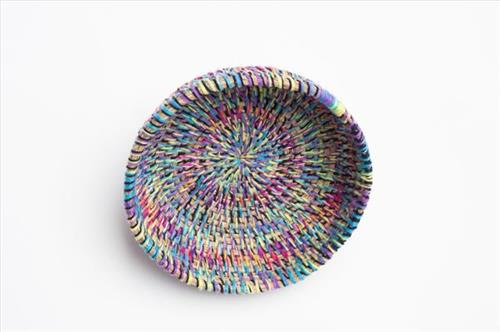
Weaving is a skill that has been practiced by Martu for thousands of years in the making of utilitarian and ceremonial items, such as yakapiri (bark sandals) and manguri (head pads for balancing carved carrying dishes). However, coiled basket weaving as an artform is a relatively newly adopted practice for the Martu, a skill passed on from Central Desert artists in the 1990’s. Leading Martu fibre arts practitioner Nola Taylor says that basket weaving was so popular amongst Martu women that it “spread across the desert like a waru (fire)”.

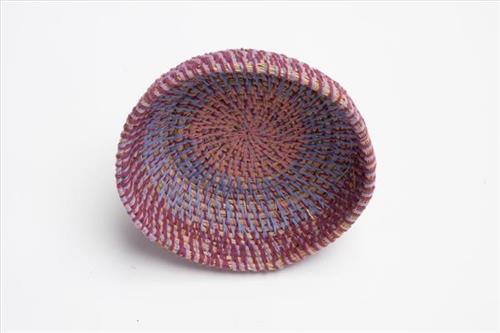
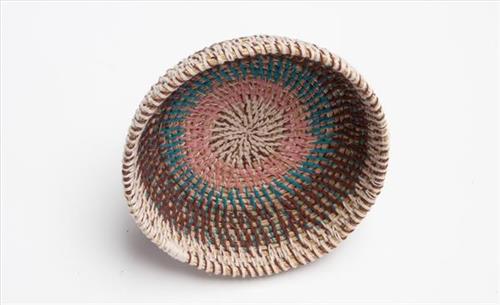
Each basket is built up through wrapping fine bundles of grass in brightly coloured wool and then stitching each round on to the previous one. The baskets are primarily made from puntayarra and minarri (Amphipogon Caricinus) grass, usually collected incidentally during trips to visit family, attend ceremonies, maintain Country, and hunt and gather bush tucker. Martu artists have developed a distinctive style of basketry and individual artists continue to develop new designs and incorporate novel materials, including steel, wire and wood, into their work. 

111582426712


Basket

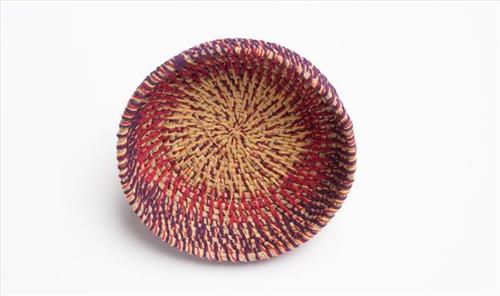
Weaving is a skill that has been practiced by Martu for thousands of years in the making of utilitarian and ceremonial items, such as yakapiri (bark sandals) and manguri (head pads for balancing carved carrying dishes). However, coiled basket weaving as an artform is a relatively newly adopted practice for the Martu, a skill passed on from Central Desert artists in the 1990’s. Leading Martu fibre arts practitioner Nola Taylor says that basket weaving was so popular amongst Martu women that it “spread across the desert like a waru (fire)”.

Each basket is built up through wrapping fine bundles of grass in brightly coloured wool and then stitching each round on to the previous one. The baskets are primarily made from puntayarra and minarri (Amphipogon Caricinus) grass, usually collected incidentally during trips to visit family, attend ceremonies, maintain Country, and hunt and gather bush tucker. Martu artists have developed a distinctive style of basketry and individual artists continue to develop new designs and incorporate novel materials, including steel, wire and wood, into their work. 

111582426708


Basket

Weaving is a skill that has been practiced by Martu for thousands of years in the making of utilitarian and ceremonial items, such as yakapiri (bark sandals) and manguri (head pads for balancing carved carrying dishes). However, coiled basket weaving as an artform is a relatively newly adopted practice for the Martu, a skill passed on from Central Desert artists in the 1990’s. Leading Martu fibre arts practitioner Nola Taylor says that basket weaving was so popular amongst Martu women that it “spread across the desert like a waru (fire)”.

Each basket is built up through wrapping fine bundles of grass in brightly coloured wool and then stitching each round on to the previous one. The baskets are primarily made from puntayarra and minarri (Amphipogon Caricinus) grass, usually collected incidentally during trips to visit family, attend ceremonies, maintain Country, and hunt and gather bush tucker. Martu artists have developed a distinctive style of basketry and individual artists continue to develop new designs and incorporate novel materials, including steel, wire and wood, into their work. 

111582426707


Basket

Weaving is a skill that has been practiced by Martu for thousands of years in the making of utilitarian and ceremonial items, such as yakapiri (bark sandals) and manguri (head pads for balancing carved carrying dishes). However, coiled basket weaving as an artform is a relatively newly adopted practice for the Martu, a skill passed on from Central Desert artists in the 1990’s. Leading Martu fibre arts practitioner Nola Taylor says that basket weaving was so popular amongst Martu women that it “spread across the desert like a waru (fire)”.

Each basket is built up through wrapping fine bundles of grass in brightly coloured wool and then stitching each round on to the previous one. The baskets are primarily made from puntayarra and minarri (Amphipogon Caricinus) grass, usually collected incidentally during trips to visit family, attend ceremonies, maintain Country, and hunt and gather bush tucker. Martu artists have developed a distinctive style of basketry and individual artists continue to develop new designs and incorporate novel materials, including steel, wire and wood, into their work. 

111582426706


Basket

Weaving is a skill that has been practiced by Martu for thousands of years in the making of utilitarian and ceremonial items, such as yakapiri (bark sandals) and manguri (head pads for balancing carved carrying dishes). However, coiled basket weaving as an artform is a relatively newly adopted practice for the Martu, a skill passed on from Central Desert artists in the 1990’s. Leading Martu fibre arts practitioner Nola Taylor says that basket weaving was so popular amongst Martu women that it “spread across the desert like a waru (fire)”.

Each basket is built up through wrapping fine bundles of grass in brightly coloured wool and then stitching each round on to the previous one. The baskets are primarily made from puntayarra and minarri (Amphipogon Caricinus) grass, usually collected incidentally during trips to visit family, attend ceremonies, maintain Country, and hunt and gather bush tucker. Martu artists have developed a distinctive style of basketry and individual artists continue to develop new designs and incorporate novel materials, including steel, wire and wood, into their work. 

111582426705


Basket

Weaving is a skill that has been practiced by Martu for thousands of years in the making of utilitarian and ceremonial items, such as yakapiri (bark sandals) and manguri (head pads for balancing carved carrying dishes). However, coiled basket weaving as an artform is a relatively newly adopted practice for the Martu, a skill passed on from Central Desert artists in the 1990’s. Leading Martu fibre arts practitioner Nola Taylor says that basket weaving was so popular amongst Martu women that it “spread across the desert like a waru (fire)”.

Each basket is built up through wrapping fine bundles of grass in brightly coloured wool and then stitching each round on to the previous one. The baskets are primarily made from puntayarra and minarri (Amphipogon Caricinus) grass, usually collected incidentally during trips to visit family, attend ceremonies, maintain Country, and hunt and gather bush tucker. Martu artists have developed a distinctive style of basketry and individual artists continue to develop new designs and incorporate novel materials, including steel, wire and wood, into their work. 

111982426696


Mun-dirra (fish fence)

Mun-dirra, in Burarra language, means “fish fence”. Mun-dirra were traditionally made by men using coastal sedge grass called gurdagarra and were designed to fence in schools of fish in ocean shallows or riverbeds. They were used in conjunction with conical traps, called an-gujechiya, which are woven with mirlarl, a hardy jungle vine, and burdaga, the sinewy inner bark from Kurrajong trees. 

Fish traps and fish fences have been used throughout west and central Arnhem Land by various language groups; in Kuninjku, people call them kunkarlewabe (fish fence) and mandjabu (fish trap).

Artist Doreen Jinggarrabarra explains, “In the old days, they didn’t have any casting nets, [so] they made a fish trap and a long fence net, [put] them side to side, and put the fish trap in the middle. Then the fish came and went in the fish trap.”

To make a fish trap (an-gujechiya), jungle vine (mirlarl) is soaked in water for one night to make it soft. Then, the structural form of the fishtrap would be worked on, with hibiscus (bardainy) rings fashioned inside to keep the fish trap’s shape. Kurrajong string (burdaga) would be made to attach the inner rings and to tie the conical end of the fish trap closed. This fish trap is used in both saltwater and freshwater.

 The fish fences (mun-dirra) would be set up across rivers and creeks, with the fish trap (an-gujechiya) placed in the middle of the two fences. Sticks, rocks, mud and grass would be used to hold the fences in position and funnel the fish into the trap. This ingenious system could catch fish like saltwater barramundi (rajarra), freshwater barramundi (janambal), small black freshwater catfish (buliya), bonefish (an-guwirrpiya), and sand bass (dalakan).

Doreen remembers seeing the traps in riverbeds around Maningrida when she was young: “The older ladies and the older men [would] usually go down, say about seven or eight o’clock, to go and check the trap. Maybe seven fish can go in, crabs and catfish,” she recalls.

Today, people generally use fishing lines and casting nets for fishing, but the woven traps and fences continue to be made as works of art. Women are now considered the knowledge holders, and are leaders in the development of sophisticated examples of woven design and material culture.

 *Maningrida Arts & Culture acknowledges the work of many academic and non-academic voices when writing on this topic. It is important to note Anna Freeland and Myles Russell-Cook, whose writing have informed this text.
111982426693


Bawáliba

‘Bawáliba is the djang (Dreaming) of my mother and my uncles. They are good spirits, they protect us and they recognise families. They are really tall – just like human beings, like us. They dance late at night and have a lot of hair.

In olden times, long long long time ago Bawáliba were here, before people were on the land. Bawáliba used to go out hunting and care for country. They hunt carrying fish traps and digging sticks, near the homeland Djinkarr. They go out hunting on the floodplains with dilly bags and digging sticks. They collect a lot of bush foods, and sleep together with one bark shelter.


Sometimes now they still come alive when we sleep, they might come to our houses and peep through the window. At night, they cover themselves with white clay and red cloth tied around their waist. If we hear them, we jump out of bed and get up to look -but they have disappeared, they’re just too quick. Bawáliba might knock on the window to remind us they are there looking out for us.If you listen deeply you can hear them whisper, sometimes they talk about us and might say, ‘why are those people making camp here?’ then they realise ‘Oh they are family from here, it’s ok, they are just sleeping here for the night’.

During the day they always turn into stone and they sleep. We still know that green rock covered in moss near Djinkarr, that’s Bawáliba sleeping.
Some of my ancestors used to speak the same language as the Bawaliba, but all those old people are passed away now. It’s a little bit sad for us, because no one now can speak that Bawaliba language anymore.’ Lucy Yarawanga 2019

221382426821


WWI

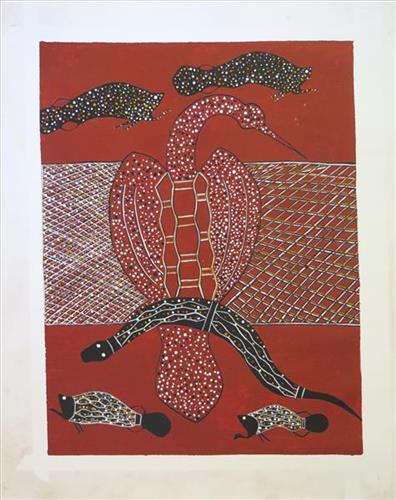
The mununga (white people) wanted to shoot the old man gnak gnak (duck). The old man went diving under the water to get away from the gunfire from the white people. Coming up from under the water were lots of bubbles. There were (borgone) bait fish swimming under water with the old man. The djaykuŋ (file snake) came to help the old man who held onto the snake and the snake pulled him away under the water. The old man gnak gnak then travelled to Numbulwar and Ngukurr.

Djilpin Arts is a not for profit Aboriginal Corporation that promotes the maintenance, development and transmission of traditional cultural knowledge systems.

For two decades, Djilpin Arts has been working on country with kin and culture, across generations. Our activities are rich in spirit, bringing, healing to the community and linking traditional knowledge with modern enterprise. Our Centre features galleries, museum collection and award winning accommodation for visitors.

Meet local people and artists, learn about traditional life and culture, browse and buy artworks, stay with us and experience seasonal cultural events, tours and immersions.

All artworks are made by local artists living in the community. Artwork reflects the traditional songs and stories that have been passed down through the generations with a contemporary edge: from paintings, prints, fibre art, carvings and dijeridu together to contemporary design prducts and fine woven wire jewellery.

221382426800


Djaykuŋ

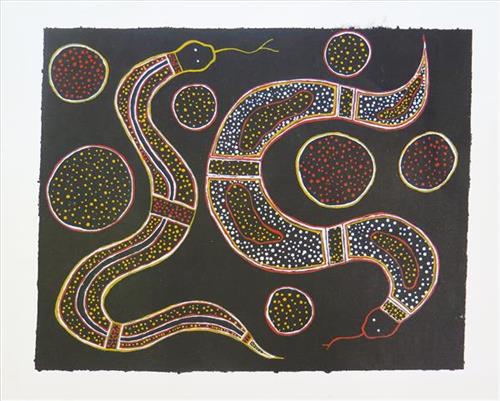
In this painting are two djaykuŋ (file snakes). The one on the left is male and the one on the right is female. Around the snakes are holes with freshwater coming up from underneath.

Djilpin Arts is a not for profit Aboriginal Corporation that promotes the maintenance, development and transmission of traditional cultural knowledge systems.

For two decades, Djilpin Arts has been working on country with kin and culture, across generations. Our activities are rich in spirit, bringing, healing to the community and linking traditional knowledge with modern enterprise. Our Centre features galleries, museum collection and award winning accommodation for visitors.

Meet local people and artists, learn about traditional life and culture, browse and buy artworks, stay with us and experience seasonal cultural events, tours and immersions.

All artworks are made by local artists living in the community. Artwork reflects the traditional songs and stories that have been passed down through the generations with a contemporary edge: from paintings, prints, fibre art, carvings and dijeridu together to contemporary design prducts and fine woven wire jewellery.