111982428914


Nawarlah – Brown River Stingray

We hunt the Nawarlah (Brown River Stingray) during the wet season.  There is a plant with a yellow flower that tells us that it is the right time.  We know it will be fat. 

It is well known that Aboriginal art often depicts images of sacred totems or dreamings of Aboriginal culture. However, the world of the non-sacred also provides a rich source of subject matter for Aboriginal art. Much of the rock art of western Arnhem Land for example features secular topics such as common food animals and plants, depicted because of their economic importance but also merely because of their existence in the environment.

111982428913


Nawarlah – Brown River Stingray

We hunt the Nawarlah (Brown River Stingray) during the wet season.  There is a plant with a yellow flower that tells us that it is the right time.  We know it will be fat. 

It is well known that Aboriginal art often depicts images of sacred totems or dreamings of Aboriginal culture. However, the world of the non-sacred also provides a rich source of subject matter for Aboriginal art. Much of the rock art of western Arnhem Land for example features secular topics such as common food animals and plants, depicted because of their economic importance but also merely because of their existence in the environment.

116482429196


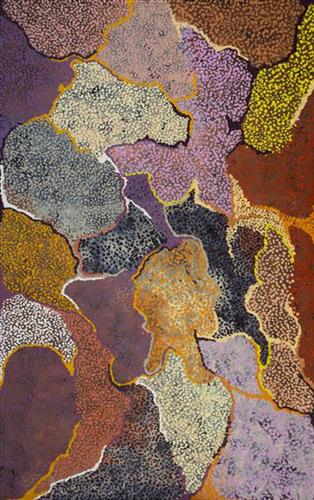
Seeds and Waterways (Dawn)

I am inspired by the colours in the rocks, the seeds on the ground, and the way water moves through the land. When I paint, I think about the flow of a waterway. Water is always moving, and I follow that movement in my lines and shapes. The forms in my work come from that flow, and my colours come from what I see in Country. I use strong, vivid colours because that is how I see Country in my mind and how i feel when i paint. There is a lot of new life when you find water on Country. It is where you find the beautiful colours and the flowers.  When i paint I feel connected to culture, the old people and memories. 

116482429192


Spiritual Serpents

When us Yindjibarndi people could no longer stay at our own Country we moved to Ngarluma Country then something was getting wild over us. The seaside Serpent. So we called on our fresh water snake. They fought a big battle in the sky until the Sea Snake was pushed back out to sea and we were allowed to stay here.

377815582429120


Nyangumarta Warrarn (Country)

“This painting represents the rocky outcrop and all the different areas of claypans, and the dark area represents all the jurnga (sands) in the cool time, warri. All the light yellowish colour represents the paru (spinifex).

I like to go out working with the rangers and all the elders. I go out Country with them and they show me all the places, all mapped out with GPS. We mark out all the other places for next time. Sometimes I go out in the ranger’s vehicle and walk around the Country and look around for goanna holes. We try to keep an eye on the animals, look out for all the bilby and skinks and everything with the Nyangumarta Rangers. I go in my spare time because I’m busy you know, I’m busy with my artwork and council meetings.

In the cool dry time, when it’s a little bit warm and cool in the morning, that’s when we do the fire patch burning. When we doing it also depends on the wind, the warngal, which way it’s blowing. We do that because it’s a big part of controlled fires. Wild fires, we don’t want them, they destroy the animals and their living area, destroy the Country. We do it too for the regrowth. When I went back to Country a couple of weeks ago, all the burned up area had a little bit of regrowth after a little bit of rain.”
 – Edward Badal

This artwork honours Nyangumarta Country — from the long sweep of Eighty Mile Beach and coastal flats to the rolling sand dunes and salt lakes of the Great Sandy Desert. It holds the movement between saltwater and desert: tides, reefs and mangroves to the west; dunes, claypans and waterholes to the east.

Lines flow like wind across spinifex and waves in the ocean; dots gather where waters sit after rain; colours shift from deep blues to desert reds and whites of saltpan. The painting also reflects the ongoing work of Nyangumarta families and rangers to look after Country — sea and land — guided by community plans and Indigenous Protected Area management.

377815582429119


Kulyakartu

“This painting is about all the rocks and kurru (creeks) all around Kulyakartu and Kirriwirri. We went camping there for two weeks, we went to Wirnpa first and then to Kirriwirri. We camped in the nice flat ground in the open when we got to Kulyakartu. We visited the waterholes and soaks, cleaned them out, and made sure there were no dead animals. It was typical ranger work — making sure the animals and Country were surviving. We listened to Muuki and my grandfather talk about how they walked around trying to find waterholes, how my grandfather finally came to Bidyadanga, and how he met my grandmother.

I painted these paintings at home in Bidyadanga, near the ocean. The paintings are of Kulyakartu, which is in the Great Sandy Desert. There is a lot of spinifex, sandhills, wildlife, and little flowers like frangipanis — blue, red, and pink flowers just along the road when you’re driving.

When I’m not in the desert, I feel like I want to paint about it, and painting makes me feel like I want to be there. I think about Muuki and his brothers’ wishes for us to see the Country and be there. It’s important to paint about the Country because our Elders looked after the Country long before us.

When you look out of a plane, you can see lots of different colours, but I chose blues and greens because that’s how I want to express how I see the landscape. When people see my paintings, they might say, ‘That could be the ocean,’ but I say, ‘No, that’s Kulyakartu, the desert.’ Blues and greens make me feel comfortable. For me, I like to keep colours separate and not mix them together.”
 – Chloe Jadai

This artwork shares the story of Kulyakartu, a vast and peaceful area north-east of the community, on the edge of Nyangumarta and Martu Country. Kulyakartu is a place of wide open skies, long claypans, sandhills and soft grasses that come alive after rain.

Families remember camping there, visiting waterholes, looking for goanna and bush foods, watching birds, and travelling with old people who knew every dune, track and soak. The painting celebrates the beauty and calm of Kulyakartu, often shown through soft lines and dots that follow the movement of water and sand. It honours the knowledge of where to find water, how to move across Country, and the deep belonging felt when returning to ancestral places.

Through this work, the artist invites viewers to feel that stillness and connection — the strength of Country, memory and family.

220982349941


Elizabeth Ngwarraye Bonney – My Grandmothers Country

I still hunt my Grand Mothers country for goanna, bush medicine and yams.

I hunt all year round, hunting and walking through the country makes me happy.  When I look at the distant hills I can feel my grandmother.  Bush flowers are everywhere.

Painting and printing my grandmother’s country reminds about those times.


Dimensions: 30 x 30 cm Lino Print – Charcoal S/H 300gsm

220982349940


Elizabeth Ngwarraye Bonney – My Grandmothers Country

I still hunt my Grand Mothers country for goanna, bush medicine and yams.

I hunt all year round, hunting and walking through the country makes me happy.  When I look at the distant hills I can feel my grandmother.  Bush flowers are everywhere.

Painting and printing my grandmother’s country reminds about those times.


Dimensions: 30 x 30 cm Lino Print – Charcoal S/H 300gsm

220982349939


Elizabeth Ngwarraye Bonney – My Grandmothers Country

I still hunt my Grand Mothers country for goanna, bush medicine and yams.

I hunt all year round, hunting and walking through the country makes me happy.  When I look at the distant hills I can feel my grandmother.  Bush flowers are everywhere.

Painting and printing my grandmother’s country reminds about those times.


Dimensions: 30 x 30 cm Lino Print – Charcoal S/H 300gsm

111982395287


Mimih Spirit

The mimih spirit exists in a realm that runs parallel to and mirrors many facets of human life, demonstrating the deep sense of time and place understood by Aboriginal and Torres Strait Islander people. Such spirits feature importantly in relation to Aboriginal spirituality, cosmology, social and moral tales as well as ritual. As is true with the multiple mediums employed by artists of West Arnhem Land, the development of artistic style and form is in line with an awareness by the artist that the work produced is predominantly made for a broader audience. Whether shown in a national or international context these works communicate and exist in a particular space that is cross-cultural and simultaneously particular to the Arnhem region.

The mimih sits within a complex pedagogical and religious body of knowledge which links Kuninjku people to their distinctive escarpment homelands. Young Kuninjku artists, or apprentices, employ the mimih as an important exercise for the practice of the rarrk technique, as it could be achieved on a smaller surface area before being attempted in larger scale on pieces of bark. The mimih serves a purpose for those young artists first learning to carve in a social space of sharing and innovating. The initial mimih manifestation was a large form that almost mirrored the anatomy of a human and at this stage the sculptures have been likened to mokuy carvings visible in eastern Arnhem Land. Contemporaneously, mimih are depicted in a refined, slender, even emaciated form with a broad range of facial expressions giving both individual character to, and denoting the potential volatility and humour that mimih spirits are notable for in their interaction with bininj (humans). The sculptures are frequently carved from the thin trunks of softwoods such as kapok (bombax ceiba or cottonwood) kurrajong, beach hibiscus or leichardt and are painted with earth pigments for their colouring and design.

A leading figure engaging the spirit in visual storytelling was Crusoe Kuningbal, a Kuninjku man, who while traveling was familiarised with carving styles from the east of Arnhem at the mission in Milingimbi pre-dating World War II. The connection and development of art forms informed by cross cultural dialogues within northern Aboriginal language groups is notable. The mimih became a valued inclusion in performance and public ceremony by Kuninjku people like Kuningbal. At times these ceremonies were performed for extended language groups in the local region. 

Now a familiar and broadly depicted figure of iconography, it is important to acknowledge the development of this quite recent sculptural tradition. The depiction of this particular spirit being, once used as an addition to the sharing of song cycles and ceremony, has since been elevated to a prominent form and subject of contemporary sculpture. Variation in the creation of mimih acts as an indication of the individualism of each artist and their stylistic markers. Additionally significant to note is that in the space of the past thirty years the mimih has begun being produced by multiple language groups residing in the Maningrida area including the traditional owners of Maningrida, the Ndjébbana, speaking Kunibidji as well as Gurrgoni people who have strong ties to Kuninjku. 

________
*Maningrida Arts & Culture acknowledge the work of many academic and non-academic voices when writing on this topic, it is important to note Luke Taylor, who’s broad research has informed this text.


Dimensions: 147.5 x 4 x 4cm