377810582273979


Manyawok (Cheeky Yam)

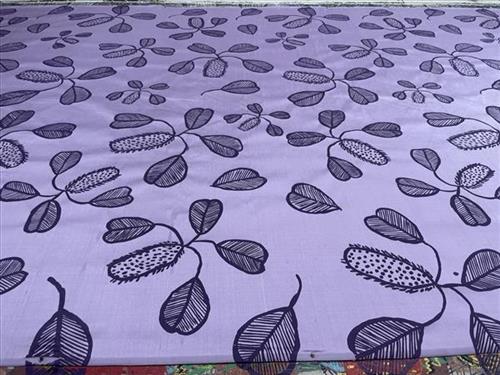
This design depicts the cheeky yam, which is found on the artist’s country, near the outstation of Mumeka in central Arnhem Land. Yams are an important bush food that are collected during the wet season.

Unlike other yams that can be eaten roasted, the cheeky yam can be poisonous if not properly prepared. The preparation process of the yam traditionally takes two days. Firstly, the yams are dug up with a digging stick and boiled over a fire. They are then peeled and sliced into thin strips, which are placed in a special dillybag woven by women from pandanus leaves. The yam-laden dillybag is then strung from an overhanging branch into a river, so the bag just touches the flowing fresh water. The cheeky yams are left like this overnight to allow the running water to remove the toxins. The next morning, people return and collect the dillybag, and leave the yam pieces in full sunlight to dry out. Finally, when the yam pieces have dried in the sun for a day, they are ready to eat.

377810582273035


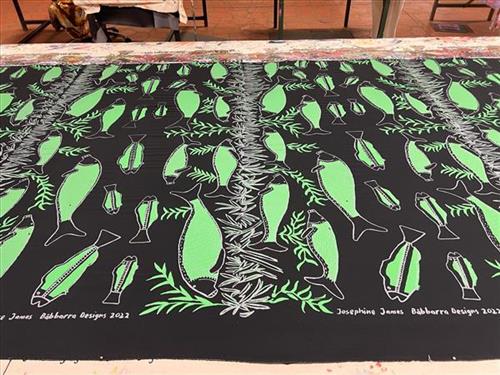
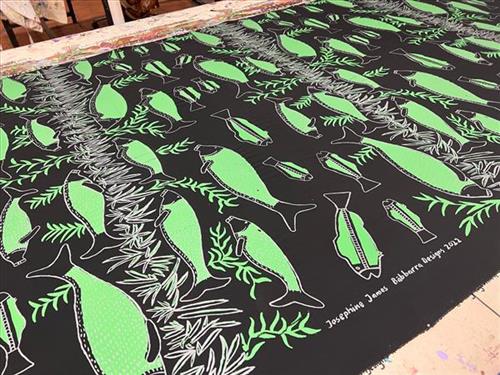
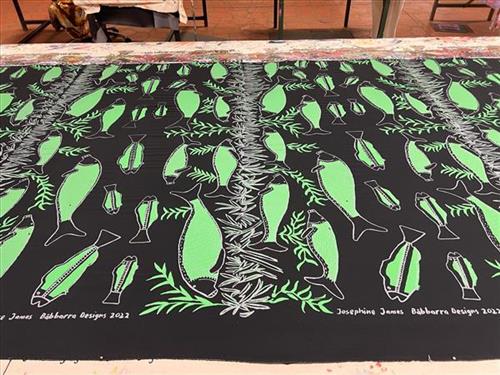
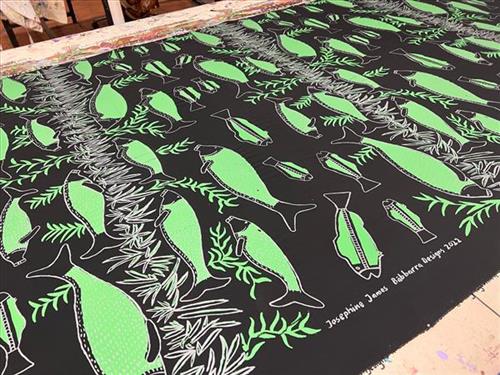
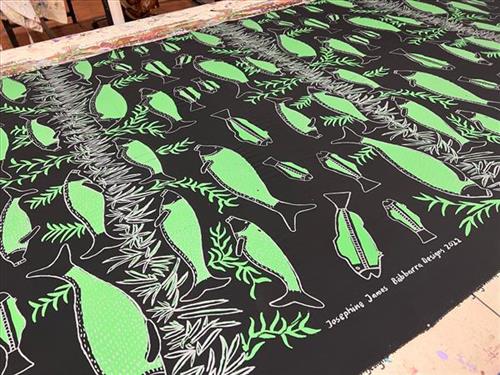
Mabbúlarr – Murnun

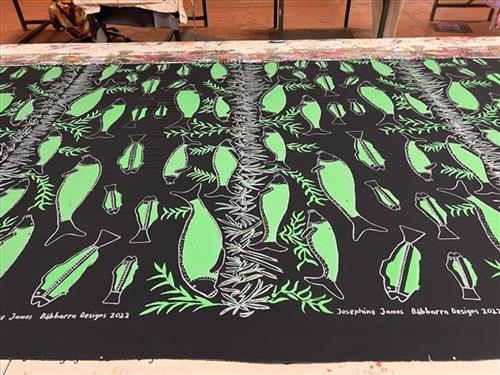
Featuring murnun (dugong) and yokkara (fish)

This new 2022 design by Josephine is part two of her Mabbúlarr collection. 

Mabbúlarr is the Ndjébbana word describing calm and stillness – both regarding people and the ocean.

Printed by hand at Injalak Art Centre 2022 using cotton poplin (sarong weight).

This design tells the story of underwater life in the shallows. The turtle we call marláddja (green turtle, Chelonia mydas) and the stingray we call marnandjúbba (Cowtail Stingray, Pastinachus sephen).

‘When strong wind blows the sea is rough, when there’s no wind the sea is calm. We call that mábbularr. You can see through the water and look at the turtle and stingray eating karlómerr (sea grass) and dancing underwater to find their mate. When we go on the boat hunting, we go at times of mábbularr.

In the old days men used to hunt with a canoe and with traditional made harpoon.  Guided by our ancestors’ spirits they would paddle all day to find sea turtle and dugongs in the right places. The men had to be smart for the tide and know the weather to balance their canoes. They would go at times of mábbularr (calm), early morning in daytime or at night-time when there is no moon and the water glows. We call the night-time glimmer of phosphorescence mílarrng-milarrng. Today people still go hunting, it brings a lot of families together and they share eating down the beach.

We have songline for sea turtle, also men paint turtle on their back and dance turtle in the Míddjarn the same way turtle dance underwater. It is very important we look after our country and songline passed on from many generations’. Josephine James 2021

377810582273034


Mabbúlarr – Murnun

Featuring murnun (dugong) and yokkara (fish)

This new 2022 design by Josephine is part two of her Mabbúlarr collection. 

Mabbúlarr is the Ndjébbana word describing calm and stillness – both regarding people and the ocean.

Printed by hand at Injalak Art Centre 2022 using cotton poplin (sarong weight).

This design tells the story of underwater life in the shallows. The turtle we call marláddja (green turtle, Chelonia mydas) and the stingray we call marnandjúbba (Cowtail Stingray, Pastinachus sephen).

‘When strong wind blows the sea is rough, when there’s no wind the sea is calm. We call that mábbularr. You can see through the water and look at the turtle and stingray eating karlómerr (sea grass) and dancing underwater to find their mate. When we go on the boat hunting, we go at times of mábbularr.

In the old days men used to hunt with a canoe and with traditional made harpoon.  Guided by our ancestors’ spirits they would paddle all day to find sea turtle and dugongs in the right places. The men had to be smart for the tide and know the weather to balance their canoes. They would go at times of mábbularr (calm), early morning in daytime or at night-time when there is no moon and the water glows. We call the night-time glimmer of phosphorescence mílarrng-milarrng. Today people still go hunting, it brings a lot of families together and they share eating down the beach.

We have songline for sea turtle, also men paint turtle on their back and dance turtle in the Míddjarn the same way turtle dance underwater. It is very important we look after our country and songline passed on from many generations’. Josephine James 2021

377810582273091


Lorrkon

Jennifer Wurrkidj

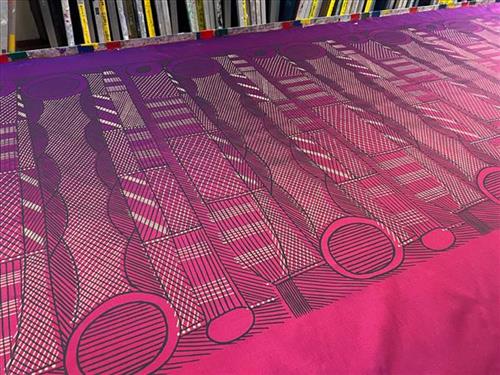
TITLE                         Lorrkon (Hollow funeral log)

YEAR                          2010

MEDIUM                     Screen print

DETAILS                    2 screen design, 1000 x 420mm

Before, a long time ago, when old people would die they would put their bones inside the lorrkkon and leave it outside. It is part of ceremony. The old people remembering and thinking about that person who passed away, there is lots of talking about where that lorrkkon needs to go.

My father, James Iyuna, taught me how to paint, to paint that rarrk. That memory is from him, he taught my sister Deborah and me. This story is from him, this design. When he was painting and drawing we would watch and we would learn.

Jennifer Wurrkidj

Jennifer is a Kuninjku artist from the Kurulk clan whose country lies around the outstation of Mumeka in central Arnhem Land. She has depicted lorrkkon (hollow-log coffin), kun-karninj (digging stick) and mandjabu (fishtrap) in this design.

The Lorrkkon or hollow-log coffin ceremony is the final ceremony in a sequence of mortuary rituals celebrated by the people of Arnhem Land. This ceremony might take place many years after the person has died, and involves the placing of the deceased’s bones into a hollow log that is decorated with painted clan designs and ceremonially placed into the ground where it slowly decays over many years.

The lorrkkon (hollow-log coffin) is made from the trunk of a termite-hollowed manbuluduk (stringybark tree, Eucalyptus tetradonta) and is decorated with totemic emblems. The western Arnhem Land version of the Lorrkkon ceremony involves the singing of sacred songs to the accompaniment of karlikarli, a pair of sacred boomerangs used as rhythm instruments. During the final evening of the ceremony, dancers decorate themselves with kapok down or, today, cotton wool, and conduct much of the final segments of the ceremony in the secrecy of a restricted men’s camp. The complete ceremony may stretch over a period of two weeks, but on the last night the bones of the deceased, which have been kept in a bark container, or today wrapped in cloth and kept in a suitcase, are taken out, and are painted with red ochre and placed inside the hollow-log coffin.

At first light on the final morning of the Lorrkkon ceremony, the men appear, coming out of their secret bush camp carrying the lorrkkon towards the women’s camp. The two groups call to each other using distinct ceremonial calls. The women have prepared a hole for the lorrkkon to be placed into, and when it is stood upright, women in particular kinship relationships to the deceased dance around the lorrkkon in a jumping/shuffling motion. It is then often covered with a tarpaulin and left to slowly decay.

377810582273050


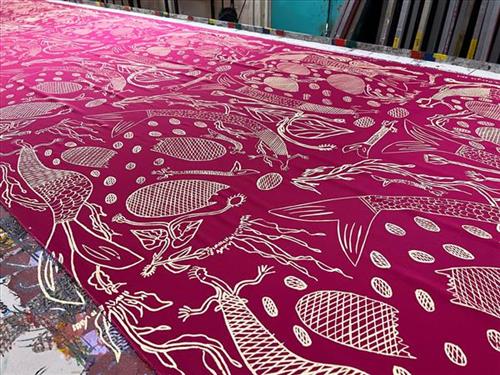
Djomi (Fresh Water Spirit)

This design depicts the story of the artist’s ancestral dreaming, the Djomi fresh water spirit mermaid.

The Djomi figure is a mermaid like spirit with fish tail that lives in the fresh water stream that flows out to the sea cliff near Maningrida. Djomi is a known to be a very powerful fertility symbol.

‘If you go there you can get pregnant easily. Djomi has babies, and they can give others babies too. The Djomi spirit is so powerful, that women can end up with multiple babies at once, twins or sometimes even more. The Djomi spirits lay eggs near the sacred freshwater stream in Maningrida. Inside the eggs are human babies as well as young Djomi.

Men do not go near that swamp, because Djomi is so powerful that men might get pregnant there too. So men, they are too scared of that Djomi. When we visit the Djomi freshwater spring, we can hear young Djomi crying. They sound like normal babies crying, those Djomi spirits. They are looking for a mother.

This Djomi is my dreaming, I got permission from my djunguys to paint this Djomi design. For me I always ask my djunguy permission to paint, because that is our cultural way.

This design also depicts the fresh water lily leaves, and seaweed from the base of the sea floor.

377810582273191


Mabbúlarr – Murnun

Featuring murnun (dugong) and yokkara (fish)

This new 2022 design by Josephine is part two of her Mabbúlarr collection. 

Mabbúlarr is the Ndjébbana word describing calm and stillness – both regarding people and the ocean.

Printed by hand at Injalak Art Centre 2022 using cotton poplin (sarong weight).

This design tells the story of underwater life in the shallows. The turtle we call marláddja (green turtle, Chelonia mydas) and the stingray we call marnandjúbba (Cowtail Stingray, Pastinachus sephen).

‘When strong wind blows the sea is rough, when there’s no wind the sea is calm. We call that mábbularr. You can see through the water and look at the turtle and stingray eating karlómerr (sea grass) and dancing underwater to find their mate. When we go on the boat hunting, we go at times of mábbularr.

In the old days men used to hunt with a canoe and with traditional made harpoon.  Guided by our ancestors’ spirits they would paddle all day to find sea turtle and dugongs in the right places. The men had to be smart for the tide and know the weather to balance their canoes. They would go at times of mábbularr (calm), early morning in daytime or at night-time when there is no moon and the water glows. We call the night-time glimmer of phosphorescence mílarrng-milarrng. Today people still go hunting, it brings a lot of families together and they share eating down the beach.

We have songline for sea turtle, also men paint turtle on their back and dance turtle in the Míddjarn the same way turtle dance underwater. It is very important we look after our country and songline passed on from many generations’. Josephine James 2021

377810582273189


Mabbúlarr – Murnun

Featuring murnun (dugong) and yokkara (fish)

This new 2022 design by Josephine is part two of her Mabbúlarr collection. 

Mabbúlarr is the Ndjébbana word describing calm and stillness – both regarding people and the ocean.

Printed by hand at Injalak Art Centre 2022 using cotton poplin (sarong weight).

This design tells the story of underwater life in the shallows. The turtle we call marláddja (green turtle, Chelonia mydas) and the stingray we call marnandjúbba (Cowtail Stingray, Pastinachus sephen).

‘When strong wind blows the sea is rough, when there’s no wind the sea is calm. We call that mábbularr. You can see through the water and look at the turtle and stingray eating karlómerr (sea grass) and dancing underwater to find their mate. When we go on the boat hunting, we go at times of mábbularr.

In the old days men used to hunt with a canoe and with traditional made harpoon.  Guided by our ancestors’ spirits they would paddle all day to find sea turtle and dugongs in the right places. The men had to be smart for the tide and know the weather to balance their canoes. They would go at times of mábbularr (calm), early morning in daytime or at night-time when there is no moon and the water glows. We call the night-time glimmer of phosphorescence mílarrng-milarrng. Today people still go hunting, it brings a lot of families together and they share eating down the beach.

We have songline for sea turtle, also men paint turtle on their back and dance turtle in the Míddjarn the same way turtle dance underwater. It is very important we look after our country and songline passed on from many generations’. Josephine James 2021

377810582273182


Gunga (Pandanus)

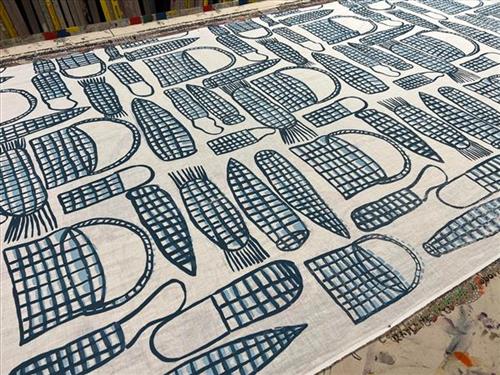
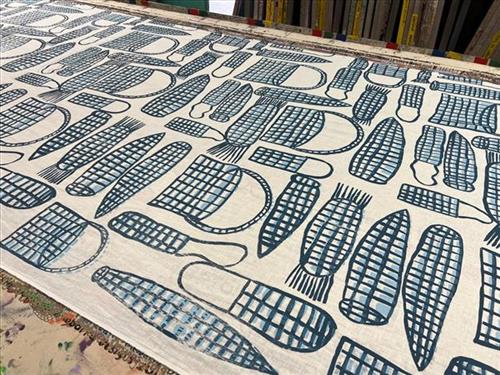
Gunga refers to the weaving and production of goods from pandanus leaves and natural fibres. This design depicts fibre art from her homeland Galiwinku, Elcho Island.

The fish trap, basket, string bag and pandanus mats are objects as well as ancestral spirits and are significant to the artists as together they relate to her djang (Aboriginal religious belief).

Fish traps are woven by hand using the milirl (Burney vine, Trophis scandens) from the jungle, which is soaked overnight to make it soft. Fish traps are used by both saltwater and freshwater hunters. Baskets and pandanus mats are made from pandanus leaves, which are collected using long hooks, stripped, dried, boiled in natural dye, then woven.

377810582273179


Gunga (Pandanus)

Gunga refers to the weaving and production of goods from pandanus leaves and natural fibres. This design depicts fibre art from her homeland Galiwinku, Elcho Island.

The fish trap, basket, string bag and pandanus mats are objects as well as ancestral spirits and are significant to the artists as together they relate to her djang (Aboriginal religious belief).

Fish traps are woven by hand using the milirl (Burney vine, Trophis scandens) from the jungle, which is soaked overnight to make it soft. Fish traps are used by both saltwater and freshwater hunters. Baskets and pandanus mats are made from pandanus leaves, which are collected using long hooks, stripped, dried, boiled in natural dye, then woven.

377810582273167


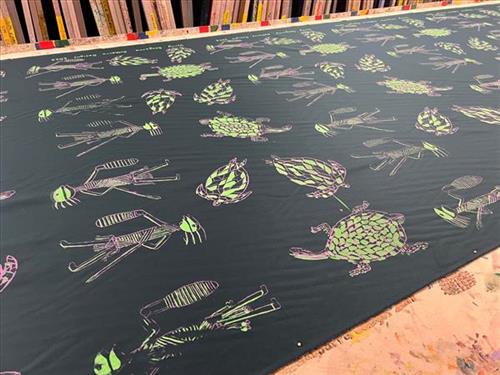
Makéddja (Turtle)

Makéddja is the generic word for turtle in the Ndjébbana language of the Kunibidji people of Maningrida.