377810582190575


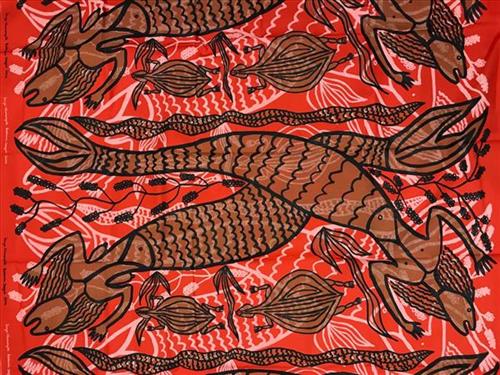
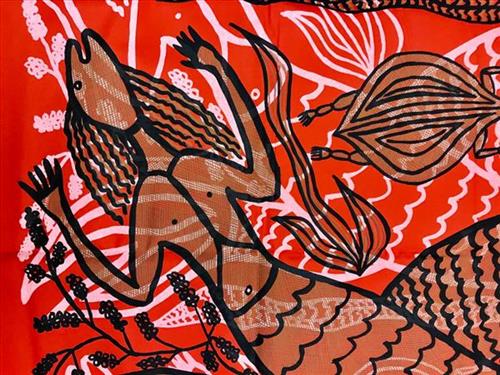
Yawkyawk (Young Woman Spirit)

Yawkyawk is a word from the Aboriginal Kuninjku language, meaning ‘young woman’ and ‘young woman spirit being’.

Sometimes compared to the European notion of mermaids, yawkyawks are usually depicted with the tails of fish. They have long hair, associated with trailing blooms of algae, typically found in Arnhem Land streams and rock pools.

377810582190595


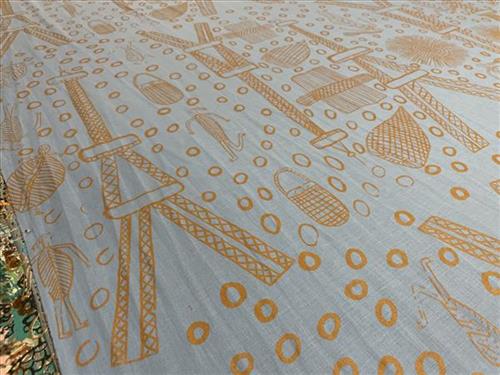
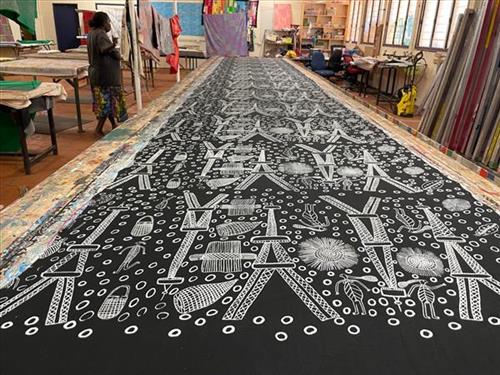
Eiffel tower and the Maladj spirit

“I want to tell you about my design, that Eiffel tower one.

This year it was my first time going to Paris. I didn’t know that place, nothing. We travelled around the world to get there, we flew underneath the world in an aeroplane.

Paris was a big, crowded city. They speak a different language there, just like here in Maningrida with all our different languages.

The Bábbarra artists and Ingrid, we were all walking around, like tourists. We went on the boat in the Paris river. There was a film crew taking videos of us. We saw so many beautiful buildings covered with black string (iron balconies) and big statues. We’d never seen things like that before.

I remember when we got off that boat and I looked up and saw that tower. When I first looked up at that tower, it made me happy- it’s so long up into the sky. We walked towards it. I was standing there watching that tower and thinking, ‘wow, first time for me seeing a tower like that’.

Then I was thinking, and I said to myself, when I go back to my own country, I’m going to paint that tower.

We came to Maningrida, I started to draw. I drew that tower from France, but also I drew maladj (stone country orphan spirit), women’s sacred woven mat, fish traps and rolk (insects). I also put round kunngol (clouds) in the design, those circles. That maladj spirit, it’s standing there next to the Eiffel tower, looking at the dancing lights at night. The tower is from Paris, but everything else in my design I took from my mother’s country and my father’s country.

Maybe one day I’ll travel back to France, and take my design with me to show them, all the French mob.” Janet Marawarr

377810582190569


Eiffel tower and the Maladj spirit

“I want to tell you about my design, that Eiffel tower one.

This year it was my first time going to Paris. I didn’t know that place, nothing. We travelled around the world to get there, we flew underneath the world in an aeroplane.

Paris was a big, crowded city. They speak a different language there, just like here in Maningrida with all our different languages.

The Bábbarra artists and Ingrid, we were all walking around, like tourists. We went on the boat in the Paris river. There was a film crew taking videos of us. We saw so many beautiful buildings covered with black string (iron balconies) and big statues. We’d never seen things like that before.

I remember when we got off that boat and I looked up and saw that tower. When I first looked up at that tower, it made me happy- it’s so long up into the sky. We walked towards it. I was standing there watching that tower and thinking, ‘wow, first time for me seeing a tower like that’.

Then I was thinking, and I said to myself, when I go back to my own country, I’m going to paint that tower.

We came to Maningrida, I started to draw. I drew that tower from France, but also I drew maladj (stone country orphan spirit), women’s sacred woven mat, fish traps and rolk (insects). I also put round kunngol (clouds) in the design, those circles. That maladj spirit, it’s standing there next to the Eiffel tower, looking at the dancing lights at night. The tower is from Paris, but everything else in my design I took from my mother’s country and my father’s country.

Maybe one day I’ll travel back to France, and take my design with me to show them, all the French mob.” Janet Marawarr
377810582189954


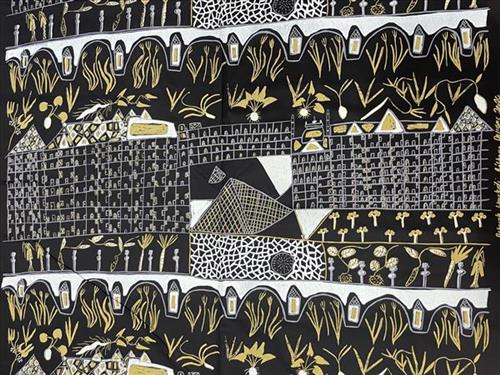
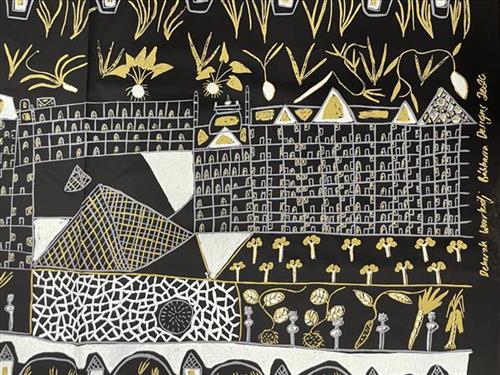
Kunred Kodbarre (The Louvre)

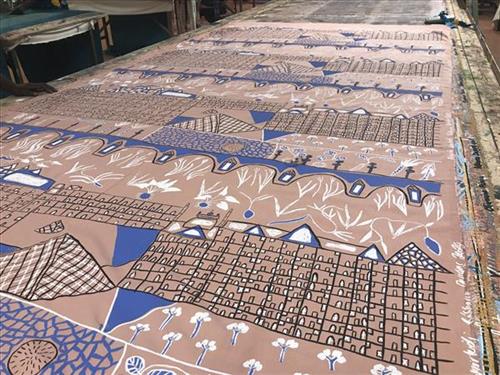
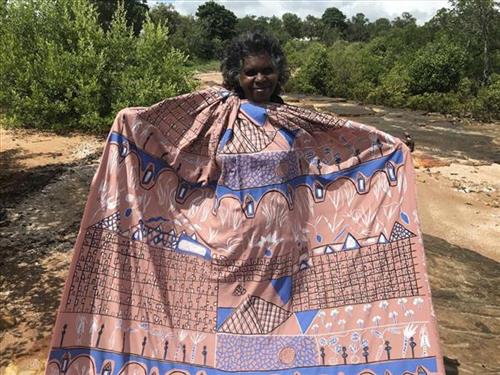
“This design is new and tells a different story of when I went to Paris. This building in the middle of my design is the Louvre. We went and saw that big building made of glass, and there were lots of people walking around. In Paris, there is a big creek made from bricks, with water flowing through the city. I have painted it here too, with the light poles next to it. There are so many tall buildings in Paris. When I see this design, I remember everything about my trip to Paris. For this design I had the idea of putting our Aboriginal bush tucker around the Louvre, so the plants here are kundayarr (pandanus), wayuk (water lily) and karrbarda (long yam). I painted some French trees too’.

In 2019 five artists from Babbarra Women’s Centre travelled to France for the opening of their exhibition Jarracharra: Dry Season Wind. Deborah Wurrkidj, Jennifer Wurrkidj, Janet Marawarr, Jacinta Lami Lami and Elizabeth Kala Kala danced at the opening of the exhibition to a packed embassy gallery, and hosted various public panels including at the Musee du Quai Branly. The artists featured in Vogue magazine, wearing garments featuring their own printed designs on the balcony of the Ambassador to France, with a panoramic view of the Eiffel Tower in the background.

Inspired by the same voyage, on return to Maningrida Deborah Wurrkidj wove a sculpture of the Eiffel Tower out of naturally dyed pandanus, titled Ngaye ngawam nganang kunred  kukimukken, kubba nakornamkuyeng karri (I travelled a long way away, to that place with the tall tower). The work was a finalist in the prestigious 2020 Telstra National Aboriginal & Torres Strait Islander Art Awards (NATSIAA).

The blue in this fabric is slightly more navy than pictured. 

377810582189953


Kunred Kodbarre (The Louvre)

“This design is new and tells a different story of when I went to Paris. This building in the middle of my design is the Louvre. We went and saw that big building made of glass, and there were lots of people walking around. In Paris, there is a big creek made from bricks, with water flowing through the city. I have painted it here too, with the light poles next to it. There are so many tall buildings in Paris. When I see this design, I remember everything about my trip to Paris. For this design I had the idea of putting our Aboriginal bush tucker around the Louvre, so the plants here are kundayarr (pandanus), wayuk (water lily) and karrbarda (long yam). I painted some French trees too’.

In 2019 five artists from Babbarra Women’s Centre travelled to France for the opening of their exhibition Jarracharra: Dry Season Wind. Deborah Wurrkidj, Jennifer Wurrkidj, Janet Marawarr, Jacinta Lami Lami and Elizabeth Kala Kala danced at the opening of the exhibition to a packed embassy gallery, and hosted various public panels including at the Musee du Quai Branly. The artists featured in Vogue magazine, wearing garments featuring their own printed designs on the balcony of the Ambassador to France, with a panoramic view of the Eiffel Tower in the background.

Inspired by the same voyage, on return to Maningrida Deborah Wurrkidj wove a sculpture of the Eiffel Tower out of naturally dyed pandanus, titled Ngaye ngawam nganang kunred  kukimukken, kubba nakornamkuyeng karri (I travelled a long way away, to that place with the tall tower). The work was a finalist in the prestigious 2020 Telstra National Aboriginal & Torres Strait Islander Art Awards (NATSIAA).

377810582189952


Lorrkkon

The Lorrkkon or hollow-log coffin ceremony is the final ceremony in a sequence of mortuary rituals celebrated by the people of Arnhem Land. This ceremony might take place many years after the person has died, and involves the placing of the deceased’s bones into a hollow log that is decorated with painted clan designs and ceremonially placed into the ground where it slowly decays over many years.

The lorrkkon (hollow-log coffin) is made from the trunk of a termite-hollowed manbuluduk (stringybark tree, Eucalyptus tetradonta) and is decorated with totemic emblems. The western Arnhem Land version of the Lorrkkon ceremony involves the singing of sacred songs to the accompaniment of karlikarli, a pair of sacred boomerangs used as rhythm instruments. During the final evening of the ceremony, dancers decorate themselves with kapok down or, today, cotton wool, and conduct much of the final segments of the ceremony in the secrecy of a restricted men’s camp. The complete ceremony may stretch over a period of two weeks, but on the last night the bones of the deceased, which have been kept in a bark container, or today wrapped in cloth and kept in a suitcase, are taken out, and are painted with red ochre and placed inside the hollow-log coffin.

At first light on the final morning of the Lorrkkon ceremony, the men appear, coming out of their secret bush camp carrying the lorrkkon towards the women’s camp. The two groups call to each other using distinct ceremonial calls. The women have prepared a hole for the lorrkkon to be placed into, and when it is stood upright, women in particular kinship relationships to the deceased dance around the lorrkkon in a jumping/shuffling motion. It is then often covered with a tarpaulin and left to slowly decay.

377810582189950


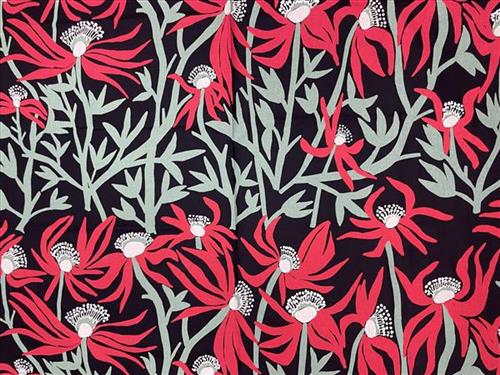
Manwak (Mumeka blooms)

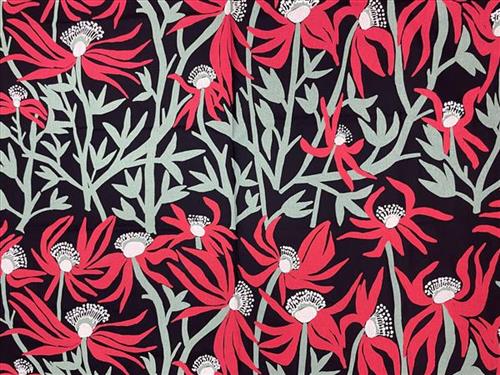
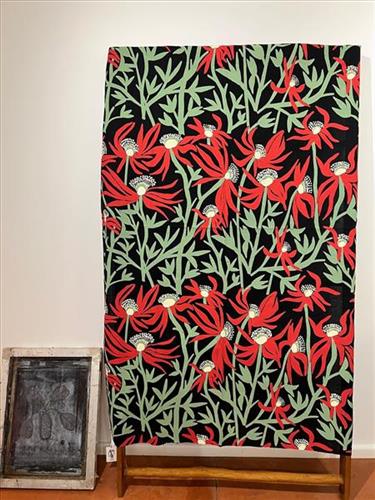
Manwak grows near Mumeka creek, on the artist’s homeland. This beautiful large flower blooms during the mandjelk (wet season). It has deep green petals with a central red kernel which swells to the size of a berry. It is known for its long, sweeping petals which seem to dance in the winds.

By dry season, the inside kernel resembles a strawberry in appearance and flavour, but is also very spicy so it burns our mouth. Kids and adults pick these berries enthusiastically when walking or going hunting on my country. The inside of the flowers are eaten fresh, a favourite manme (bush food) of our people.

“When I was painting this Manwak story, I was painting in Maningrida. In my head I was dreaming of being on my homeland, eating ripe Manwak berries”- Deborah Wurrkidj

377810582189949


Au-gujechiya (fishtrap)

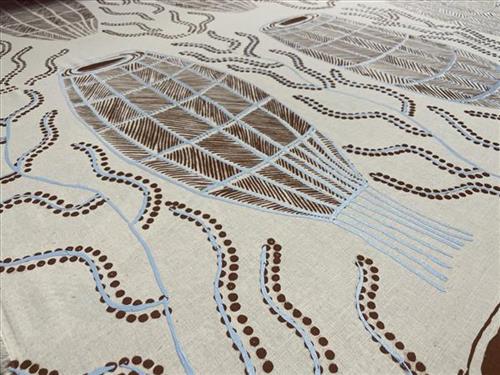
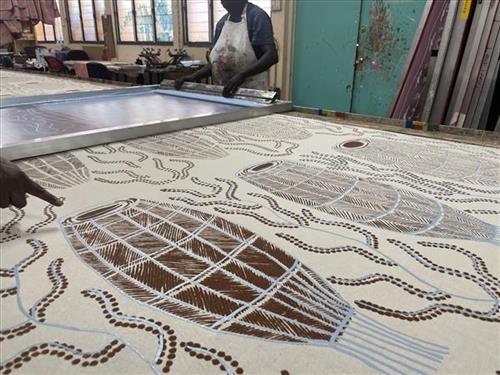
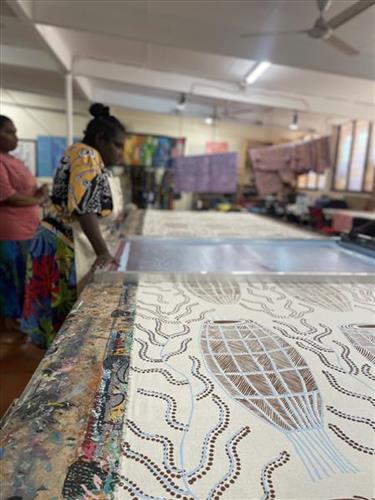
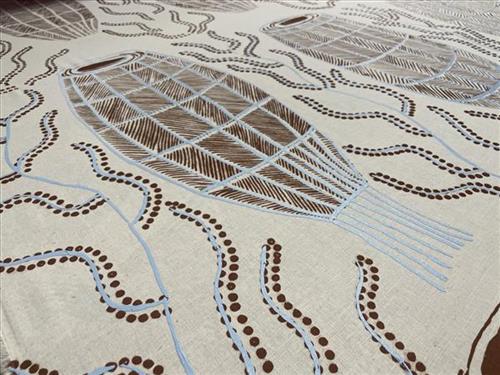
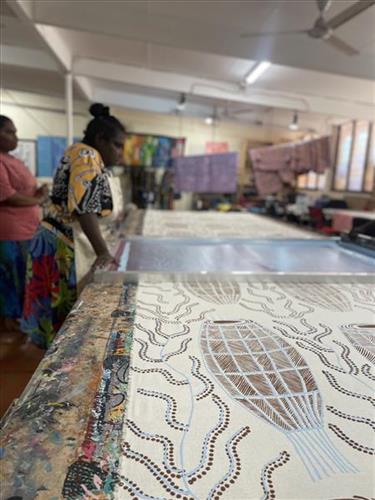
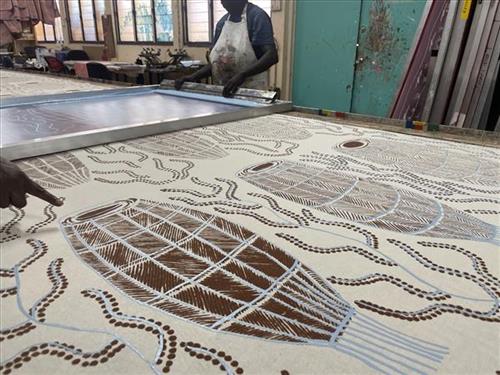
Au-gujechiya (fishtrap) sometimes portrayed with an-maka (cowtail stingray), rajarra (barramundi) and other fish inside. 

Elizabeth has permission from her djunkay to draw this historic and important object traditionally used to trap fish in rivers, creeks and estuaries. In the early wet season they swim upstream for breeding in creeks and billabongs, then downstream to spend the dry season in larger rivers. The traps would be set to face the oncoming fish, with woven fencing either side. Within the mouth of the trap is a woven funnel that guides the fish in and prevents their escape. The clever design ensures that only adult fish are caught as smaller fish can escape through the weaving or even through the funnel. The fish that are caught can survive in the trap for up to two months. Once the trap is removed, the end is untied to remove the fish. This sustainable design means the trap can be used again and again.


Elizabeth is from the Burrarra language group and her homeland is Gupanga, Arnhem Land.  

377810582189948


Au-gujechiya (fishtrap)

Au-gujechiya (fishtrap) sometimes portrayed with an-maka (cowtail stingray), rajarra (barramundi) and other fish inside. 

Elizabeth has permission from her djunkay to draw this historic and important object traditionally used to trap fish in rivers, creeks and estuaries. In the early wet season they swim upstream for breeding in creeks and billabongs, then downstream to spend the dry season in larger rivers. The traps would be set to face the oncoming fish, with woven fencing either side. Within the mouth of the trap is a woven funnel that guides the fish in and prevents their escape. The clever design ensures that only adult fish are caught as smaller fish can escape through the weaving or even through the funnel. The fish that are caught can survive in the trap for up to two months. Once the trap is removed, the end is untied to remove the fish. This sustainable design means the trap can be used again and again.


Elizabeth is from the Burrarra language group and her homeland is Gupanga, Arnhem Land.  

377810582189951


Manwak (Mumeka blooms)

Manwak grows near Mumeka creek, on the artist’s homeland. This beautiful large flower blooms during the mandjelk (wet season). It has deep green petals with a central red kernel which swells to the size of a berry. It is known for its long, sweeping petals which seem to dance in the winds.

By dry season, the inside kernel resembles a strawberry in appearance and flavour, but is also very spicy so it burns our mouth. Kids and adults pick these berries enthusiastically when walking or going hunting on my country. The inside of the flowers are eaten fresh, a favourite manme (bush food) of our people.

“When I was painting this Manwak story, I was painting in Maningrida. In my head I was dreaming of being on my homeland, eating ripe Manwak berries”- Deborah Wurrkidj