377810582187680


Mandjabu

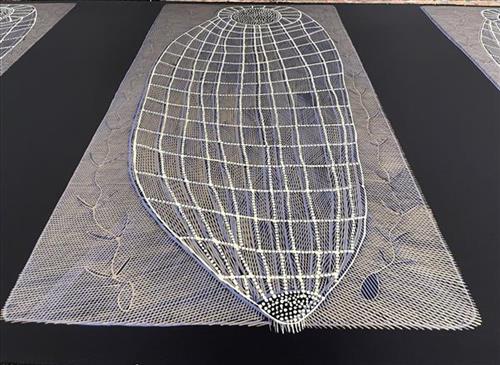
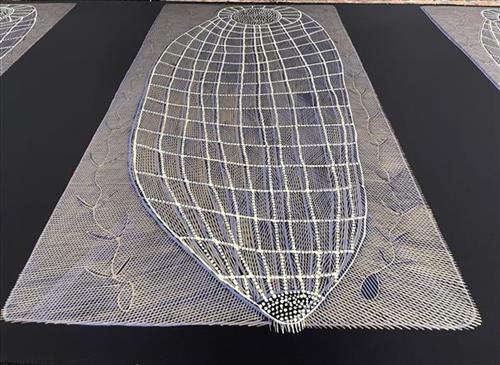
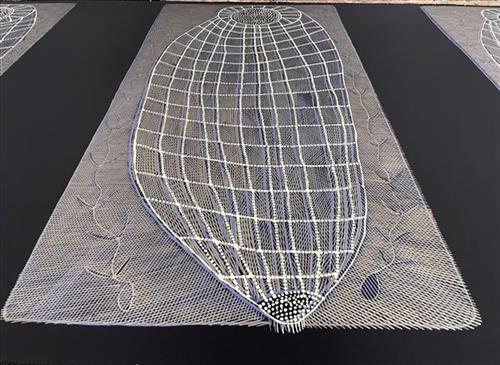
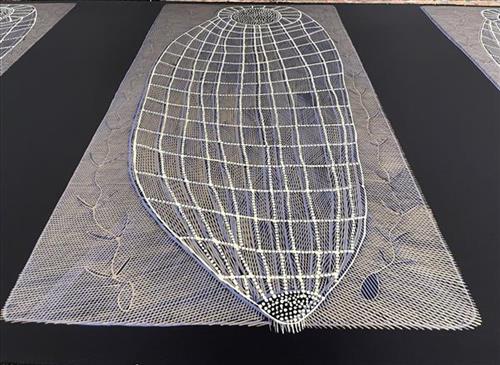
Kuninjku people traditionally make two sorts of conical fish traps. One is called mandjabu and is made from a strong, durable vine called milil, and a smaller one is called manylik mandjabu, and made from the grass manylik. The mandjabuconical fish trap is bigger and stronger and used in tidal reaches of creeks to catch large fish. The smaller, lighter manyliktrap is used in freshwater flowing creeks to catch smaller fish and freshwater prawns. In earlier times, only men were involved in the construction of the large fish traps, but children would often crawl inside and assist.

To make mandjabu, weavers firstly harvest milil (burney vine, Malaisia scandens) and put it in water overnight to make it soft. Then they start weaving it; they make rings for the inside to keep the fish trap’s shape. People also make string from the bark of burdaga (kurrajong) to attach the bardainy (hibiscus) rings and to tie the conical end of the fish trap. It’s hard work and it can take three or four weeks to make a fish trap. People also use fish-net fences called kunkarlewabe. They would put the kunkarlewabe  across rivers and creeks. In the middle they would place the mandjabu. They also used small things like sticks, rocks, mud and grass to block the fish from going through. This way we would catch fish such as saltwater barramundi rajarra, ngaldadmurrng (freshwater barramundi), small black freshwater catfish (buliya), bonefish (an-guwirrpiya), and sand bass (dalakan) in the mandjabu.

377810582187679


Mankotbe (Bush Onion)

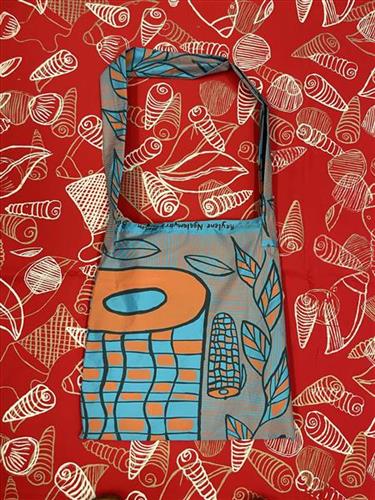
Mankotbe (bush onion) grows under the ground, we follow the vine to dig it up. It is brown on the outside and white inside and we cook it on the fire, just like a potato. All the old people used to eat Mankotbe on my homeland. My grandmother showed me how to find that plant and the first time I ate so much my mouth got sore! You can’t be too greedy.

This design brings back good memories for me. I used to eat Mankotbe when I was young and living at my homeland Buluhkaduru. In those old times, my house was made of paper bark and sticks. If we wanted to come into town we had to walk, and it’s a long walk, so we would fill our dilly bags with sugar bag honey, Mankotbe and long yams to eat on the way. They were good times for me.

You can find Mankotbe any time of the year- the plant has big black leaves. When you find one onion, you know there is big mob around- they are always connected by a big long vine underground

377810582187642


Ngalng and Kunred

Ngalng (fresh water yabby)

‘This is a story from Mankorlod. This is a djang story. This is the creation story about the fresh water yabby. Starting with the stone, that’s the raw one and the cooked one. The stone rock suddenly turned to ngalng, in a flash. Ngalng started growing and turned into a body. It’s a magic one and it can change from rock to ngalng to human and back to ngalng. Now it’s a ngalng. 

The country is near Mankorlod and Korlobididah. The ngalng is stuck there forever on the rock at Korlobididah,’ 

‘There is also duruk (camp dog) called ‘Djanbokkon’. This is a duruk that comes from water and no one has seen it. This is a true duruk, he goes everywhere in the country. His body is striped. He is a secret dog and he has a secret story.’ 

Janet Marawarr 2022

377810582187973


Mandjabu

Kuninjku people traditionally make two sorts of conical fish traps. One is called mandjabu and is made from a strong, durable vine called milil, and a smaller one is called manylik mandjabu, and made from the grass manylik. The mandjabuconical fish trap is bigger and stronger and used in tidal reaches of creeks to catch large fish. The smaller, lighter manyliktrap is used in freshwater flowing creeks to catch smaller fish and freshwater prawns. In earlier times, only men were involved in the construction of the large fish traps, but children would often crawl inside and assist.

To make mandjabu, weavers firstly harvest milil (burney vine, Malaisia scandens) and put it in water overnight to make it soft. Then they start weaving it; they make rings for the inside to keep the fish trap’s shape. People also make string from the bark of burdaga (kurrajong) to attach the bardainy (hibiscus) rings and to tie the conical end of the fish trap. It’s hard work and it can take three or four weeks to make a fish trap. People also use fish-net fences called kunkarlewabe. They would put the kunkarlewabe  across rivers and creeks. In the middle they would place the mandjabu. They also used small things like sticks, rocks, mud and grass to block the fish from going through. This way we would catch fish such as saltwater barramundi rajarra, ngaldadmurrng (freshwater barramundi), small black freshwater catfish (buliya), bonefish (an-guwirrpiya), and sand bass (dalakan) in the mandjabu.
377810582187972


Mandjabu

Kuninjku people traditionally make two sorts of conical fish traps. One is called mandjabu and is made from a strong, durable vine called milil, and a smaller one is called manylik mandjabu, and made from the grass manylik. The mandjabuconical fish trap is bigger and stronger and used in tidal reaches of creeks to catch large fish. The smaller, lighter manyliktrap is used in freshwater flowing creeks to catch smaller fish and freshwater prawns. In earlier times, only men were involved in the construction of the large fish traps, but children would often crawl inside and assist.

To make mandjabu, weavers firstly harvest milil (burney vine, Malaisia scandens) and put it in water overnight to make it soft. Then they start weaving it; they make rings for the inside to keep the fish trap’s shape. People also make string from the bark of burdaga (kurrajong) to attach the bardainy (hibiscus) rings and to tie the conical end of the fish trap. It’s hard work and it can take three or four weeks to make a fish trap. People also use fish-net fences called kunkarlewabe. They would put the kunkarlewabe  across rivers and creeks. In the middle they would place the mandjabu. They also used small things like sticks, rocks, mud and grass to block the fish from going through. This way we would catch fish such as saltwater barramundi rajarra, ngaldadmurrng (freshwater barramundi), small black freshwater catfish (buliya), bonefish (an-guwirrpiya), and sand bass (dalakan) in the mandjabu.

377810582187971


Mandjabu

Kuninjku people traditionally make two sorts of conical fish traps. One is called mandjabu and is made from a strong, durable vine called milil, and a smaller one is called manylik mandjabu, and made from the grass manylik. The mandjabuconical fish trap is bigger and stronger and used in tidal reaches of creeks to catch large fish. The smaller, lighter manyliktrap is used in freshwater flowing creeks to catch smaller fish and freshwater prawns. In earlier times, only men were involved in the construction of the large fish traps, but children would often crawl inside and assist.

To make mandjabu, weavers firstly harvest milil (burney vine, Malaisia scandens) and put it in water overnight to make it soft. Then they start weaving it; they make rings for the inside to keep the fish trap’s shape. People also make string from the bark of burdaga (kurrajong) to attach the bardainy (hibiscus) rings and to tie the conical end of the fish trap. It’s hard work and it can take three or four weeks to make a fish trap. People also use fish-net fences called kunkarlewabe. They would put the kunkarlewabe  across rivers and creeks. In the middle they would place the mandjabu. They also used small things like sticks, rocks, mud and grass to block the fish from going through. This way we would catch fish such as saltwater barramundi rajarra, ngaldadmurrng (freshwater barramundi), small black freshwater catfish (buliya), bonefish (an-guwirrpiya), and sand bass (dalakan) in the mandjabu.
377810582187970


Mandjabu

Kuninjku people traditionally make two sorts of conical fish traps. One is called mandjabu and is made from a strong, durable vine called milil, and a smaller one is called manylik mandjabu, and made from the grass manylik. The mandjabuconical fish trap is bigger and stronger and used in tidal reaches of creeks to catch large fish. The smaller, lighter manyliktrap is used in freshwater flowing creeks to catch smaller fish and freshwater prawns. In earlier times, only men were involved in the construction of the large fish traps, but children would often crawl inside and assist.

To make mandjabu, weavers firstly harvest milil (burney vine, Malaisia scandens) and put it in water overnight to make it soft. Then they start weaving it; they make rings for the inside to keep the fish trap’s shape. People also make string from the bark of burdaga (kurrajong) to attach the bardainy (hibiscus) rings and to tie the conical end of the fish trap. It’s hard work and it can take three or four weeks to make a fish trap. People also use fish-net fences called kunkarlewabe. They would put the kunkarlewabe  across rivers and creeks. In the middle they would place the mandjabu. They also used small things like sticks, rocks, mud and grass to block the fish from going through. This way we would catch fish such as saltwater barramundi rajarra, ngaldadmurrng (freshwater barramundi), small black freshwater catfish (buliya), bonefish (an-guwirrpiya), and sand bass (dalakan) in the mandjabu.