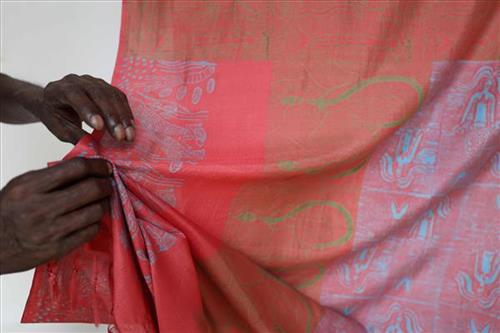
Rolk (maggot dreaming)
Rolk, that’s my mothers dreaming. What is it called, maggot?
This is from the area near Marrkolidjban Outstation, on the way to Maningrida.
Janet Marawarr
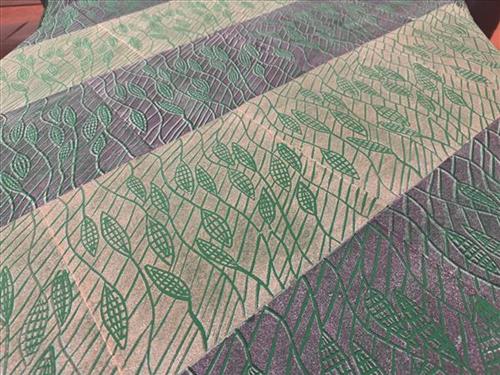
Rolk, that’s my mothers dreaming. What is it called, maggot?
This is from the area near Marrkolidjban Outstation, on the way to Maningrida.
Janet Marawarr
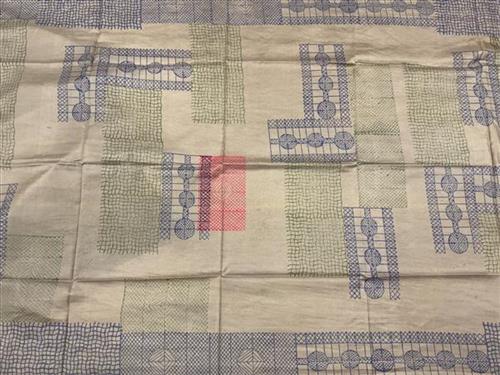
Woodblock print on handwoven silk, extract print with organic dyes, 100% Silk
Co-created by Bábbarra Women’s Centre, Maningrida and Tharangini Studio, India
Printed by artisans at Tharangini Studio
Design brief by Bábbarra Women’s Centre Artists
Woodblock carving by Shri C.H. Sreeram and Shri S.K. Rajak
This fabric may feature the following woodblock designs.
“I’m excited to see my Lino design made into a woodblock. We are going to spend Saturday printing with Tharangini Studio. We are going to learn woodblock printing. I’ve been working Bábbarra Women’s Centre for 37 years since it started. I’ve been printing Lino on fabric.” Janet Marawarr 2023
“Tomorrow we do printing Yawkyawk (mermaid spirit) and Ngalyod (rainbow serpent). My design is together with my sister. Together, we started working at the Women’s Centre and Maningrida Arts and Culture, taught by our mother and grandmother. My sister is a sick one, and she passed on her story to me – Ngalyod (rainbow serpent). I help my sister, I help carry the knowledge for her. That’s why we both have designs being made into woodblock.” Deborah Wurrkidj 2024
BACKGROUND
Bábbarra Women’s Centre is located in the Djelk area of Arnhem Land, in a town known as Maningrida and was established in 1987. We represent over 50 women artists from 12 languages and operate under the First Nations-owned Bawinanga Homelands Aboriginal Corporation. The artists at Bábbarra Women’s Centre design screen printed and lino print textiles that illustrate the djang or rich cultural narratives, histories and powerful creation stories of West Arnhem Land. The tradition of lino printing began in the mid-1990s as a way for women to become economically empowered.
Tharangini Studio was established in 1977 in Bangalore by artist and textile enthusiast Lakshmi Srivathsa. Today, it is managed by Srivathsa’s daughter, Padmini Govind, whose global corporate career in technology and defence has led to ingenious eco-friendly printing practices within the lush tropical locale. Under Padmini’s leadership, Tharangini is the only artisan studio with a NEST Ethical Seal of Compliance (fair trade). As the last surviving heritage block print studio in Bangalore, Tharangini is home to one of the largest private archives of vintage woodblocks in India
“Karri-djarrk-durrkmirri means “We work together” in the Kuninjku language of West Arnhem Land and its more than cultural exchange with India, it is two way learning.
Tharangini’s skilled artisans worked closely with Babbarra in 2023-2025 to hand-carve some of Babbarra’s old linocut designs into woodblocks. This initiative was supported by the Centre for Australia-India Relations, Maitri Cultural Partnerships Fund 2023.
The creative relationship not only serves art but it also informs a practical and critical archival outcome for Babbarra Women’s Centre. The walls of Tharangini Studio were neatly lined with boxes of durable woodblocks and many over 200 years old and still being printed. At Bábbarra, we house cupboards and shelves of historic and vulnerable lino tiles, some 30 years old but no longer able to be printed.Tharangini Studio specialises in woodblocks carved out of teak by master artisans, creating a solid medium for textile printing. For Bábbarra Women’s Centre artists, this had the added benefit of preserving the original lino designs. Many lino sheets are crumbling and decaying, a process hastened by the kudjewk (wet season) and humid kurrung (build up).
Combining the cultural authority to share djang and print-making practices at Bábbarra Women’s Centre with the tradition of woodblock printing in India, the project exchanges many thousands of years of knowledge across the globe. The Bábbarra artists, as custodians of these designs, must receive permission from their djungkays (ritual manager through the maternal line) to share their stories.
This connection will undoubtedly sustain a lasting and significant impact on the legacy and longevity of Bábbarra Women’s Centre. The story doesn’t end here in honour of the generosity shown by Tharangini Studio, Padmini Govind will join Babbarra Women’s Centre artists in Maningrida for a workshop in June 2025.”
Extract taken from karri-djarrk–durrkmirri catalogue essay, Jessica Stalenberg 2025
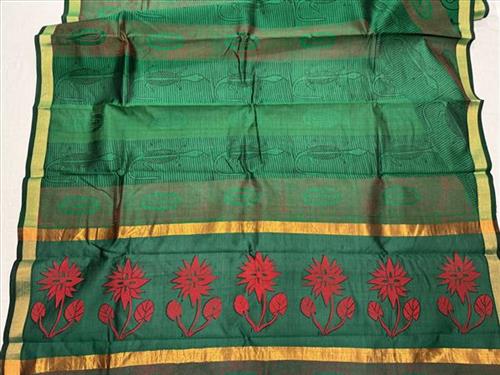
Woodblock print on handwoven silk, extract print with organic dyes, 100% Silk
Co-created by Bábbarra Women’s Centre, Maningrida and Tharangini Studio, India
Printed by artisans at Tharangini Studio
Design brief by Bábbarra Women’s Centre Artists
Woodblock carving by Shri C.H. Sreeram and Shri S.K. Rajak
This fabric may feature the following woodblock designs.
“I’m excited to see my Lino design made into a woodblock. We are going to spend Saturday printing with Tharangini Studio. We are going to learn woodblock printing. I’ve been working Bábbarra Women’s Centre for 37 years since it started. I’ve been printing Lino on fabric.” Janet Marawarr 2023
“Tomorrow we do printing Yawkyawk (mermaid spirit) and Ngalyod (rainbow serpent). My design is together with my sister. Together, we started working at the Women’s Centre and Maningrida Arts and Culture, taught by our mother and grandmother. My sister is a sick one, and she passed on her story to me – Ngalyod (rainbow serpent). I help my sister, I help carry the knowledge for her. That’s why we both have designs being made into woodblock.” Deborah Wurrkidj 2024
BACKGROUND
Bábbarra Women’s Centre is located in the Djelk area of Arnhem Land, in a town known as Maningrida and was established in 1987. We represent over 50 women artists from 12 languages and operate under the First Nations-owned Bawinanga Homelands Aboriginal Corporation. The artists at Bábbarra Women’s Centre design screen printed and lino print textiles that illustrate the djang or rich cultural narratives, histories and powerful creation stories of West Arnhem Land. The tradition of lino printing began in the mid-1990s as a way for women to become economically empowered.
Tharangini Studio was established in 1977 in Bangalore by artist and textile enthusiast Lakshmi Srivathsa. Today, it is managed by Srivathsa’s daughter, Padmini Govind, whose global corporate career in technology and defence has led to ingenious eco-friendly printing practices within the lush tropical locale. Under Padmini’s leadership, Tharangini is the only artisan studio with a NEST Ethical Seal of Compliance (fair trade). As the last surviving heritage block print studio in Bangalore, Tharangini is home to one of the largest private archives of vintage woodblocks in India
“Karri-djarrk-durrkmirri means “We work together” in the Kuninjku language of West Arnhem Land and its more than cultural exchange with India, it is two way learning.
Tharangini’s skilled artisans worked closely with Babbarra in 2023-2025 to hand-carve some of Babbarra’s old linocut designs into woodblocks. This initiative was supported by the Centre for Australia-India Relations, Maitri Cultural Partnerships Fund 2023.
The creative relationship not only serves art but it also informs a practical and critical archival outcome for Babbarra Women’s Centre. The walls of Tharangini Studio were neatly lined with boxes of durable woodblocks and many over 200 years old and still being printed. At Bábbarra, we house cupboards and shelves of historic and vulnerable lino tiles, some 30 years old but no longer able to be printed.Tharangini Studio specialises in woodblocks carved out of teak by master artisans, creating a solid medium for textile printing. For Bábbarra Women’s Centre artists, this had the added benefit of preserving the original lino designs. Many lino sheets are crumbling and decaying, a process hastened by the kudjewk (wet season) and humid kurrung (build up).
Combining the cultural authority to share djang and print-making practices at Bábbarra Women’s Centre with the tradition of woodblock printing in India, the project exchanges many thousands of years of knowledge across the globe. The Bábbarra artists, as custodians of these designs, must receive permission from their djungkays (ritual manager through the maternal line) to share their stories.
This connection will undoubtedly sustain a lasting and significant impact on the legacy and longevity of Bábbarra Women’s Centre. The story doesn’t end here in honour of the generosity shown by Tharangini Studio, Padmini Govind will join Babbarra Women’s Centre artists in Maningrida for a workshop in June 2025.”
Extract taken from karri-djarrk–durrkmirri catalogue essay, Jessica Stalenberg 2025
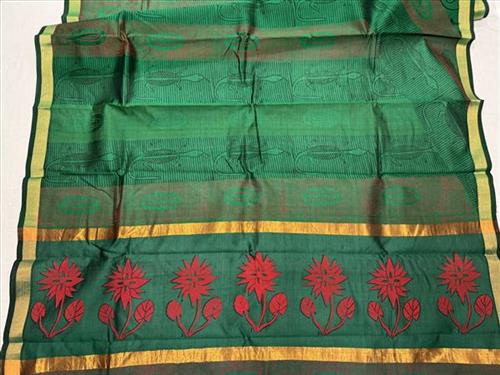
Woodblock print on handwoven silk, extract print with organic dyes, 100% Silk
Co-created by Bábbarra Women’s Centre, Maningrida and Tharangini Studio, India
Printed by artisans at Tharangini Studio
Design brief by Bábbarra Women’s Centre Artists
Woodblock carving by Shri C.H. Sreeram and Shri S.K. Rajak
This fabric may feature the following woodblock designs.
“I’m excited to see my Lino design made into a woodblock. We are going to spend Saturday printing with Tharangini Studio. We are going to learn woodblock printing. I’ve been working Bábbarra Women’s Centre for 37 years since it started. I’ve been printing Lino on fabric.” Janet Marawarr 2023
“Tomorrow we do printing Yawkyawk (mermaid spirit) and Ngalyod (rainbow serpent). My design is together with my sister. Together, we started working at the Women’s Centre and Maningrida Arts and Culture, taught by our mother and grandmother. My sister is a sick one, and she passed on her story to me – Ngalyod (rainbow serpent). I help my sister, I help carry the knowledge for her. That’s why we both have designs being made into woodblock.” Deborah Wurrkidj 2024
BACKGROUND
Bábbarra Women’s Centre is located in the Djelk area of Arnhem Land, in a town known as Maningrida and was established in 1987. We represent over 50 women artists from 12 languages and operate under the First Nations-owned Bawinanga Homelands Aboriginal Corporation. The artists at Bábbarra Women’s Centre design screen printed and lino print textiles that illustrate the djang or rich cultural narratives, histories and powerful creation stories of West Arnhem Land. The tradition of lino printing began in the mid-1990s as a way for women to become economically empowered.
Tharangini Studio was established in 1977 in Bangalore by artist and textile enthusiast Lakshmi Srivathsa. Today, it is managed by Srivathsa’s daughter, Padmini Govind, whose global corporate career in technology and defence has led to ingenious eco-friendly printing practices within the lush tropical locale. Under Padmini’s leadership, Tharangini is the only artisan studio with a NEST Ethical Seal of Compliance (fair trade). As the last surviving heritage block print studio in Bangalore, Tharangini is home to one of the largest private archives of vintage woodblocks in India
“Karri-djarrk-durrkmirri means “We work together” in the Kuninjku language of West Arnhem Land and its more than cultural exchange with India, it is two way learning.
Tharangini’s skilled artisans worked closely with Babbarra in 2023-2025 to hand-carve some of Babbarra’s old linocut designs into woodblocks. This initiative was supported by the Centre for Australia-India Relations, Maitri Cultural Partnerships Fund 2023.
The creative relationship not only serves art but it also informs a practical and critical archival outcome for Babbarra Women’s Centre. The walls of Tharangini Studio were neatly lined with boxes of durable woodblocks and many over 200 years old and still being printed. At Bábbarra, we house cupboards and shelves of historic and vulnerable lino tiles, some 30 years old but no longer able to be printed.Tharangini Studio specialises in woodblocks carved out of teak by master artisans, creating a solid medium for textile printing. For Bábbarra Women’s Centre artists, this had the added benefit of preserving the original lino designs. Many lino sheets are crumbling and decaying, a process hastened by the kudjewk (wet season) and humid kurrung (build up).
Combining the cultural authority to share djang and print-making practices at Bábbarra Women’s Centre with the tradition of woodblock printing in India, the project exchanges many thousands of years of knowledge across the globe. The Bábbarra artists, as custodians of these designs, must receive permission from their djungkays (ritual manager through the maternal line) to share their stories.
This connection will undoubtedly sustain a lasting and significant impact on the legacy and longevity of Bábbarra Women’s Centre. The story doesn’t end here in honour of the generosity shown by Tharangini Studio, Padmini Govind will join Babbarra Women’s Centre artists in Maningrida for a workshop in June 2025.”
Extract taken from karri-djarrk–durrkmirri catalogue essay, Jessica Stalenberg 2025
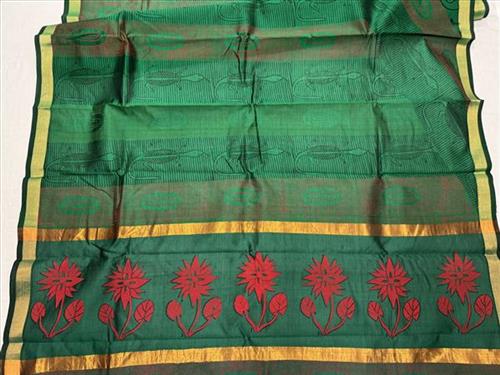
Woodblock print on handwoven silk, extract print with organic dyes, 100% Silk
Co-created by Bábbarra Women’s Centre, Maningrida and Tharangini Studio, India
Printed by artisans at Tharangini Studio
Design brief by Bábbarra Women’s Centre Artists
Woodblock carving by Shri C.H. Sreeram and Shri S.K. Rajak
This fabric may feature the following woodblock designs.
“I’m excited to see my Lino design made into a woodblock. We are going to spend Saturday printing with Tharangini Studio. We are going to learn woodblock printing. I’ve been working Bábbarra Women’s Centre for 37 years since it started. I’ve been printing Lino on fabric.” Janet Marawarr 2023
“Tomorrow we do printing Yawkyawk (mermaid spirit) and Ngalyod (rainbow serpent). My design is together with my sister. Together, we started working at the Women’s Centre and Maningrida Arts and Culture, taught by our mother and grandmother. My sister is a sick one, and she passed on her story to me – Ngalyod (rainbow serpent). I help my sister, I help carry the knowledge for her. That’s why we both have designs being made into woodblock.” Deborah Wurrkidj 2024
BACKGROUND
Bábbarra Women’s Centre is located in the Djelk area of Arnhem Land, in a town known as Maningrida and was established in 1987. We represent over 50 women artists from 12 languages and operate under the First Nations-owned Bawinanga Homelands Aboriginal Corporation. The artists at Bábbarra Women’s Centre design screen printed and lino print textiles that illustrate the djang or rich cultural narratives, histories and powerful creation stories of West Arnhem Land. The tradition of lino printing began in the mid-1990s as a way for women to become economically empowered.
Tharangini Studio was established in 1977 in Bangalore by artist and textile enthusiast Lakshmi Srivathsa. Today, it is managed by Srivathsa’s daughter, Padmini Govind, whose global corporate career in technology and defence has led to ingenious eco-friendly printing practices within the lush tropical locale. Under Padmini’s leadership, Tharangini is the only artisan studio with a NEST Ethical Seal of Compliance (fair trade). As the last surviving heritage block print studio in Bangalore, Tharangini is home to one of the largest private archives of vintage woodblocks in India
“Karri-djarrk-durrkmirri means “We work together” in the Kuninjku language of West Arnhem Land and its more than cultural exchange with India, it is two way learning.
Tharangini’s skilled artisans worked closely with Babbarra in 2023-2025 to hand-carve some of Babbarra’s old linocut designs into woodblocks. This initiative was supported by the Centre for Australia-India Relations, Maitri Cultural Partnerships Fund 2023.
The creative relationship not only serves art but it also informs a practical and critical archival outcome for Babbarra Women’s Centre. The walls of Tharangini Studio were neatly lined with boxes of durable woodblocks and many over 200 years old and still being printed. At Bábbarra, we house cupboards and shelves of historic and vulnerable lino tiles, some 30 years old but no longer able to be printed.Tharangini Studio specialises in woodblocks carved out of teak by master artisans, creating a solid medium for textile printing. For Bábbarra Women’s Centre artists, this had the added benefit of preserving the original lino designs. Many lino sheets are crumbling and decaying, a process hastened by the kudjewk (wet season) and humid kurrung (build up).
Combining the cultural authority to share djang and print-making practices at Bábbarra Women’s Centre with the tradition of woodblock printing in India, the project exchanges many thousands of years of knowledge across the globe. The Bábbarra artists, as custodians of these designs, must receive permission from their djungkays (ritual manager through the maternal line) to share their stories.
This connection will undoubtedly sustain a lasting and significant impact on the legacy and longevity of Bábbarra Women’s Centre. The story doesn’t end here in honour of the generosity shown by Tharangini Studio, Padmini Govind will join Babbarra Women’s Centre artists in Maningrida for a workshop in June 2025.”
Extract taken from karri-djarrk–durrkmirri catalogue essay, Jessica Stalenberg 2025
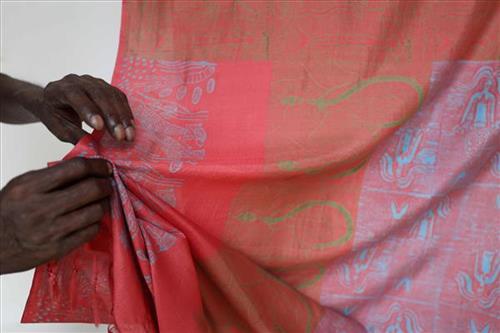
Deborah Kamanj Wurrkidj b. 1971, Darwin, Australia YAWKYAWK (YOUNG WOMAN SPIRIT)
Janet Kalidjan Marawarr b. 1962, Oenpelli, Australia YAWKYAWK LA NGALNG (YOUNG WOMAN SPIRIT AND YABBY)
Owen Ngarridj Yalandja b. 1962, Oenpelli, Australia YAWKYAWK (YOUNG WOMAN SPIRIT)
Joy Bulandjan Garlbin b. 1959, Maningrida, Australia DJÓMI (MERMAID)
Elizabeth Gochan Wullunmingu b. 1972, Darwin, Australia JIN-MERDAWA (MERMAID)
Woodblock print on handwoven silk, extract print with organic dyes
Design brief by Janet Marawarr
Print composition by Anshu Arora and Prithi Pais
Printed by artisans at Tharangini Studio
Woodblock carving by Shri C.H. Sreeram and Shri S.K. Rajak
Fabric by Nandita Sulur
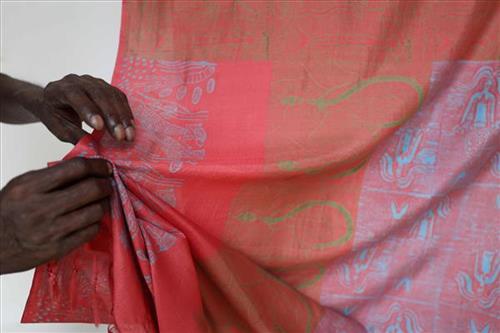
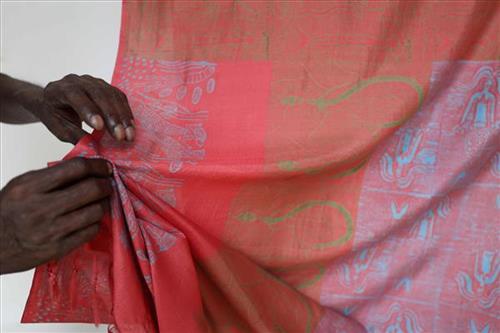
Yawkyawk is a word from the Aboriginal Kunwinjku and Kuninjku language, meaning young woman and young woman spirit being. Residing in fresh or saltwater, some Yawkyawk have long hair, associated with trailing blooms of algae. The female water spirit and fertility mermaid for the Kunibidji people is known as Djómi. Kuninjku artist Owen Ngarridj Yalandja is a senior member of the Darnkolo clan,custodians of an important Yawkyawk site near their outstation, Barrihdjowkkeng. The Yawkyawk djang (cultural histories) is central to the Darnkolo clan’s identity, for which they have spiritual and cultural responsibility. Yalandja was impressed by the carving technique on the woodblocks that returned with the team from India in 2023. He submitted a Yawkyawk design to Raylene Bonson for carving, and she prepared it for Tharangini Studio. Yalandja’s design is repeated throughout this sari. Yawkyawk swim underneath the rock. They always stay there. When the sun comes out they come out from underneath the river, make themselves warm. When they sit, they cry [sing] to themselves. Sometimes they go out to find the manme (food) and the mankung (sugarbag honey). – Janet Kalidjan Marawarr
Deborah Kamanj Wurrkidj b. 1971, Darwin, Australia YAWKYAWK (YOUNG WOMAN SPIRIT)
Janet Kalidjan Marawarr b. 1962, Oenpelli, Australia YAWKYAWK LA NGALNG (YOUNG WOMAN SPIRIT AND YABBY)
Owen Ngarridj Yalandja b. 1962, Oenpelli, Australia YAWKYAWK (YOUNG WOMAN SPIRIT)
Joy Bulandjan Garlbin b. 1959, Maningrida, Australia DJÓMI (MERMAID)
Elizabeth Gochan Wullunmingu b. 1972, Darwin, Australia JIN-MERDAWA (MERMAID)
Woodblock print on handwoven silk, extract print with organic dyes
Design brief by Janet Marawarr
Print composition by Anshu Arora and Prithi Pais
Printed by artisans at Tharangini Studio
Woodblock carving by Shri C.H. Sreeram and Shri S.K. Rajak
Fabric by Nandita Sulur
Yawkyawk is a word from the Aboriginal Kunwinjku and Kuninjku language, meaning young woman and young woman spirit being. Residing in fresh or saltwater, some Yawkyawk have long hair, associated with trailing blooms of algae. The female water spirit and fertility mermaid for the Kunibidji people is known as Djómi. Kuninjku artist Owen Ngarridj Yalandja is a senior member of the Darnkolo clan,custodians of an important Yawkyawk site near their outstation, Barrihdjowkkeng. The Yawkyawk djang (cultural histories) is central to the Darnkolo clan’s identity, for which they have spiritual and cultural responsibility. Yalandja was impressed by the carving technique on the woodblocks that returned with the team from India in 2023. He submitted a Yawkyawk design to Raylene Bonson for carving, and she prepared it for Tharangini Studio. Yalandja’s design is repeated throughout this sari. Yawkyawk swim underneath the rock. They always stay there. When the sun comes out they come out from underneath the river, make themselves warm. When they sit, they cry [sing] to themselves. Sometimes they go out to find the manme (food) and the mankung (sugarbag honey). – Janet Kalidjan Marawarr
Deborah Kamanj Wurrkidj b. 1971, Darwin, Australia YAWKYAWK (YOUNG WOMAN SPIRIT)
Janet Kalidjan Marawarr b. 1962, Oenpelli, Australia YAWKYAWK LA NGALNG (YOUNG WOMAN SPIRIT AND YABBY)
Owen Ngarridj Yalandja b. 1962, Oenpelli, Australia YAWKYAWK (YOUNG WOMAN SPIRIT)
Joy Bulandjan Garlbin b. 1959, Maningrida, Australia DJÓMI (MERMAID)
Elizabeth Gochan Wullunmingu b. 1972, Darwin, Australia JIN-MERDAWA (MERMAID)
Woodblock print on handwoven silk, extract print with organic dyes
Design brief by Janet Marawarr
Print composition by Anshu Arora and Prithi Pais
Printed by artisans at Tharangini Studio
Woodblock carving by Shri C.H. Sreeram and Shri S.K. Rajak
Fabric by Nandita Sulur
Yawkyawk is a word from the Aboriginal Kunwinjku and Kuninjku language, meaning young woman and young woman spirit being. Residing in fresh or saltwater, some Yawkyawk have long hair, associated with trailing blooms of algae. The female water spirit and fertility mermaid for the Kunibidji people is known as Djómi. Kuninjku artist Owen Ngarridj Yalandja is a senior member of the Darnkolo clan,custodians of an important Yawkyawk site near their outstation, Barrihdjowkkeng. The Yawkyawk djang (cultural histories) is central to the Darnkolo clan’s identity, for which they have spiritual and cultural responsibility. Yalandja was impressed by the carving technique on the woodblocks that returned with the team from India in 2023. He submitted a Yawkyawk design to Raylene Bonson for carving, and she prepared it for Tharangini Studio. Yalandja’s design is repeated throughout this sari. Yawkyawk swim underneath the rock. They always stay there. When the sun comes out they come out from underneath the river, make themselves warm. When they sit, they cry [sing] to themselves. Sometimes they go out to find the manme (food) and the mankung (sugarbag honey). – Janet Kalidjan Marawarr
Deborah Kamanj Wurrkidj b. 1971, Darwin, Australia YAWKYAWK (YOUNG WOMAN SPIRIT)
Janet Kalidjan Marawarr b. 1962, Oenpelli, Australia YAWKYAWK LA NGALNG (YOUNG WOMAN SPIRIT AND YABBY)
Owen Ngarridj Yalandja b. 1962, Oenpelli, Australia YAWKYAWK (YOUNG WOMAN SPIRIT)
Joy Bulandjan Garlbin b. 1959, Maningrida, Australia DJÓMI (MERMAID)
Elizabeth Gochan Wullunmingu b. 1972, Darwin, Australia JIN-MERDAWA (MERMAID)
Woodblock print on handwoven silk, extract print with organic dyes
Design brief by Janet Marawarr
Print composition by Anshu Arora and Prithi Pais
Printed by artisans at Tharangini Studio
Woodblock carving by Shri C.H. Sreeram and Shri S.K. Rajak
Fabric by Nandita Sulur
Yawkyawk is a word from the Aboriginal Kunwinjku and Kuninjku language, meaning young woman and young woman spirit being. Residing in fresh or saltwater, some Yawkyawk have long hair, associated with trailing blooms of algae. The female water spirit and fertility mermaid for the Kunibidji people is known as Djómi. Kuninjku artist Owen Ngarridj Yalandja is a senior member of the Darnkolo clan,custodians of an important Yawkyawk site near their outstation, Barrihdjowkkeng. The Yawkyawk djang (cultural histories) is central to the Darnkolo clan’s identity, for which they have spiritual and cultural responsibility. Yalandja was impressed by the carving technique on the woodblocks that returned with the team from India in 2023. He submitted a Yawkyawk design to Raylene Bonson for carving, and she prepared it for Tharangini Studio. Yalandja’s design is repeated throughout this sari. Yawkyawk swim underneath the rock. They always stay there. When the sun comes out they come out from underneath the river, make themselves warm. When they sit, they cry [sing] to themselves. Sometimes they go out to find the manme (food) and the mankung (sugarbag honey). – Janet Kalidjan Marawarr
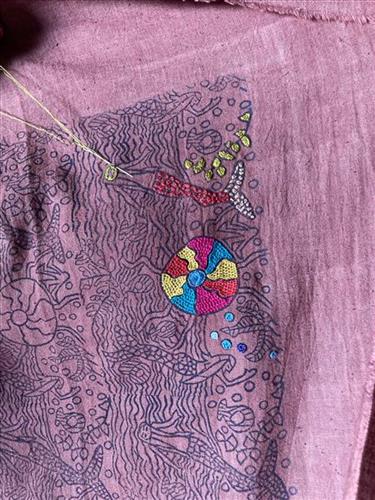
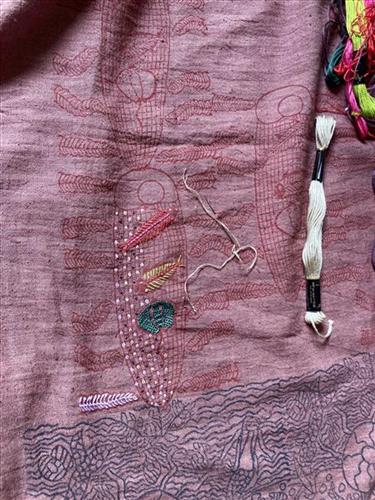
Elizabeth Gochan Wullunmingu b. 1972, Darwin, Australia
AN-GUJECHIYA (FISH TRAP)
JIN-MERDAWA (MERMAID)
Woodblock print and Lambadi embroidery on handwoven kala cotton
Pigment print with organic dyes
Design brief by Bábbarra Women’s Centre
Print composition by Anshu Arora and Prithi Pais
Printed by artisans at Tharangini Studio
Embroidery by M.Vasanthi & Sangeetha at Porgai Artisans Association
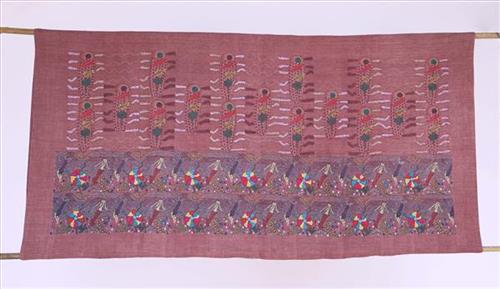
Woodblock carving by Shri C.H.Sreeram and Shri S.K. Rajak Fabric by Green Tailor Elizabeth Wullunmingu is an An-barra Burarra woman who grew up speaking Burarra language on her mother country at the entrance of the Blyth River in Arnhem Land, Australia. Her adopted mother, P. Galijan Dungudja, was a sewer in the Bábbarra Women’s Centre sewing room and a strong advocate for women in the community. Wullunmingu’s style is intricate, with delicate (shells) and dakarra (cockles) representative of the balaji (bush food) found on the beaches and saltwater estuaries east of Maningrida. The detailed hand embroidery is glorious, respectfully aligned to Wullunmingu’s own passion for sewing. Wullunmingu exclaims: I love to make Lino print fabric showing Jin-Merdawa (mermaid) . I like using bright colours. Jin-Merdawa live at Gupanga. Gupanga is located at the mouth of the Blyth River, Arnhem Land. It is a saltwater place. There must be more than one Jin-Merdawa living there? They eat fish, shellfish and seaweed. Sometimes they travel to the end of the river to find food in the ocean, but they don’t go far and always swim back to their home.