377810582372259


Mardarda and Njarlarla (Bones and Fire Sticks)

Designed 2019

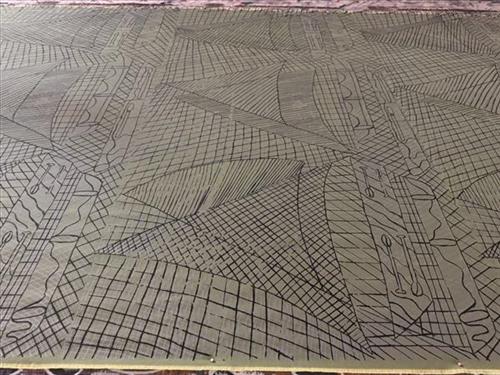
In Esther’s first screen design, she depicts the story of Mardarda (bones) and Njarlarla (fire sticks) carried in a dilly bag, reminiscent of traditional ways of the Ndjebenna people.

‘Back in the old days, our people would use a ‘bush lighter’ for lighting fires, which was two pieces of special wood which would make fire easily. The old people carried a dilly bag containing the fire stick all times, when they moved camps.

Old people would always carry dilly bags, sometimes with water, honey, food or bones of our deceased people.

When someone passed away their body would be put on a high platform built from eucalyptus and paperbark. They would use a firestick to light a fire under the platform, and people would sing and dance around that platform to send the deceased’s spirit back to his or her country.

The body would then be left here for many months. When ready, the clan would return to collect the bones to take them back to the deceased’s homeland for burial.

To travel to the homeland, people would paint the bones with brown ochre and place them in a dillybag. When they reached the deceased’s homeland, people would sing together, place the bones in the lorrkkon and to leave them rest forever.”

377810582372256


Djomi (Fresh Water Spirit)

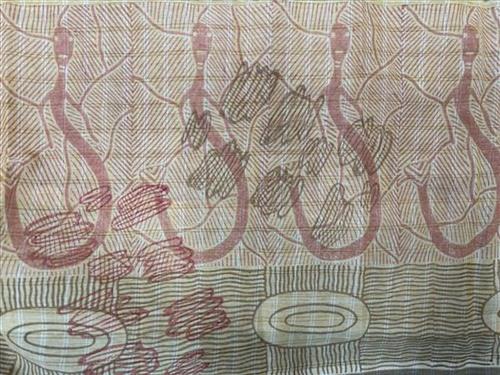
This design depicts the story of the artist’s ancestral dreaming, the Djómi (Fresh Water Spirit).

The Djómi figure is a mermaid-like spirit with fish tail that lives in the freshwater stream that flows out to the sea cliff near Maningrida. Djómi is known to be a very powerful fertility symbol.

“If you go there, you can get pregnant easily. Djómi has babies, and they can give other babies too. The Djómi spirit is so powerful, that women can end up with multiple babies at once, twins or sometimes even more. The Djómi spirits lay eggs near the sacred freshwater stream in Maningrida. Inside the eggs are human babies as well as young Djómi. Men do not go near that swamp, because Djomi is so powerful that men might get pregnant there too. So men are too scared of that Djómi. When we visit the Djómi freshwater spring, we can hear young Djómi  crying. They sound like normal babies crying, those Djómi spirits. They are looking for a mother. This Djómi is my dreaming, I got permission from my djungkay (ritual manager) to paint this Djómi design. For me I always ask my djunguy permission to paint, because that is our cultural way. This design also depicts the freshwater lily leaves and seaweed from the base of the sea floor.” Joy Galrbin

377810582368124


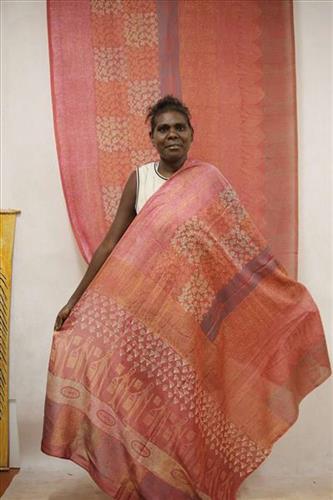
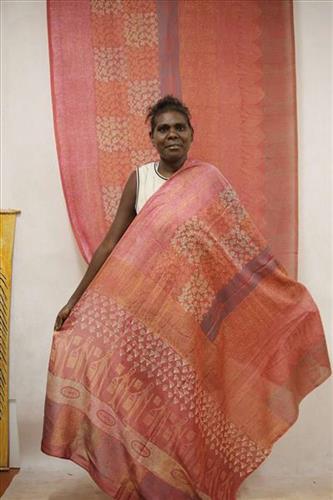
Yawkyawk (Mermaid) la Manjelk (Rain) Sari

A beautiful pink discharge dyed cotton silk sari featuring woodblock designs created in 2023 – 2025.

Co-created by Bábbarra Women’s Centre, Maningrida and Tharangini Studio, India.

Marebu (floor mat)  by Raylene Bonson

Manjelk (Rain) by Helen Lanyinwanga

Kundalk (grass) by Deborah Wurrkidj

Yawyyawk (young woman spirit) by Deborah Wurrkidj

Printed in India by Tharangini Studio – Bangalore. This is a limited edition cotton yardage created due to workshops in India in January 2023. As part of their visit to India to open their exhibition, Jarracharra (dry season wind), Janet Marawarr and Deborah Wurrkidj visited Tharangini Studio, Bangalore’s oldest heritage textile studio. Established in 1977, Tharangini is woman-owned and specialises in organic, sustainable woodblock printed textiles. Tharangini’s skilled artisans worked closely with Babbarra in 2022 to hand-carve some of Babbarra’s old linocut designs into woodblocks. This initiative was supported by Kinaway Chamber of Commerce, Victoria and Bawinanga Aboriginal Corporation.

Karri-djarrk-durrkmirri means we work together in the Indigenous language of Kuninjku.

Supported by the Australian Government’s Centre for Australia India Relations, this exhibition has been two years in the making. It honours the rich textile traditions of the Indo-pacific Region and tells women’s cultural and ancestral stories in a new way.

80 woodblocks were carved in India based on the lino designs made by generations of Babbarra Women’s Centre artists. They were then printed and embroidered in India in a slow and considered process of briefing and consultation.

Many hands have brought the djang (dreaming) stories of the Maningrida and Djelk region of Arnhem Land alive. Exhibition curators and printers, Anshu Arora and Prithi Pais said:

‘The act of printing is one of careful consideration. It drew us deeper into the meaning and history that saturates every motif. Their deep connection to their landscape opens up a space for reflection in the context of our world today.’

This exhibition honours the cultural heritage of the Indo-pacific region. It celebrates Bábbarra Women’s Centre as they continue to innovate and tell their personal stories through rich textile traditions.

I’m excited to see my Lino design made into a woodblock. We are going to spend Saturday printing with Tharangini Studio. We are going to learn woodblock printing. I’ve been working Bábbarra Women’s Centre for 37 years since it started. I’ve been printing Lino on fabric.’ Janet Marawarr 2023

‘Tomorrow we do printing Yawkyawk (mermaid spirit) and Ngalyod (rainbow serpent). My design is together with my sister. Together, we started working at the Women’s Centre and Maningrida Arts and Culture, taught by our mother and grandmother. My sister is a sick one and she pass on her story to me – Ngalyod (rainbow serpent). I help my sister, I help carry the knowledge for her. That’s why we both have designs being made into woodblock.’ Deborah Wurrkidj 2022
 

377810582368122


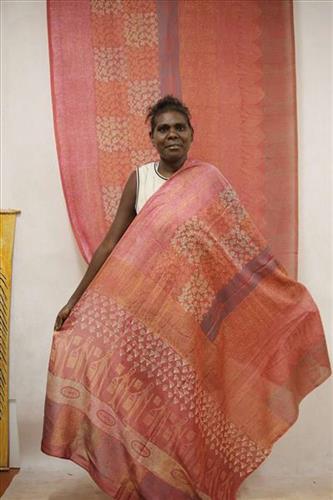
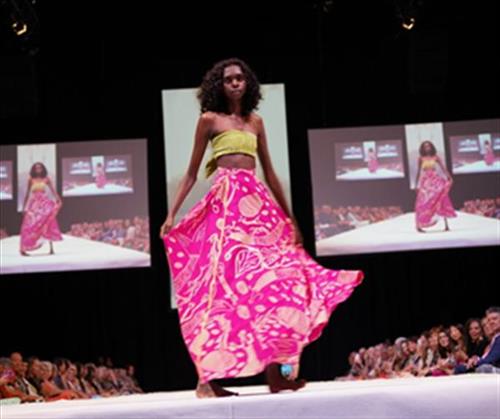
Yawkyawk (Mermaid) la Manjelk (Rain) Sari

A beautiful pink discharge dyed cotton silk sari featuring woodblock designs created in 2023 – 2025.

Co-created by Bábbarra Women’s Centre, Maningrida and Tharangini Studio, India.

Marebu (floor mat)  by Raylene Bonson

Manjelk (Rain) by Helen Lanyinwanga

Kundalk (grass) by Deborah Wurrkidj

Yawyyawk (young woman spirit) by Deborah Wurrkidj

Printed in India by Tharangini Studio – Bangalore. This is a limited edition cotton yardage created due to workshops in India in January 2023. As part of their visit to India to open their exhibition, Jarracharra (dry season wind), Janet Marawarr and Deborah Wurrkidj visited Tharangini Studio, Bangalore’s oldest heritage textile studio. Established in 1977, Tharangini is woman-owned and specialises in organic, sustainable woodblock printed textiles. Tharangini’s skilled artisans worked closely with Babbarra in 2022 to hand-carve some of Babbarra’s old linocut designs into woodblocks. This initiative was supported by Kinaway Chamber of Commerce, Victoria and Bawinanga Aboriginal Corporation.

Karri-djarrk-durrkmirri means we work together in the Indigenous language of Kuninjku.

Supported by the Australian Government’s Centre for Australia India Relations, this exhibition has been two years in the making. It honours the rich textile traditions of the Indo-pacific Region and tells women’s cultural and ancestral stories in a new way.

80 woodblocks were carved in India based on the lino designs made by generations of Babbarra Women’s Centre artists. They were then printed and embroidered in India in a slow and considered process of briefing and consultation.

Many hands have brought the djang (dreaming) stories of the Maningrida and Djelk region of Arnhem Land alive. Exhibition curators and printers, Anshu Arora and Prithi Pais said:

‘The act of printing is one of careful consideration. It drew us deeper into the meaning and history that saturates every motif. Their deep connection to their landscape opens up a space for reflection in the context of our world today.’

This exhibition honours the cultural heritage of the Indo-pacific region. It celebrates Bábbarra Women’s Centre as they continue to innovate and tell their personal stories through rich textile traditions.

I’m excited to see my Lino design made into a woodblock. We are going to spend Saturday printing with Tharangini Studio. We are going to learn woodblock printing. I’ve been working Bábbarra Women’s Centre for 37 years since it started. I’ve been printing Lino on fabric.’ Janet Marawarr 2023

‘Tomorrow we do printing Yawkyawk (mermaid spirit) and Ngalyod (rainbow serpent). My design is together with my sister. Together, we started working at the Women’s Centre and Maningrida Arts and Culture, taught by our mother and grandmother. My sister is a sick one and she pass on her story to me – Ngalyod (rainbow serpent). I help my sister, I help carry the knowledge for her. That’s why we both have designs being made into woodblock.’ Deborah Wurrkidj 2022
 

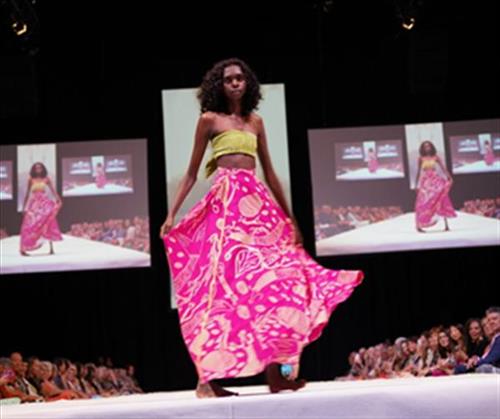
377810582368121


Yawkyawk (Mermaid) la Manjelk (Rain) Sari

A beautiful pink discharge dyed cotton silk sari featuring woodblock designs created in 2023 – 2025.

Co-created by Bábbarra Women’s Centre, Maningrida and Tharangini Studio, India.

Marebu (floor mat)  by Raylene Bonson

Manjelk (Rain) by Helen Lanyinwanga

Kundalk (grass) by Deborah Wurrkidj

Yawyyawk (young woman spirit) by Deborah Wurrkidj

Printed in India by Tharangini Studio – Bangalore. This is a limited edition cotton yardage created due to workshops in India in January 2023. As part of their visit to India to open their exhibition, Jarracharra (dry season wind), Janet Marawarr and Deborah Wurrkidj visited Tharangini Studio, Bangalore’s oldest heritage textile studio. Established in 1977, Tharangini is woman-owned and specialises in organic, sustainable woodblock printed textiles. Tharangini’s skilled artisans worked closely with Babbarra in 2022 to hand-carve some of Babbarra’s old linocut designs into woodblocks. This initiative was supported by Kinaway Chamber of Commerce, Victoria and Bawinanga Aboriginal Corporation.

Karri-djarrk-durrkmirri means we work together in the Indigenous language of Kuninjku.

Supported by the Australian Government’s Centre for Australia India Relations, this exhibition has been two years in the making. It honours the rich textile traditions of the Indo-pacific Region and tells women’s cultural and ancestral stories in a new way.

80 woodblocks were carved in India based on the lino designs made by generations of Babbarra Women’s Centre artists. They were then printed and embroidered in India in a slow and considered process of briefing and consultation.

Many hands have brought the djang (dreaming) stories of the Maningrida and Djelk region of Arnhem Land alive. Exhibition curators and printers, Anshu Arora and Prithi Pais said:

‘The act of printing is one of careful consideration. It drew us deeper into the meaning and history that saturates every motif. Their deep connection to their landscape opens up a space for reflection in the context of our world today.’

This exhibition honours the cultural heritage of the Indo-pacific region. It celebrates Bábbarra Women’s Centre as they continue to innovate and tell their personal stories through rich textile traditions.

I’m excited to see my Lino design made into a woodblock. We are going to spend Saturday printing with Tharangini Studio. We are going to learn woodblock printing. I’ve been working Bábbarra Women’s Centre for 37 years since it started. I’ve been printing Lino on fabric.’ Janet Marawarr 2023

‘Tomorrow we do printing Yawkyawk (mermaid spirit) and Ngalyod (rainbow serpent). My design is together with my sister. Together, we started working at the Women’s Centre and Maningrida Arts and Culture, taught by our mother and grandmother. My sister is a sick one and she pass on her story to me – Ngalyod (rainbow serpent). I help my sister, I help carry the knowledge for her. That’s why we both have designs being made into woodblock.’ Deborah Wurrkidj 2022
377810582368120


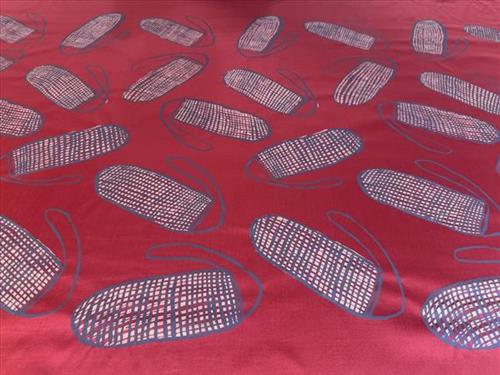
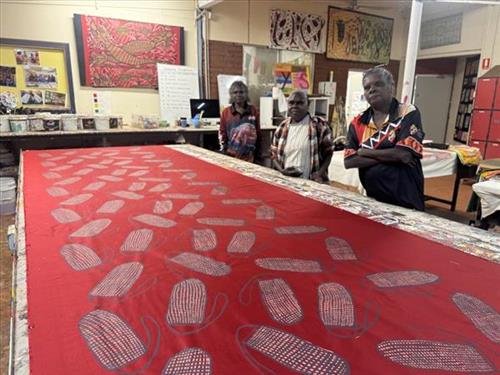
Kunmadj – Dora Diaguma

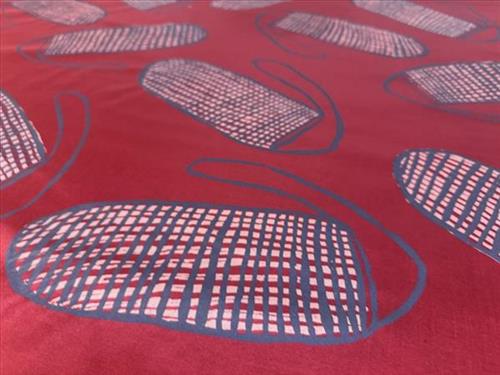
Dora has depicted kunmadj (dillybag), which is a large woven collecting basket. These large bags are often made from the burney vine (Malaisia scandens), a strong, pliable plant that grows along the ground and into the canopy of monsoon vine thickets. The bags are used to collect heavy foods, such as fish caught in conical fish traps or yams. They can also be made from kun-dayarr (Pandanus spiralis), a palm that grows in many areas of Arnhem Land. Tightly woven dillybags are used to collect sugarbag, the native honey.

As well as being of practical use, dillybags are of cultural significance to Arnhem Land people. They are totemic objects associated with particular sites in the landscape. 

377810582368098


Marebu (Floor Mat) and Yawkyawk (Young woman mermaid)

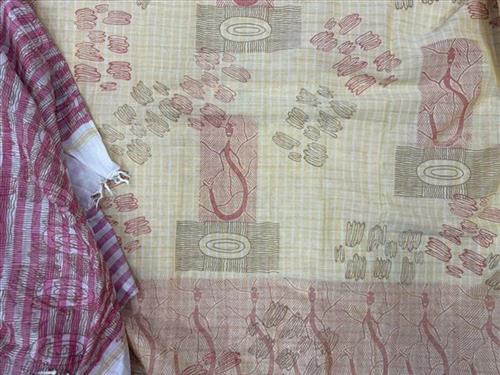
A beautiful indigo discharge dyed cotton silk sari featuring woodblock designs created in 2023 during a special workshop with Tharangini Studio in Bangalore. This fabric features the following block designs:

Kunred (Country) by Janet Marawarr)

Marebu (Raylene Bonson)

Kunngol ( clouds)

Yawyyawk (young woman spirit) by Deborah Wurrkidj

Printed in India by Tharangini Studio – Bangalore. This is a limited edition cotton yardage created due to workshops in India in January 2023. As part of their visit to India to open their exhibition, Jarracharra (dry season wind), Janet Marawarr and Deborah Wurrkidj visited Tharangini Studio, Bangalore’s oldest heritage textile studio. Established in 1977, Tharangini is woman-owned and specialises in organic, sustainable woodblock printed textiles. Tharangini’s skilled artisans worked closely with Babbarra in 2022 to hand-carve some of Babbarra’s old linocut designs into woodblocks. This initiative was supported by Kinaway Chamber of Commerce, Victoria and Bawinanga Aboriginal Corporation.

I’m excited to see my Lino design made into a woodblock. We are going to spend Saturday printing with Tharangini Studio. We are going to learn woodblock printing. I’ve been working Bábbarra Women’s Centre for 37 years since it started. I’ve been printing Lino on fabric.’ Janet Marawarr 2023

‘Tomorrow we do printing Yawkyawk (mermaid spirit) and Ngalyod (rainbow serpent). My design is together with my sister. Together, we started working at the Women’s Centre and Maningrida Arts and Culture, taught by our mother and grandmother. My sister is a sick one and she pass on her story to me – Ngalyod (rainbow serpent). I help my sister, I help carry the knowledge for her. That’s why we both have designs being made into woodblock.’ Deborah Wurrkidj 2022
377810582368119


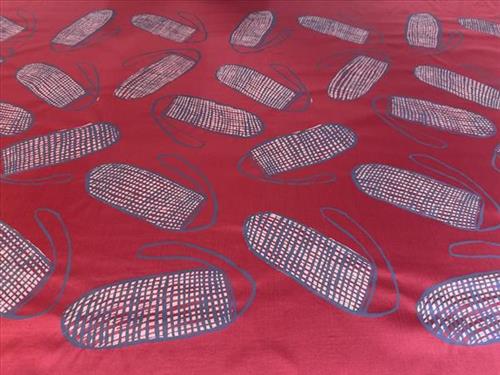
Kunmadj – Dora Diaguma

Dora has depicted kunmadj (dillybag), which is a large woven collecting basket. These large bags are often made from the burney vine (Malaisia scandens), a strong, pliable plant that grows along the ground and into the canopy of monsoon vine thickets. The bags are used to collect heavy foods, such as fish caught in conical fish traps or yams. They can also be made from kun-dayarr (Pandanus spiralis), a palm that grows in many areas of Arnhem Land. Tightly woven dillybags are used to collect sugarbag, the native honey.

As well as being of practical use, dillybags are of cultural significance to Arnhem Land people. They are totemic objects associated with particular sites in the landscape. 

377810582368118


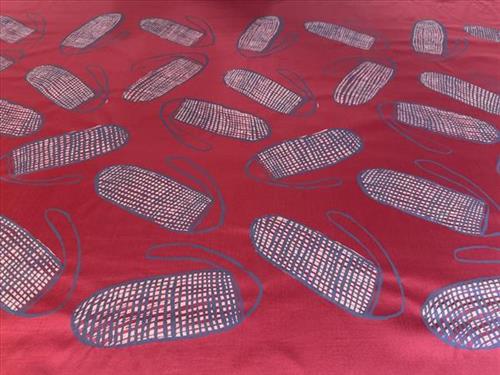
Kunmadj – Dora Diaguma

Dora has depicted kunmadj (dillybag), which is a large woven collecting basket. These large bags are often made from the burney vine (Malaisia scandens), a strong, pliable plant that grows along the ground and into the canopy of monsoon vine thickets. The bags are used to collect heavy foods, such as fish caught in conical fish traps or yams. They can also be made from kun-dayarr (Pandanus spiralis), a palm that grows in many areas of Arnhem Land. Tightly woven dillybags are used to collect sugarbag, the native honey.

As well as being of practical use, dillybags are of cultural significance to Arnhem Land people. They are totemic objects associated with particular sites in the landscape. 

377810582368116


Wubbunj (Paperbark Canoe)

“Wubbunj is our traditional canoe. This design is the old history story of how people came to live in this place we call Maningrida. Two old people were staying on the other side of the saltwater, in Narlarrambarr area. The old people slept in a paper bark shelter and hunted on the water using their canoe.

A long time ago our people carved these canoes from the big paperbark trees. They had paddles with one person at the front, one at back, and other kids and passengers in the middle. Kunkot (paper bark) was used to make the sails which they would stand up and catch the wind.

One day these old people saw a new boat in their waters, which belonged to the Makassans (Indonesians). Those two old men saw the big Makassan boat coming in, and decided to paddle their canoe from Narlarrambarr to the other side (modern day Maningrida). We were scared of the Makassans, they gave us tobacco and tea, but they took many of our women.

When those two old people tasted that water at Maningrida from the Djomi spring, it was sweet freshwater and they decided to stay here. People here had no clothes in those time, we were just wearing string morkoi (loin cloths). Seven tribes were here then, but now in Maningrida there are lots more languages.” – Raylene Bonson