111582142666


Waterhole

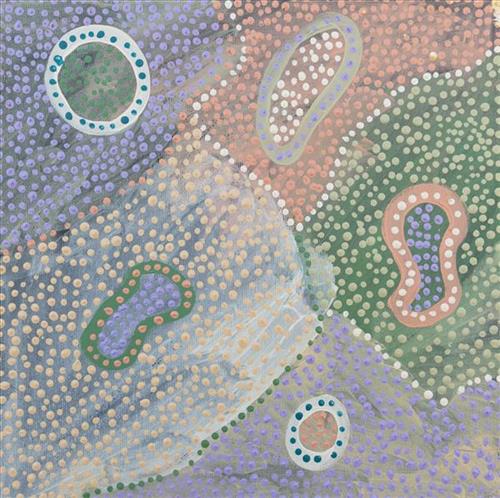
This work depicts a waterhole within the artists’ ngurra (home Country, camp), typically represented with circular forms. Waterholes are sites that require maintenance, including digging to increase flow, clearing out surrounding growth, and cleaning up after sullying by camels or cattle.

During the pujiman (traditional, desert dwelling) period, knowledge of water sources was critical for survival, and today Martu Country is still defined in terms of the location and type of water. Each of the hundreds of claypans, rockholes, waterholes, soaks and springs found in the Martu desert homelands is known through real life experience and the recounting of Jukurrpa (Dreaming) narratives by name, location, quality and seasonal availability. This encyclopedic knowledge extends even to the nature and movement of arterial waterways, and sustained Martu as they travelled across their Country, hunting and gathering, visiting family, and fulfilling ceremonial obligations. They would traverse very large distances annually, visiting specific areas in the dry and wet season depending on the availability of water and the corresponding cycles of plant and animal life on which hunting and gathering bush tucker was reliant.

111582142663


Punmu waterholes

“Punmu, I went there when I was a young girl, a teenager with my mother and father before my mother passed. Big mob of people was there. No building, just little cubby houses [bough shelters]. Long time I been there. 

These here are the waterholes around Punmu; Rawa spring- Rawa means ‘long time’, Tuu-tuu, Jila-jila, Wirlarra and Yilyara. That is my ngurra (home Country, camp). We grew up in Punmu around all these water holes. I still live here with my grandkids, [we share the] same stories for all these places.” 

 – Marianne Burton


 Punmu refers to a region and an Aboriginal community within its vicinity, located 670km North-East of Newman. Created during the return to Country movement of the 1980s, with the recognition of Martu land rights and native title, the community was named after a nearby Jukurrpa (Dreaming) story. As described by Marianne, Punmu is her ngurra; she grew up in this region with her parents. 

Punmu community sits on the edge of a large salt lake known as Nyayartakujarra, or Lake Dora. The lake runs south into Karlamilyi River (Rudall River). Surrounding Punmu are numerous fresh water soaks and the red tali (sandhills) typical of the area. The most frequently visited yinta (permanent springs) around Punmu include Wirlarra, Rawa, Yilyara, Jila-jila and Tuu-tuu.

The Country around Punmu features in several Jukurrpa stories. Of particular importance is the story of the Jila Kujarra (Two Snakes), one of the key Jukurrpa narratives for the Martu. Though the story belongs to Warnman people, it is shared across the Western Desert with several other language groups. The narrative centres on the travels of two snakes as they are pursued by the Niminjarra, spiritual ancestors of the Warnman people. 

 Before transforming themselves into snakes, the Jila Kujarra were young brothers. As snakes, they began travelling home to their mother, but were intercepted by the Niminjarra, who tracked the Jila Kujarra to Paji, east of Nyayartakujarra (Lake Dora). Though the Jila Kujarra eluded their pursuers here by escaping under the lake at Paji, they were soon after speared and injured by two Pukurti (initiates with bundled hair) at Nyayartakujarra, who returned with the Niminjarra to cook the snakes at the site of Kumpupirntily (Kumpupintily, Lake Disappointment). As the Niminjarra cut down the length of the Jila Kujarra, the snake’s bladders were pierced, causing an explosion of scalding hot urine in which the Niminjarra all perished and became black rocks at the site. The spirits of the Jila Kujarra returned to their mother at Nyayartakujarra, where the mother and her sons entered the ground below Nyayartakujarra and remain to this day.

111582142662


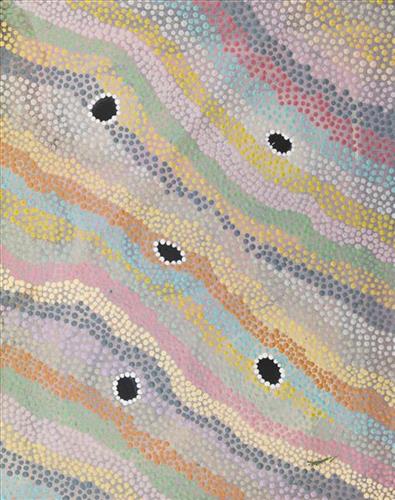
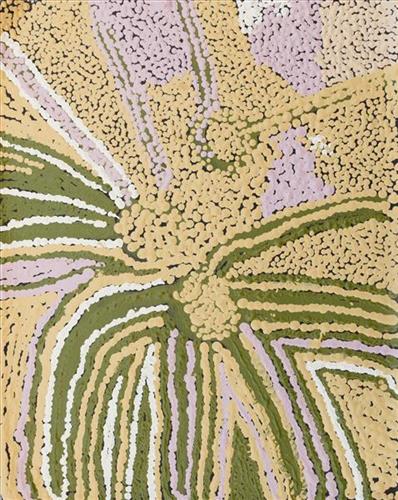
Untitled

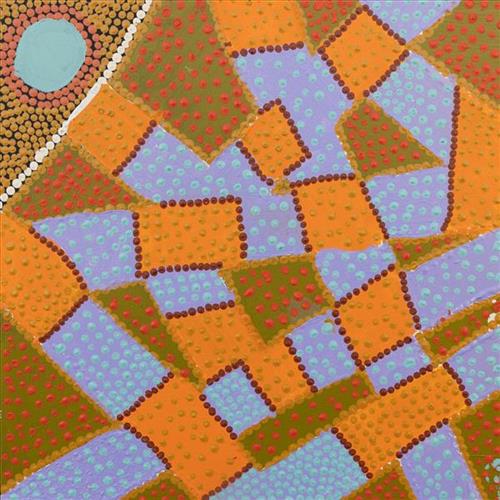
This is Kumpaya’s Country- her ‘ngurra’ (home Country, camp). People identify with their ngurra in terms of specific rights and responsibilities, and the possession of intimate knowledge of the physical and cultural properties of one’s Country. Painting ngurra, and in so doing sharing the Jukurrpa (Dreaming) stories and physical characteristics of that place, has today become an important means of cultural maintenance. 

Kumpaya’s ngurra encompasses the Country that she and her family walked in the pujiman (traditional, desert-dwelling) era. At this time she travelled nomadically with her own and other family groups, traversing an enormous tract of land around the middle section of the Canning Stock Route, and between Punmu Aboriginal community and Kiwirrkura, more than 500 kilometres eastward. 

Kumpaya was born close to Kiwirrkurra, a rockhole located in the Gibson Desert and to the south west of Lake McKay. She grew up, walked and hunted primarily around this area. As a young woman Kumpaya travelled westward, through to Kunawarritji (Canning Stock Route Well 33). She continued to live nomadically before eventually deciding to move to Jigalong Mission along with many other relatives following an extreme and prolonged drought in the 1960s. 

Portrayed in this work are features of Kumpaya’s ngurra, such as the striking salt lakes, dominant permanent red tali (sandhills), warta (trees, vegetation), and the individually named water sources she and her family camped at. These include Luurnkurangu, Karingkarra , Katarta, Pinkari, Pintu-pintu, Yanjiwara, Kunalimpi, Juntu-juntu (Canning Stock Route Well 30), Warla-warla (Canning Stock Route Well 31), Kunawarritji, Kinyu (Canning Stock Route Well 35), Natawalu (Canning Stock Route Well 40), and Kupankurlu. Rock holes, waterholes, soaks and springs were all extremely important sites for Martu people during the pujiman period, and are generally depicted with circular forms. 

The encyclopaedic knowledge of the location, quality and seasonal availability of the hundreds of water bodies found in one’s Country sustained Martu as they travelled across their Country, hunting and gathering, visiting family, and fulfilling ceremonial obligations. They would traverse very large distances annually, visiting specific areas in the dry and wet season depending on the availability of water and the corresponding cycles of plant and animal life on which hunting and gathering bush tucker was reliant. As they travelled and hunted they would also burn areas of Country, generating a greater diversity of plant and animal life.

111582142661


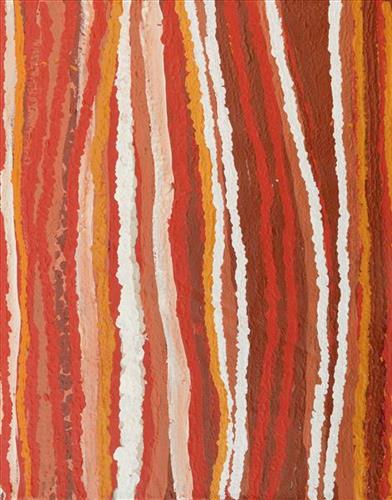
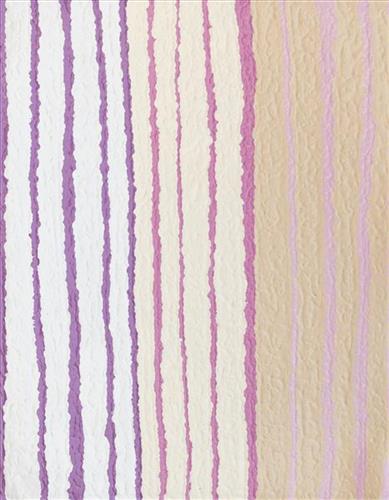
Untitled

This is Ngamaru’s Country- her ‘ngurra’ (home Country, camp). People identify with their ngurra in terms of specific rights and responsibilities, and the possession of intimate knowledge of the physical and cultural properties of one’s Country. Painting ngurra, and in so doing sharing the Jukurrpa (Dreaming) stories and physical characteristics of that place, has today become an important means of cultural maintenance. 

Ngamaru’s ngurra encompasses the Country that she and her family walked in the pujiman (traditional, desert dwelling) era. At this time Ngamaru travelled nomadically with her own and other family groups, most notably the Biljabu and Whyoulter families. 

Ngamaru was born at Martilirri (Canning Stock Route Well 22). She grew up, walked and hunted primarily around Wikiri, Rarrki (Canning Stock Route Well 27), Wantili (Warntili, Canning Stock Route Well 25), Pitu, Nyilangkurr and Nyinyari. She continued to live nomadically before eventually deciding to move to Jigalong Mission along with many other relatives following an extreme and prolonged drought in the 1960s. 

Portrayed in this work are features of Ngamaru’s ngurra, such as the striking salt lakes, dominant permanent red tali (sandhills), warta (trees, vegetation), and the individually named water sources Ngamaru and her family camped at. These include Julyjarru, Juntiwa, Jaturti, Karanyal (Canning Stock Route Well 20), Martilirri (Canning Stock Route Well 22), Kaalpa (Canning Stock Route Well 23), Kartarru (Blue Hills Station, Canning Stock Route Well 24), Wantili (Canning Stock Route Well 25, Tiwa (Canning Stock Route Well 26), Rarrki (Canning Stock Route Well 27), Warla-warla (Canning Stock Route Well 31), Kulilu, Kunapila, Nyilangkurr, Parnngurr, Pitu, Purn, Wangkakalu, Wikiri, Yiranang, and Yulpu. Rock holes, waterholes, soaks and springs were all extremely important sites for Martu people during the pujiman period, and are generally depicted with circular forms. 

The encyclopaedic knowledge of the location, quality and seasonal availability of the hundreds of water bodies found in one’s Country sustained Martu as they travelled across their Country, hunting and gathering, visiting family, and fulfilling ceremonial obligations. They would traverse very large distances annually, visiting specific areas in the dry and wet season depending on the availability of water and the corresponding cycles of plant and animal life on which hunting and gathering bush tucker was reliant. As they travelled and hunted they would also burn areas of Country, generating a greater diversity of plant and animal life.

111582142659


Wantili (Warntili, Canning Stock Route Well 25)

Wantili (Warntili, Canning Stock Route Well 25) is a large round jurnu (soak) and linyji (claypan) near Well 25 on the Canning Stock Route. The area is dominated by claypans surrounded by tuwa (sandhills), and Nyilangkurr, a prominent yapu (hill) is located on the edge of the claypan. Following rain the typically dry claypans are filled with water, with the overflow from nearby waterholes flowing to Wantili. At that time, Wantili becomes an important place for obtaining fresh water for drinking and bathing. Wantili is significant for the fact that at this site Kartujarra, Manyjilyjarra, Putijarra and Warnman people would all come together for ceremonies during the pujiman (traditional, desert dwelling) era. Many jiwa (stones used by women for grinding seeds) from these times can still be found there today. 

Wantili is an incredibly important cultural site, ‘where the creation started.’ (Cyril Whyoulter). In this creation story, the world was initially dark, and people were like rocks, with no arms or legs. Following the sun’s first rising, life-forms become increasingly complex while particular features in the land were created. Beyond these details much of the Jukurrpa (Dreaming) narrative relating to Wantili is ngurlu (sacred, taboo), and only for Martu, but the site is open, and anyone can go there. 

Wantili is also one of the many sites featured in the epic Minyipuru (Jakulyukulyu, Seven Sisters) Jukurrpa story. Minyipuru is a central Jukurrpa narrative for Martu, Ngaanyatjarra, Pitjantjatjara and Yankunytjatjara people that is associated with the seasonal Pleiades star constellation. Relayed in song, dance, stories and paintings, Minyipuru serves as a creation narrative, a source of information relating to the physical properties of the land, and an embodiment of Aboriginal cultural laws. The story follows the movement of a group of women travelling all the way across the desert, beginning at Roebourne on the coast of Western Australia, as they are pursued by Yurla, a lustful old man. As the women travelled, they stopped to rest at many sites to eat, dance, rest and sing, on the way leaving behind an assortment of articles that became formations in the land, such as groupings of rocks and trees, grinding stones and seeds. The sisters rested at Wantili before throwing seeds, then continued their journey far to the east and beyond Martu Country, stopping at various sites through central and South Australia.

The intersection of the Canning Stock Route with Wantili also made this a site of early contact with Europeans for many Martu then living a pujiman life in the desert. Following the route’s construction, Martu encountered Europeans and other Martu working as cattle drovers as they would travel up and down the Stock Route from water source to water source. Increasingly, pujimanpa (desert dwellers) followed the route to newly established ration depots, mission and pastoral stations. They were drawn to the route in search of food, by a sense of curiosity, or by loneliness. By the late 1950s and early 1960s, most of the desert family groups had left the desert. Eventually, these factors combined with an extreme and prolonged drought in the 1960s to prompt the few remaining pujimanpa to move in from the desert.

111582142653


Yilyara

Yilyara is one of several frequently visited yinta (permanent springs) located in the Country immediately surrounding Punmu Aboriginal community. Yilyara is located immediately east of Nyayartakujarra (Lake Dora), a vast and culturally significant salt lake in the north east section of the Karlamilyi River (Rudall River) region. Surrounding the site are the permanent tali (sandhills) typical of the area. 


Yilyara also features as a site in two important Jukurrpa narratives, Jila Kujarra (Two Snakes) and Wirnpa. Jila Kujarra is one of the key Jukurrpa narratives for the Martu. Though the story belongs to Warnman people, it is shared across the Western Desert with several other language groups. The narrative centres on the travels of two snakes as they are pursued by the Niminjarra, spiritual ancestors of the Warnman people. Wirnpa is one of the most powerful of the ancestral jila (snake) men and the last to travel the desert during the Jukurrpa. Wirnpa is a rainmaking jila whose travels are described in the songs and stories of many language groups across the Western Desert, even those far removed from his home site. In his epic travels, Wirnpa created a series of different laws and ceremonies.

111582142652


Wirlarra (Wilarra)

Wirlarra, the site depicted in this painting, lies on the eastern edge of a large salt lake, Nyayartakujarra (Lake Dora), near Punmu Aboriginal community. A distinctive group of small salt water pools are clustered together here. The water from these pools is known for its’ powerful healing properties, and the pools are still visited today by Martu to bathe cuts and sores. 

Wirlarra is also a term for ‘moon’ in Manyjilyjarra, and through the site’s Jukurrpa (Dreaming) narrative, the site is united with the moon in significance. It is said that at Wirlarra, the moon called to a family of dingoes; a mother, father and their large litter of dingo pups. The dingoes gathered at Wirlarra, where the moon cared for them and created a windbreak for the family to shelter. Here the dingoes scratched at the surface of the salt lake and created the cluster of salt water pools located there today. They lay down there. After a time, the dingoes continued travelling eastward toward the rising moon until they reached Kinyu (Well 35 on the Canning Stock Route), where they remained until all of the dingo pups had grown up. From Kinyu the family travelled further east with the moon.

11594002177


Status: Stock


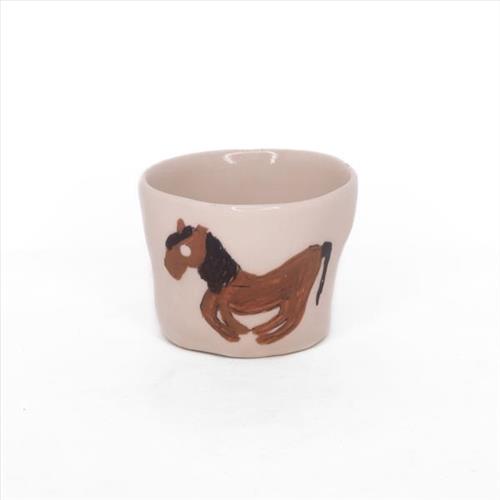
Cup Kuka Inthurra – Nanda (Horse)

STORY 

_____________________________________________________________________________________

This cup has travelled all the way from our pottery studio in the community of Ntaria (Hermannsburg), Western Aranda Country, to you.

Nanda means horse in Western Aranda. All around Ntaria are lots of wild horses! 

Hermannsburg Potters is an Aboriginal owned art centre located at the remote foothills of the MacDonnell Ranges, 130 kilometres west of Alice Springs in the Northern Territory. Taking inspiration from Country, culture, history and day to day life activities the Potters depict family, birds, animals, bush tucker, mission days, stories of Country and current life in Ntaria. 

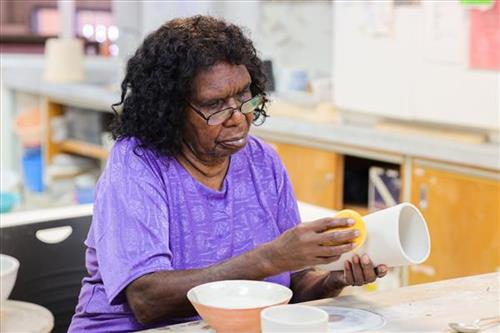
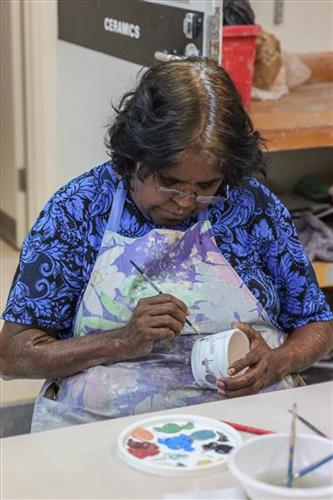
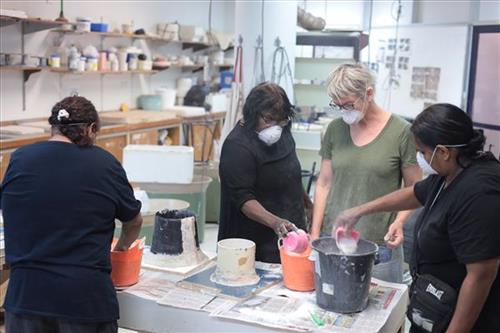
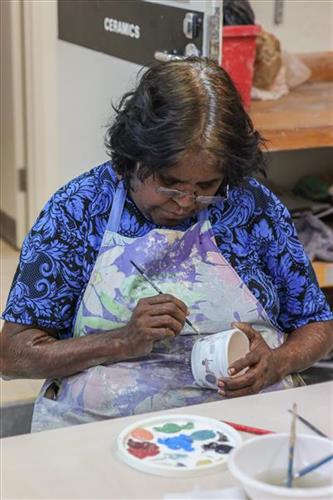
Our new range of homewares was designed by the Potters in a series of workshops at Charles Darwin University in Alice Springs, then produced by hand out here at our pottery studio in Ntaria. Each form and painting was created by one of our artists – keep reading to find out more about the artists who made your cup.  


ARTISTS
__________________________________________________________________________________________


FORM DESIGN: 
Stephanie Ratara Ngala

Stephanie was born in Hermannsburg and then spent her early years of childhood at MutiTjulu, Uluru. Stephanie returned to Hermannsburg with her family at age 9. Stepahnie is the niece of  senior artist Anita Ratara and cousin to prominent artist Hayley Coulthard.

Stephanie draws on the landscape of Palm Valley, her fathers country. Stephanie is a strong emerging artist and dedicated member of Hermannsburg potters.


PAINTING DESIGN: Karen Inkamala

Karen was born Hermannsburg. 

Coming from Inkamala family who holds a strong legacy in the Pottery, Karen has enjoyed painting throughout her life. Joining the Pottery in 2019 Karen is an emerging artist who exhibits natural handbuilding skills. 

11594002175


Status: Stock


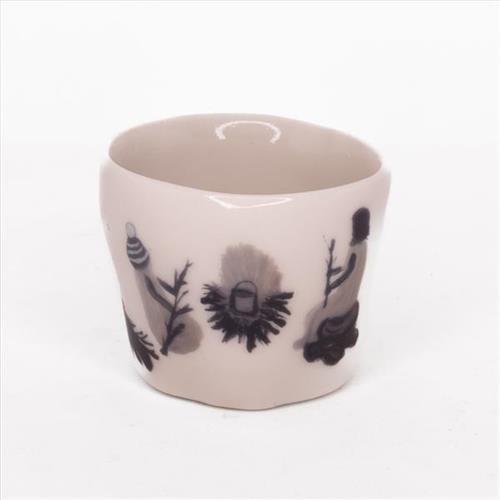
Cup Kuka Inthurra – Ura (Fire)

STORY 
_____________________________________________________________________________________

This cup has travelled all the way from our pottery studio in the community of Ntaria (Hermannsburg), Western Aranda Country, to you.

Ura means fire in Western Aranda. Women sitting by the fire, making billy tea.

Hermannsburg Potters is an Aboriginal owned art centre located at the remote foothills of the MacDonnell Ranges, 130 kilometres west of Alice Springs in the Northern Territory. Taking inspiration from Country, culture, history and day to day life activities the Potters depict family, birds, animals, bush tucker, mission days, stories of Country and current life in Ntaria (Hermannsburg). 

Our new range of homewares was designed by the Potters in a series of workshops at Charles Darwin University in Alice Springs, then produced by hand out here at our pottery studio in Ntaria. Each form and painting was created by one of our artists – keep reading to find out more about the artists who made your cup.  


ARTISTS
__________________________________________________________________________________________


FORM DESIGN: 
Stephanie Ratara Ngala

Stephanie was born in Hermannsburg and then spent her early years of childhood at MutiTjulu, Uluru. Stephanie returned to Hermannsburg with her family at age 9. Stepahnie is the niece of  senior artist Anita Ratara and cousin to prominent artist Hayley Coulthard.

Stephanie draws on the landscape of Palm Valley, her fathers country. Stephanie is a strong emerging artist and dedicated member of Hermannsburg potters.


PAINTING DESIGN: Judith Inkamala Pungarta

Judith Inkamala is the former Chair and senior member of Hermannsburg Potters Aboriginal Corporation, having joined the founding group of artists in 1993. Judith is an is an inspiring and respected leader in her community of Ntaria (Hermannsburg), for her unwavering dedication and commitment to intergenerational sharing of cultural and ceramic knowledge. Judith is also a proud, former member of the renowned Hermannsburg Choir.

In her works, Judith depicts her lived histories and distinct Western Arranta Country. She sculpts and paints these visual histories and contemporary settings, speaking to her cultural beliefs, traditions and values. With near 30 years’ experience working with clay and underglazes, Judith’s work is a skilfully painted as the pot is constructed.

Like many Hermannsburg Potters and Western Arrarnta artists, Judith’s painting style was informed by the watercolours of Albert Namatjira and the artists working in Ntaria at this time. “I remember the old people painting on paper. Painting the watercolours. I was best friends with Gillian Namatjira. After school I went to her house. Albert, her grandfather, was painting watercolours. The ladies painted too.”

Since 1993, Judith has been a part of over 100 group exhibitions both nationally and internationally. Her work has been widely collected, held in public and private collections including Art Gallery of New South Wales, National Gallery of Victoria and National Gallery of Australia. In 1996, Inkamala was invited to participate in a cultural and pottery exchange with the Sasak Potters of Lombok, Indonesia. She also travelled to China in 2010 to showcase her pottery to ceramic artists for the collaborative exhibition Meou Art: Exhibition of Australian Indigenous Art in Shanghai. Judith has been a finalist of the NATSIAA awards three times. Judith’s achievements should also be measured in terms of the significant social and cultural contributions she has made to her community, her audiences and to Australian contemporary art.
11594002174


Status: Stock


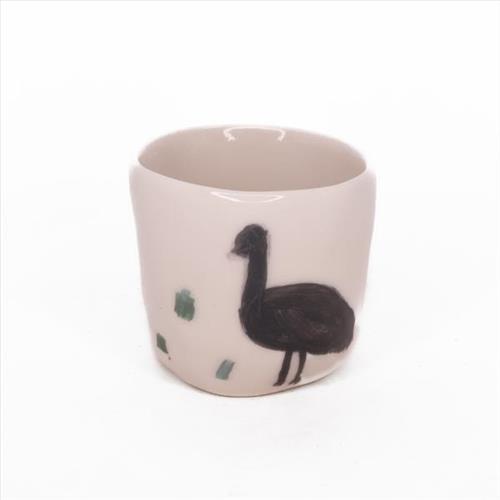
Cup Kuka Inthurra – Ilia (Emu)

STORY 
_____________________________________________________________________________________

This cup has travelled all the way from our pottery studio in the community of Ntaria (Hermannsburg), Western Aranda Country, to you.

Ilia means Emu in Western Aranda. Thepa ilia itja alkiraka-errama – the emu does not fly.

Hermannsburg Potters is an Aboriginal owned art centre located at the remote foothills of the MacDonnell Ranges, 130 kilometres west of Alice Springs in the Northern Territory. Taking inspiration from Country, culture, history and day to day life activities the Potters depict family, birds, animals, bush tucker, mission days, stories of Country and current life in Ntaria (Hermannsburg). 

Our new range of homewares was designed by the Potters in a series of workshops at Charles Darwin University in Alice Springs, then produced by hand out here at our pottery studio in Ntaria. Each form and painting was created by one of our artists – keep reading to find out more about the artists who made your cup.  


ARTISTS
__________________________________________________________________________________________


FORM DESIGN:
 Stephanie Ratara Ngala

Stephanie was born in Hermannsburg and then spent her early years of childhood at MutiTjulu, Uluru. Stephanie returned to Hermannsburg with her family at age 9. Stepahnie is the niece of  senior artist Anita Ratara and cousin to prominent artist Hayley Coulthard.

Stephanie draws on the landscape of Palm Valley, her fathers country. Stephanie is a strong emerging artist and dedicated member of Hermannsburg potters.


PAINTING DESIGN: Karen Inkamala

Karen was born Hermannsburg. 

Coming from Inkamala family who holds a strong legacy in the Pottery, Karen has enjoyed painting throughout her life. Joining the Pottery in 2019 Karen is an emerging artist who exhibits natural handbuilding skills.