377810582166933


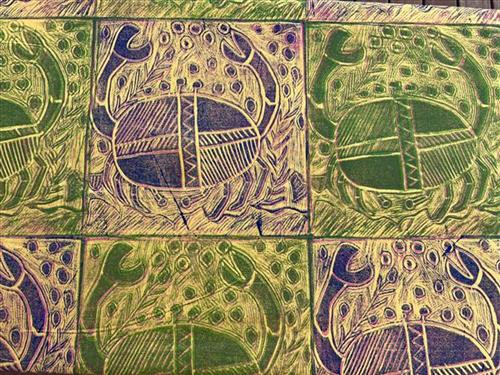
Barnkabarra (Mud Crabs)

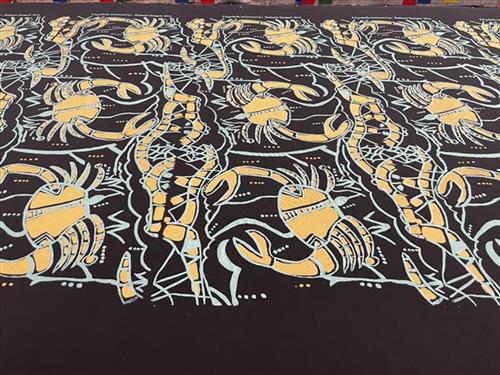
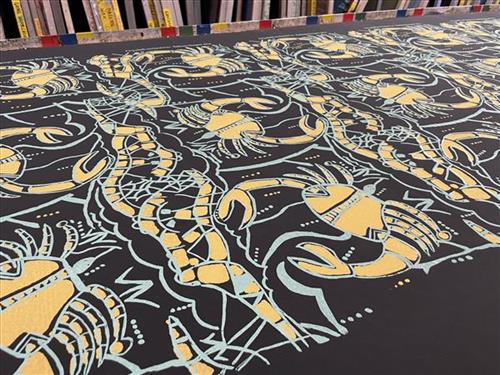
This design tells the story of Elizabeth’s homeland – a dreaming place, a good dreaming place with plenty of Barnkabarra (Mud Crabs). Elizabeth’s homeland lies east of Maningrida, at the mouth of Blyth river. This country is known for a large spiritual mud crab, which lives in the area.

Many families go and collect crabs to eat there with long sticks, or collect directly from the shores. Mud crabs hide in the muddy bottoms of estuaries and mangrove forests in areas surrounding Maningrida. After a king tide, a large cyclical tide which bring the crabs out from the mangroves, it is a good time to find crabs.

Barnkabarra (mud crabs) in Kuninjku language, or Rrugurrgurda (mud crabs) in the Burarra language, are good baladji (bush food in Burarra) and can be caught all year round. They are put on the fire to cook and they are ready when they turn a bright orange colour.

377810582166931


Bawaliba and Ngalyod (Rainbow Serpent)

‘My Kikka (mother), when she was alive, she would tell me these stories. I was just a  little girl and she would tell us the stories in her language Gurrgoni.

In the camps there were boy and girl Bawaliba, and old Bawaliba too. They loved to  dance by the firelight, keeping rhythm with a stick. They had lots of hair, they were  really tall and skinny, with spots on their bodies. The Bawaliba lived a long time in  peace. They were the only spirits on their country and so they were never disturbed.

One day, a long time ago, the Bawaliba were out hunting and they saw a large  snake- they didn’t know then but she was the Rainbow Serpent. They were really  scared, they had never seen that. creature before. She was really beautiful- like a  normal king brown snake but with a rainbow from the sky on her back. The rainbow  serpent was really hungry, and she could smell the Bawaliba from a long way away.  She was out looking for food.  The Bawaliba tried to stop Ngalyod coming for them but she was just too quick. She  snuck up behind the Bawaliba and before they could get away she ate them up.  When she was really full and couldn’t eat anymore Bawaliba she changed the rest of  them into stone. Still til this day, the Bawaliba stay on that same country as stones.’ Lucy Yarawanga

377810582166566


Rrugurrgurda (Mud Crab)

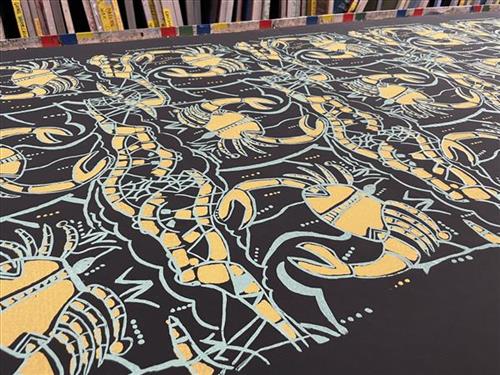
This design tells the story of Elizabeth’s homeland – a dreaming place, a good dreaming place with plentiful mud crabs. Elizabeth’s homeland lies east of Maningrida, at the mouth of Blyth river. This country is known for a large spiritual mud crab, which lives in the area.

Many families go and collect crabs to eat there with long sticks, or collect directly from the shores. Mud crabs hide in the muddy bottoms of estuaries and mangrove forests in areas surrounding Maningrida. After a king tide, a large cyclical tide that bring the crabs out from the mangroves, it is a good time to find crabs.

Rrugurrgurda (mud crabs) is pronounced Ahh-rewg-gurd-gurda in the Burarra language. Rrugurrgurda are good baladji (bush food in Burarra) and can be caught all year round. They are put on the fire to cook and they are ready when they turn a bright orange colour.
377810582166564


Rrugurrgurda (Mud Crab)

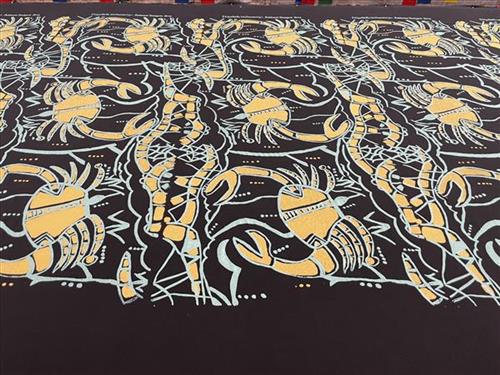
This design tells the story of Elizabeth’s homeland – a dreaming place, a good dreaming place with plentiful mud crabs. Elizabeth’s homeland lies east of Maningrida, at the mouth of Blyth river. This country is known for a large spiritual mud crab, which lives in the area.

Many families go and collect crabs to eat there with long sticks, or collect directly from the shores. Mud crabs hide in the muddy bottoms of estuaries and mangrove forests in areas surrounding Maningrida. After a king tide, a large cyclical tide that bring the crabs out from the mangroves, it is a good time to find crabs.

Rrugurrgurda (mud crabs) is pronounced Ahh-rewg-gurd-gurda in the Burarra language. Rrugurrgurda are good baladji (bush food in Burarra) and can be caught all year round. They are put on the fire to cook and they are ready when they turn a bright orange colour.
377810582166560


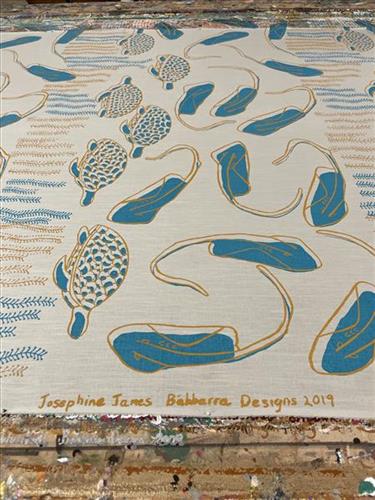
Mabbúlarr

Mabbúlarr is the Ndjébbana word describing calm and stillness – both regarding people and the ocean.

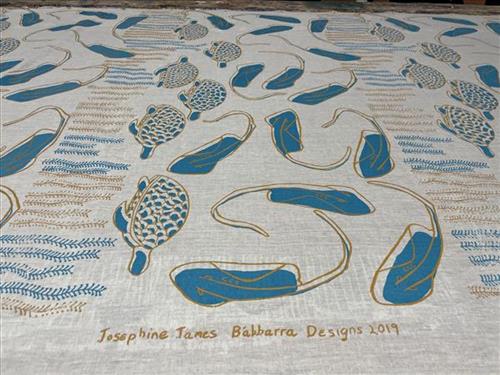
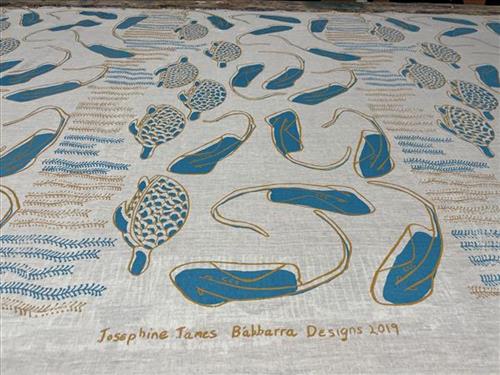
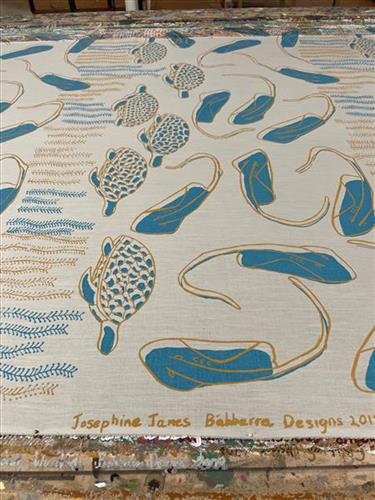
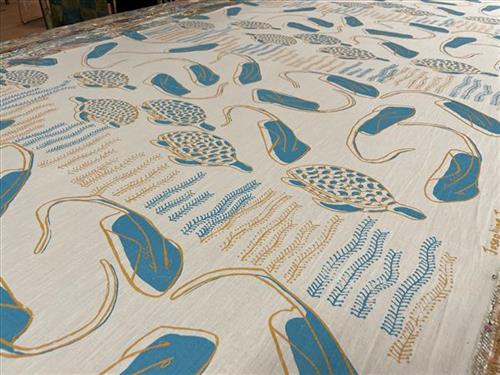
This design tells the story of underwater life in the shallows. The turtle we call marláddja (green turtle, Chelonia mydas) and the stingray we call marnandjúbba (Cowtail Stingray, Pastinachus sephen).

‘When strong wind blows the sea is rough, when there’s no wind the sea is calm. We call that mábbularr. You can see through the water and look at the turtle and stingray eating karlómerr (sea grass) and dancing underwater to find their mate. When we go on the boat hunting, we go at times of mábbularr.

In the old days men used to hunt with a canoe and with traditional made harpoon.  Guided by our ancestors’ spirits they would paddle all day to find sea turtle and dugongs in the right places. The men had to be smart for the tide and know the weather to balance their canoes. They would go at times of mábbularr (calm), early morning in daytime or at night-time when there is no moon and the water glows. We call the night-time glimmer of phosphorescence mílarrng-milarrng. Today people still go hunting, it brings a lot of families together and they share eating down the beach.

We have songline for sea turtle, also men paint turtle on their back and dance turtle in the Míddjarn the same way turtle dance underwater. It is very important we look after our country and songline passed on from many generations’. Josephine James 2021

377810582166559


Mabbúlarr

Mabbúlarr is the Ndjébbana word describing calm and stillness – both regarding people and the ocean.

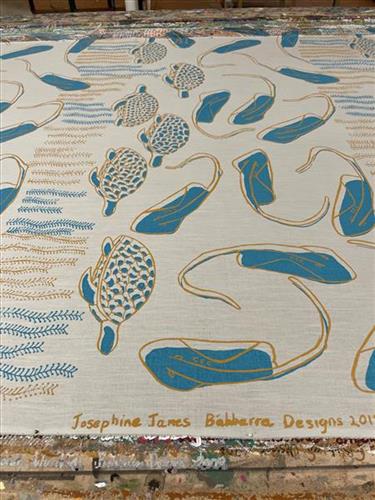
This design tells the story of underwater life in the shallows. The turtle we call marláddja (green turtle, Chelonia mydas) and the stingray we call marnandjúbba (Cowtail Stingray, Pastinachus sephen).

‘When strong wind blows the sea is rough, when there’s no wind the sea is calm. We call that mábbularr. You can see through the water and look at the turtle and stingray eating karlómerr (sea grass) and dancing underwater to find their mate. When we go on the boat hunting, we go at times of mábbularr.

In the old days men used to hunt with a canoe and with traditional made harpoon.  Guided by our ancestors’ spirits they would paddle all day to find sea turtle and dugongs in the right places. The men had to be smart for the tide and know the weather to balance their canoes. They would go at times of mábbularr (calm), early morning in daytime or at night-time when there is no moon and the water glows. We call the night-time glimmer of phosphorescence mílarrng-milarrng. Today people still go hunting, it brings a lot of families together and they share eating down the beach.

We have songline for sea turtle, also men paint turtle on their back and dance turtle in the Míddjarn the same way turtle dance underwater. It is very important we look after our country and songline passed on from many generations’. Josephine James 2021

377810582166557


Mabbúlarr

Mabbúlarr is the Ndjébbana word describing calm and stillness – both regarding people and the ocean.

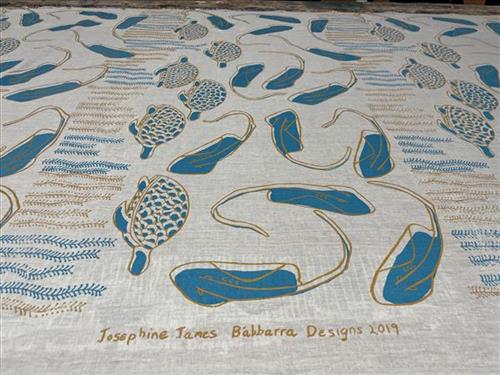
This design tells the story of underwater life in the shallows. The turtle we call marláddja (green turtle, Chelonia mydas) and the stingray we call marnandjúbba (Cowtail Stingray, Pastinachus sephen).

‘When strong wind blows the sea is rough, when there’s no wind the sea is calm. We call that mábbularr. You can see through the water and look at the turtle and stingray eating karlómerr (sea grass) and dancing underwater to find their mate. When we go on the boat hunting, we go at times of mábbularr.

In the old days men used to hunt with a canoe and with traditional made harpoon.  Guided by our ancestors’ spirits they would paddle all day to find sea turtle and dugongs in the right places. The men had to be smart for the tide and know the weather to balance their canoes. They would go at times of mábbularr (calm), early morning in daytime or at night-time when there is no moon and the water glows. We call the night-time glimmer of phosphorescence mílarrng-milarrng. Today people still go hunting, it brings a lot of families together and they share eating down the beach.

We have songline for sea turtle, also men paint turtle on their back and dance turtle in the Míddjarn the same way turtle dance underwater. It is very important we look after our country and songline passed on from many generations’. Josephine James 2021