Goanna
This piece by Clinton Brian depicts a goanna. It is painted with acrylic paint on locally harvested stringy bark. The goanna’s body is finished with traditional rarrk (fine cross-hatch style painting).
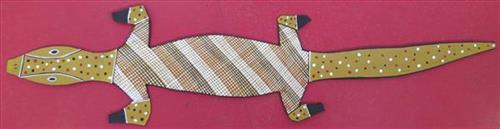
This piece by Clinton Brian depicts a goanna. It is painted with acrylic paint on locally harvested stringy bark. The goanna’s body is finished with traditional rarrk (fine cross-hatch style painting).
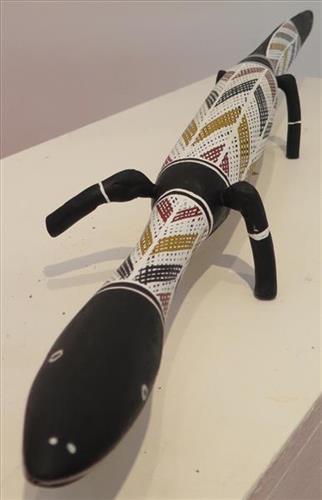
This finely crafted piece by James Malibirr depicts a goanna mid-stride. Goanna is considered to be prized bush tucker, but is less commonly found in modern times. The carving is finished with traditional rarrk (fine cross-hatching style painting).
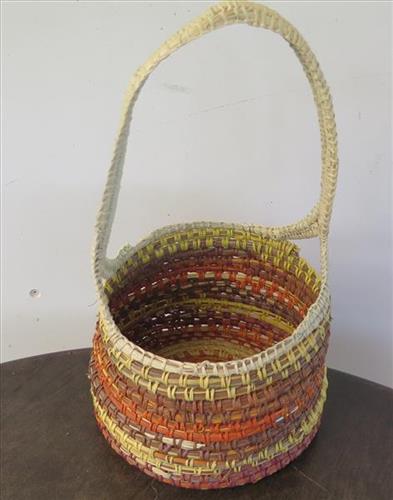
Fibre Art is an ancient Aboriginal women’s craft that is still made today using the same techniques as their ancestors. Making fibre art is labour intensive and much care and fine needlework is required to ensure the finished object is both functional and beautiful. Fibre art from the Ghunmarn Culture Centre includes dilly bags, floor mats, bush fans, woven creatures found in the landscape, plants such as yams (bush potato), baskets, place mats, and spirit figures such as mermaids and Mukuy’s.Natural pandanus fibre (Mukarra), is used to make much of the fibre art produced by the artists of Djilpin Arts. Women collect the pandaus by pulling from the top of the pandanus tree, then stripping and drying the leaves before they are dyed with natural bush colour collected from the Beswick surrounds.

This spear is representative of Aboriginal skill and ability to create something functional out of found or reclaimed materials. From nothing, a functional spear can be made, and food can be placed on the table to feed family.
Consisting of a spear shaft and spines to spear a fish or cherabin (freshwater prawn), it is simple yet deadly effective in the right hands.
Spear shaft is found from fast growing plants surrounding billabongs and wet areas. It is barked off and then steamed in a fire and gently straightened. Spines are stainless steel and have been repurposed from an oven grill tray. They are sharpened to a deadly point and lashed to the tip of the spear using heavy weight fishing line. Gaffa tape sits over the top of the fishing line to further reinforce and hold everything in place.
Traditionally a bush string would be used, and protected with bees wax to harden and cure. In this instance what can be found on hand can still create a deadly hunting implement ready to provide food for the communal table.
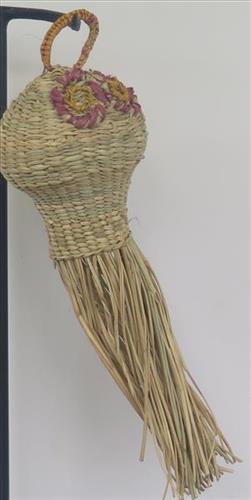
Fibre Art is an ancient Aboriginal women’s craft that is still made today using the same techniques as their ancestors. Making fibre art is labour intensive and much care and fine needlework is required to ensure the finished object is both functional and beautiful. Fibre art from the Ghunmarn Culture Centre includes dilly bags, floor mats, bush fans, woven creatures found in the landscape, plants such as yams (bush potato), baskets, place mats, and spirit figures such as mermaids and Mukuy’s.Natural pandanus fibre (Mukarra), is used to make much of the fibre art produced by the artists of Djilpin Arts. Women collect the pandaus by pulling from the top of the pandanus tree, then stripping and drying the leaves before they are dyed with natural bush colour collected from the Beswick surrounds.
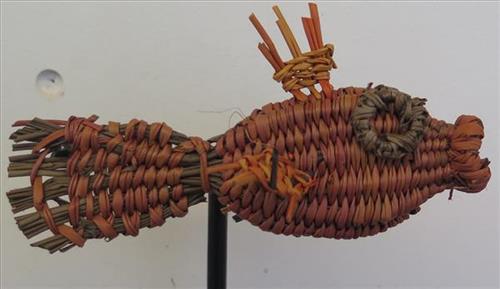
This finely crafted hand woven fish represents species found both in blue water and local billabongs surrounding Beswick / Wugularr.
Djilpin’s super talented pandanus artists have been busy pushing their skills and techniques. This fun little fish is a prime example of this and a step away from traditional baskets, mats and dilly bags. Each fish is unique, hand woven and feature natural bush dye colouring.
Pandanus fibre art is labour intensive requiring a high level of care and fine needlework. Finished works are both functional and beautiful. Women collect pandanus by pulling from the top of a pandanus tree, stripping then dying the leaves using natural bush colour.

Wood carving has always been part of Aboriginal culture and Djilpin artists continue this tradition. Men carved wood for many purposes – tools for hunting or gathering food, axes and knives for building shelters, spears and clubs for protection of their lives and territory, objects for ceremony and to mark sacred sites.
Hunting implements include the boomerang, woomera and spear. The woomera is a lever which helps to increase the speed and distance the spear travels. Clapsticks are used as percussion instruments by the Songmen to accompany dancing along with the didgeridoo (mago).
As well as the more functional carvings, artists portray animals and birds in wood, and these carvings are often painted. Ceremonial carvings include spirit creatures including mukuy (devil devils) and mimi.
Some fine mimi figures have been cast in bronze.
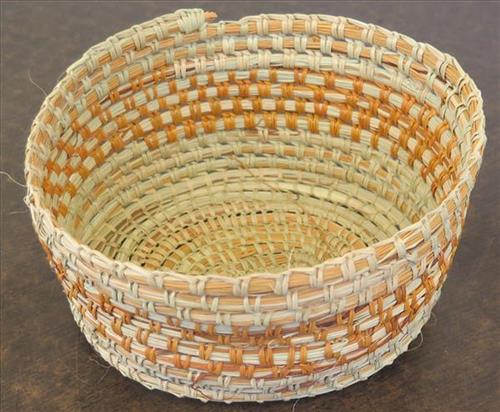
Fibre Art is an ancient Aboriginal women’s craft that is still made today using the same techniques as their ancestors. Making fibre art is labour intensive and much care and fine needlework is required to ensure the finished object is both functional and beautiful. Fibre art from the Ghunmarn Culture Centre includes dilly bags, floor mats, bush fans, woven creatures found in the landscape, plants such as yams (bush potato), baskets, place mats, and spirit figures such as mermaids and Mukuy’s.Natural pandanus fibre (Mukarra), is used to make much of the fibre art produced by the artists of Djilpin Arts. Women collect the pandaus by pulling from the top of the pandanus tree, then stripping and drying the leaves before they are dyed with natural bush colour collected from the Beswick surrounds.

Wood carving has always been part of Aboriginal culture and Djilpin artists continue this tradition. Men carved wood for many purposes – tools for hunting or gathering food, axes and knives for building shelters, spears and clubs for protection of their lives and territory, objects for ceremony and to mark sacred sites.
Hunting implements include the boomerang, woomera and spear. The woomera is a lever which helps to increase the speed and distance the spear travels. Clapsticks are used as percussion instruments by the Songmen to accompany dancing along with the didgeridoo (mago).
As well as the more functional carvings, artists portray animals and birds in wood, and these carvings are often painted. Ceremonial carvings include spirit creatures including mukuy (devil devils) and mimi.
Some fine mimi figures have been cast in bronze.

“Mimi go through rock country. Hide in cracks. May be cheeky. Mimi look after and renew country.”
This stunning Mimi Spirit has been hand crafted from native beach hibiscus sourced in Darwin. Carved using a mix of sharp hand tools it has then been finished in modern acrylic paints.
Painting has been completed using a handmade Jarlk grass reed brush harvested from local billabongs and wet areas. Raark or fine line work has been completed using this brush and is in Yirritja style. This style consists of multiple lines before alternating colour.