22023974591


Status: Stock


Puli Puli Knitted Cotton Throw (Red and Black)

This beautiful knitted throw features Keturah Zimarn’s artwork, ‘Puli Puli Rocks’, and has been made by our ethical partners, Better World Arts.

The ancient Australian landscape with it’s eroded forms and organic shapes provides motivation for Keturah’s art.

In this work Keturah depicts the natural rock formations (puli) found in and around Haasts Bluff.

Throw 100% Cotton

Size 125 x 150 cm

22023974585


Status: Stock


Watiya Tjuta Large Wool Rug (122x183cm) – Black on White

Watiya (tree) Tjuta (many) is the artist’s iconic rendering of her late father’s Tjukurrpa (Dreaming). In this design, the artist depicts the ceremonial spear straightening in Uwalkari country (Gibson desert region). The spear straightening is part of restricted men’s business. Mitjilli was given the right to depict the source of the spears by her father, however, the ceremony cannot be revealed in her works. Uwalkari is abundant with Watiya Tjuta and other plants that grow in a landscape dominated by sandhills. Mitjilli came from an acclaimed family of artists and the imagery of Watiya Tjuta is a recurring motif in her artwork. 

22023974308


Status: Stock


Puli Puli Large Lacquerware Box (5x9x11cm)

Keturah depicts the puli puli (rocks) at two different sites: the landscapes at Haasts Bluff and also Karrkurrutintja (Lake McDonald). Keturah depicts her childhood memories of both places.
“The sand hills I paint are my mother’s story and the rocks I paint are my own story. My paintings are about my story and my mother’s. When I look at my paintings I feel happy. My Grandmother used to say to me when I was younger: “One day you will paint.”

22023974292


Status: Stock


Waterhole Large Wool Rug (122x183cm)

Alice Nampitjinpa Dixon’s Waterhole Design

22023974291


Status: Stock


Puli Puli Medium Wool Rug (91×152 cm)

Keturah depicts the puli puli (rocks) at two different sites: the landscapes at Haasts Bluff and also Karrkurrutintja (Lake McDonald). Keturah depicts her childhood memories of both places.
“The sand hills I paint are my mother’s story and the rocks I paint are my own story. My paintings are about my story and my mother’s. When I look at my paintings I feel happy. My Grandmother used to say to me when I was younger: “One day you will paint.”

22023974290


Status: Stock


Puli Puli Wool Runner Rug (76x304cm)

Keturah depicts the puli puli (rocks) at two different sites: the landscapes at Haasts Bluff and also Karrkurrutintja (Lake McDonald). Keturah depicts her childhood memories of both places.
“The sand hills I paint are my mother’s story and the rocks I paint are my own story. My paintings are about my story and my mother’s. When I look at my paintings I feel happy. My Grandmother used to say to me when I was younger: “One day you will paint.”

22023974288


Status: Stock


Bushfire Medium Cushion Cover (40x40cm)

This digitally printed cushion cover features an artwork by Patricia Multa:

This painting is about three massive bushfires that burned parallel to each other, across the landscape scarring the land. It started at Warlungurru, near Kintore.

220982354378


Ntang Native Seeds

The seeds are collected under a tree by laying a tarp on the ground and hitting the tree continuously until most of the seeds have fallen. Once the seeds are collected they are then ground with a mortar and grinding stone.

A number of these grinding stones have been in families for generations. Once seeds are ground, water is added and mixed until a damper like substance is formed and placed under the coals until cooked.


Dimensions: 30 x 30 cm Lino Print – Mud BrownS/H 300gsm

115682418889


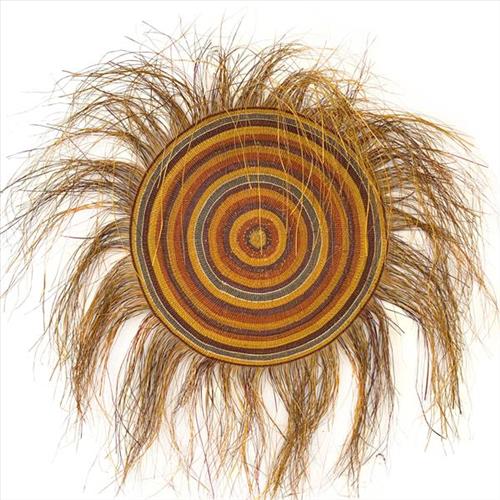
Woven Mat

Yolŋu weavers of Arnhem Land create utilitarian, ceremonial, and decorative pieces using naturally sourced materials. This mat is made from young Pandanus spiralis leaves, harvested with a wooden hook, stripped of prickles, and dried to create strong, resilient fibres. These fibres are then twisted, coiled, or woven using traditional techniques to produce both functional and decorative mats.

Bula’bula weavers exclusively use natural dyes, derived from locally sourced roots, leaves and grasses. These pigments are extracted and infused into pandanus fibres by boiling over an open fire, producing the rich, vibrant colours characteristic of contemporary Yolŋu weavings.

Traditionally, Nganiyal (conical mats) functioned as insect screens when erected and as seating mats when folded, playing an important role in both daily life and ceremonial practices. Today, Yolŋu artists create a variety of shapes, including flat, round, and oblong mats. These non-traditional styles and the use of bright colours became more common after Missionaries began commissioning pieces in this style.


Dimensions: 89cm dia