377815582418458
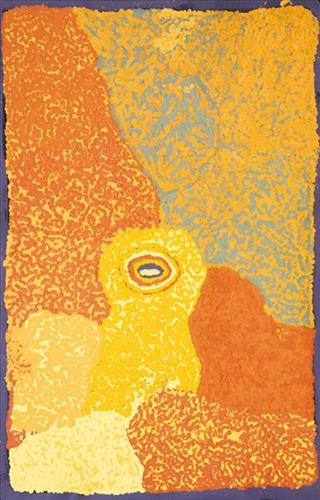
Yulpu
“The story is about Yulpu — old people’s ngurra (home Country, camp). They were walking around together, looking after each other — malpa (keeping each other company). You know, women carrying water on their heads with a piti (bowl) and carrying gigi (children) on their backs. That was pujiman (bushman, desert-born) time — a long time ago.
I was born at Lalyipuka, another water place on the side of Yulpu. Jupurr is a soak — same area, but two different waterholes. A soak is spring water coming from under the earth. Yulpu is Juwaliny and Mangala Country. Mangala, Manyjilyjarra, and Juwaliny were walking around together in pujiman days. They were following all the waterholes, sharing waterholes. They knew when the water was going down, so they moved to the next one. There are a couple of waterholes around Yulpu.”
– Yikartu Bumba, translated by Jenny Butt
This artwork depicts Country in and around the Great Sandy Desert — an immense area stretching from the edges of the Kimberley near Bidyadanga and Eighty Mile Beach, east through Walyarta (Mandora Marsh) and Percival Lakes, and down toward Kulyakartu, Kunawarritji (Well 33) and the Canning Stock Route. It is a vast landscape of dunes, claypans, salt lakes and waterholes.
For many families connected to Bidyadanga, this is ancestral land and holds places and significant sites where the old people lived pujiman (traditional desert-dwelling) lives before travelling to the coast.
The Great Sandy Desert is not empty — it is full of life, memory and movement. Soft sandhills rise and fall like waves, spinifex shimmers in the wind, flowers bloom after rain, and jila (living waterholes) lie hidden beneath the surface. People hunted goanna, bush turkey and small animals, dug for water, gathered bush foods, and camped beside claypans. Families walked long distances between soaks, teaching others how to read the land, follow tracks and travel safely.
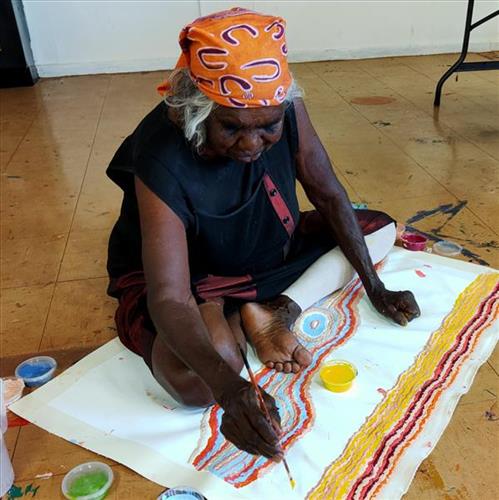
In painting, the desert becomes a map of belonging — circles showing water and camps, lines following walking tracks and dunes, and soft patterns recalling plants, sand ridges and the glow of sunsets across wide skies. Colours shift between deep reds, ochres, warm sand tones and the greens that come after rain.